


She will chat to anybody, as I discovered when she took me on a guided walk around Littlehampton, and it is the personal stories she has collected that make her walks so interesting.
Frances runs a bed-and-breakfast business with her husband David, as well as giving talks and arranging tours as a Blue Badge guide for the south east region.
The couple met while training at St Thomas's Hospital in London and moved to the Littlehampton area when David took a job as a GP.
Frances found their B&B guests were often asking questions about the local area, so she decided to improve her knowledge, eventually qualifying with the British Guild of Tourist Guides.
She said: “I didn't realise it would be so much fun!”
She offers guided walks across Sussex, including Arundel, Chichester, Bosham, Brighton, Lewes, Littlehampton, Petworth and Rye, as well as further afield to Salisbury and the east end of London around Olympic Park.
Her knowledge of Olympic Park loops us right back to Littlehampton, where she took me on a personal guided walk. We met at Red Bridge, by The Arun View, and Frances pointed out Littlehampton Welding, which installed a number of features at Queen Elizabeth Olympic Park when it was built in 2012.
She told me about the early history of the town and its links to Arundel, which was the larger port in the 19th century until Littlehampton grew to take over, as it was more accessible for larger ships.
Frances told me about Littlehampton RNLI and its Blue Peter boats, as well as other vessels for which the area is famous, like the first ship going to the Falklands, full of sheep and shepherds.
She told me Littlehampton was important in the First World War for building flying boats and motor torpedo boats, and in the Second World War, after D-Day, all the ammunition was shipped across The Channel from Littlehampton rather than Portsmouth, because of the damage it would cause if it blew up.
We also discussed industry, like William Osborne, based at Arun Shipyard, building a huge number of RNLI lifeboats to six designs, including the Arun-class, and the amphibious car specialist Duttons.
Walking along the riverside, we stopped at Littlehampton Harbour Board to look at its model of Jumna, a steam paddle boat that was regularly seen towing ships up and down the lower reaches of the River Arun.
As we headed to Littlehampton Pier, there was chat over much earlier history, like Stephen and Matilda and the civil war in the 12th century, and the gun emplacement that was sited in Littlehampton during the reign of Queen Elizabeth I, when the country was under threat from the Spanish.
We looked over to Littlehampton Fort, on the west bank, and Frances told me a little about Palmerston Forts in the area.
Famous people linked to Littlehampton she mentioned included the composer Hubert Parry and inventor Henry Shrapnel. It was also the birthplace of James Bond, although Frances did not elaborate on that one, as she discovered I already knew how the town had inspired the author Ian Fleming!
She told me about The Beach Hotel, which was closed in the 1980s, and the boarding houses in South Terrace where nannies would take their charges for a seaside break.
One of these children was Kenneth Grahame's son, known as Mouse, who received letters from the author while staying there with his governess. The letters told the stories that became the book The Wind in the Willows, so it may not have been written in Littlehampton but it was almost certainly read here first.
Frances can arrange coach tours as well as walking tours, and also gives talks on a range of subjects. Visit www.francesfarrerbrown.co.uk for more information about her services in south east England.
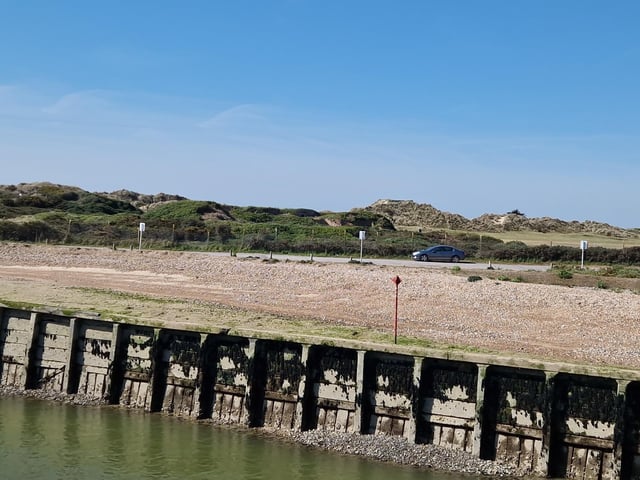
9. Guided walk
Looking across to Littlehampton Fort Photo: Elaine Hammond
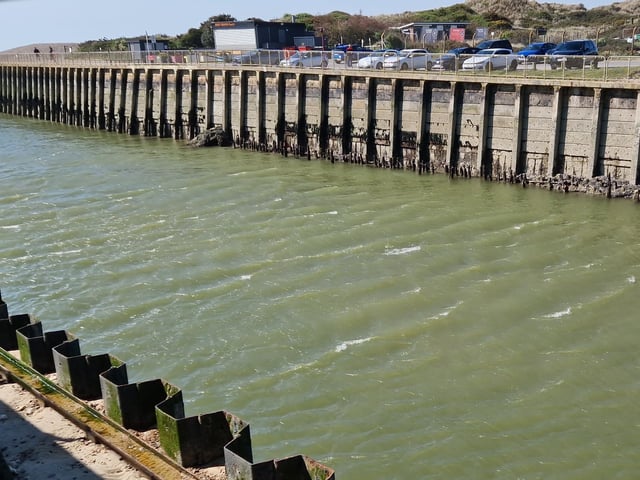
10. Guided walk
The changing tide in the harbour mouth prompted discussions on the dangers of the water Photo: Elaine Hammond
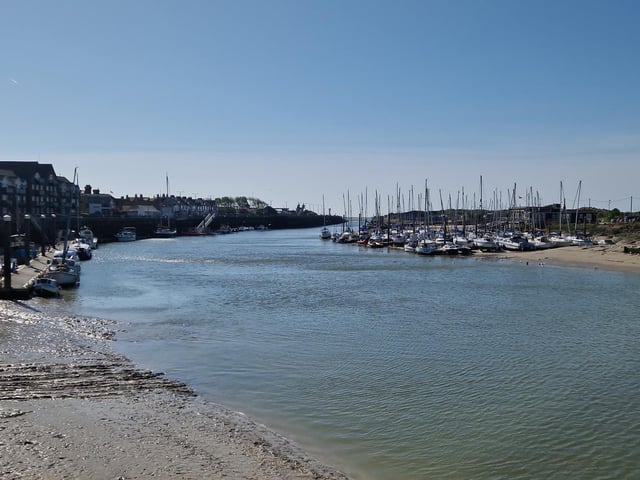
11. Guided walk
Looking south down the River Arun towards the sea Photo: Elaine Hammond