
Review: Striking a chord with Horsham Music Circle
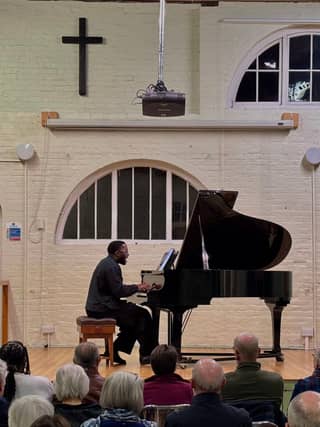

It’s always a joy to see what young talent is brought to the Horsham Music Circle through their yearly Countess of Munster Musical Trust recital scheme concerts. To see the next generation of talent early on in their career is an exciting prospect and an often rewarding one too, as was the case also with tonight’s artist, Amiri Harewood.
Having already proven his artistry in the crowing British music-halls and abroad: Harwood brought an interesting programme uniting Baroque sensibilities with the wandering harmonies of the late romantics. The first half of the concert comprised of, what could only be described as, a compendium of romantic era, Russian Preludes. Each piece in this string of characterful pieces offered pleasant and, at times, profound contrast: Shostakovich’s (Op.87) Prelude and Fugue in C major and B minor; Rachmaninoff’s (Op. 32) B major Prelude; another Shostakovich Prelude and Fugue, this time in A major, though from the same opus; before finishing off with another Rachmaninoff Prelude (Op.23) in G minor – one of his most popularly-beloved works.
Harewood, with an oftentimes strikingly powerful touch and precise articulation, gave constant drive and momentum to the more turbulent passages of music, while also managing to give a wonderful sense of breadth and tenderness in opposing phrases, culminating in a sound that at times conveyed both drama and serenity.
Almost as if through metamorphosis, the meandering fugal themes and winding harmonies of the combined preludes gave way to an emancipation of Granados’ Valses Poeticos. In many ways this work delightfully mirrored much of what we had already heard: contrastive and brilliant themes of patheticy and strident triumph, though this time in the unapologetically serial form of several waltzes. While titled ‘Poeticos,’ it would perhaps be more accurate to use the descriptor of the Greek ‘Pathos’ seeing as each waltz was seemingly at the servitude of a number of explicit expressions: sentimentality, elegancy, nobility, etc.; all of which was dutifully conveyed by Harewood with an individual quality and a fluid portfolio of technical expertise.
Further dissecting themes already established, Harewood next presented us with Walker’s fifth Piano Sonata, a piece containing a dizzying array of dissonances and gestural impulses. Performed with suitable conviction, it took on a role of the performance’s climax; finally giving way to J.S. Bach’s fourth Keyboard Partita and bringing a satisfying sense of closure to the programme. Bach’s suite of dances, whose writing styled echoed throughout tonight’s concert, was performed in a sensitive and personal style, ending Harewood’s performance with a flavour of spirit and finesse.
Reviewed by Luca J. Imperiale