
2026 highlights ahead for Chichester’s Pallant House Gallery
Chichester’s Pallant House Gallery has confirmed its exhibition programme for 2026.
Highlights will include British Landscapes: A Sense Of Place (May 30-November 1 2026).
Spokeswoman Carrie Rees said: “This major exhibition will bring the British landscape to life through the eyes of some of the 20th century’s most inspiring artists. It will explore works from 1910 to 1970 that reimagined the countryside and coastlines of the British Isles as powerful symbols of cultural identity, creativity and resilience in a turbulent century. The exhibition will capture how landscapes reflected changing ways of life, national identity and wartime anxieties.
“Drawn from the Gallery’s renowned Modern British collection and prestigious long-term loans, British Landscapes: A Sense of Place will showcase works by celebrated figures including Ivon Hitchens' Curved Barn (1922) showing a barn at Heyshott in Sussex, Graham Sutherland's pastoral etchings of Kent such as Pecken Wood (1925) and The Village (1925), Paul Nash's Wittenham (1935) showing an iron age hill fort in Oxfordshire, Eric Ravilious' Cerne Abbas Giant (1939) showing the Wiltshire chalk figure covered with earth at the start of the Second World War and Wilhelmina Barns-Graham's Snow at Wharfedale (1957), an abstract response to the Yorkshire landscape.
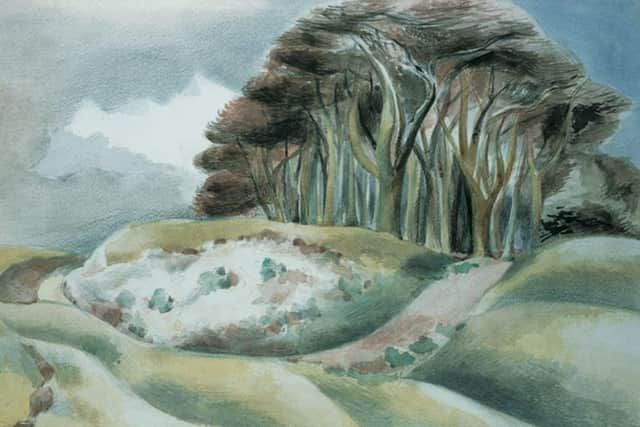

“Spanning British Post-Impressionism, the pastoral printmaking revival of the 1920s, Surrealism, and the emergence of the bold postwar abstraction of St Ives and beyond, British Landscapes: A Sense of Place offers a fresh look at how art reflected the shifting landscape of a nation.”
Also coming up is Haroun Hayward: Path Through Trees (May 30-November 1 2026).
“This exhibition will mark Haroun Hayward’s (b 1983) first solo institutional show. Hayward will present a new body of work, created in dialogue with artworks in Pallant House Gallery’s collection by Wilhelmina Barns-Graham, Paul Nash, Graham Sutherland and Ceri Richards.
“Hayward’s vibrant practice celebrates hybridity – drawing from art historical references such as postwar British landscape painting and abstract expressionism alongside the cultural politics of 90s dance music, rave culture, and graffiti. His practice also takes inspiration from his mother’s expansive collection of South Asian and West African textiles, seen in his unique oil stick technique he developed to emulate embroidery. His paintings lean towards abstraction, with shapes inspired by the rhythmic connections between sound, pattern and form, developed through a distinctive use of oil paint and oil stick.
“For Pallant House Gallery, Hayward will create a new series of paintings inspired by the surrounding Sussex landscape, including the atmospheric arboretum at West Dean, where he recently completed a joint residency between West Dean College and the Gallery.”
The year will also see a community programme display (May 30-November 1 2026).
“Responding to the British landscape and the bold work of contemporary artist Haroun Hayward, artists from Pallant House Gallery’s Community Programme will present a reflective new collaborative artwork.
“Echoing Hayward’s distinctive approach to composition, they will be encouraged to experiment freely, selecting their own mediums and methods to showcase their creativity. The result will be a vibrant, collective response that celebrates individuality while coming together as an expression of a shared artistic vision.”
The year continues with Barbara Hepworth and Greece (November 21 2026-April 11 2027).
“This will be the first exhibition to explore Barbara Hepworth’s deep affinity with Greece – from her fascination with Greek myth, tragedy and subjects to the profound effect of travelling to Greece in August 1954.
“Embarking on a cruise of the Aegean and Cycladic islands at a pivotal moment in her life and career would have a lasting impact on Barbara Hepworth’s vision and practice. The trip resulted in sculptures in wood, marble, and bronze, as well as drawings and lithographs that reflect her focus on the relationship between the human figure and the landscape.
“The exhibition will reveal how the landscapes, architecture, colours and light of Greece inspired new directions in Hepworth’s practice at the height of her international acclaim.”