
His Place Church in Hastings hosts Holodomor (Ukrainian Famine) Memorial Event
The Ukrainian and British communities came out in force to support a collective remembering of the Holodomor, a tragic event, which was one of the worst crimes against humanity ever committed.
On Saturday evening in Hastings, in a candle-lit space within His Place Church in Robertson Street saw people gather for whom uncovering the crimes of the Soviet regime is particularly important.
Jeremy Hicks, professor from Queen Mary University, London, brought to light several important history treasures, aided by a Ukrainian film “Alive” by Serhiy Bukovskyi (2008). The film avoids the most gruesome parts of Holodomor, i.e. stories of cannibalism, and does not show what happens to human bodies when they are dying from starvation. Instead, it explores the subject by talking to survivors, all of whom are Ukrainian pensioners.
Those in attendance saw the director interacting with them, with occasional well-meaning humour - and were easily able to relate to the humanity of the people who survived, despite having lived through the worst trauma imaginable, typically seeing their family starve to death around them, having survived by some miracle.

The elderly women and one man are filmed at their homes, and we get a glimpse into their lives, their trembling hands pointing to the pictures of their dead relatives on the walls, surrounded by embroidery at home and by cattle and lush vegetation outside. The film juxtaposes these lone figures resting on benches, talking, gesturing, with historical records, and Russian Soviet propaganda, bringing to light the impact that distant policies manufactured in the Kremlin by Stalin had on the lives of these hardworking, decent people, who cried and wailed when their cattle were taken away.
This is how the hunger was created - strange people would barge into your house and take away not only food, but all your possessions- sometimes even yanking clothing for her burial, stashed away underneath a dying disabled woman, from underneath her body. The simple moral values of the nation come through - the strangers that forced themselves into their homes are described as ordinary people, but with a dog’s conscience. That is, one cannot call oneself human, and behave like this, taking away the very last scrap of food from starving people in the middle of winter.
The film was a success and the audience was hooked - every member of the audience stayed for a post-show discussion. We learned from Jeremy about some hidden but obvious truths - that Soviet agriculture never recovered after the Holodomor in Ukraine, never reaching the levels of food production of the 1920s; that only 25 photographs of the famine of the 1933-44 exist, smuggled out by Austrian technician Alexander Wienerberger, which were taken in Kharkiv, the then capital of Soviet Ukraine. No photographs of rural mass deaths by starvation exist - due to the diligent supervision by the Soviet secret services.
We also learned that the only Western journalist to have ever visited starving Ukraine villagers was Gareth Jones, who valued journalistic values of telling the truth over his own career. His life was ended on the eve of his 30th birthday - he was shot dead, his body sent home to Wales in a closed casket. All we know is that he was accompanied on his journalistic trip by people provided by Communist Russia.
The audience was stunned when one of the attendees revealed himself to be a great nephew of Gareth Jones - Philip Colley, the writer of https://www.garethjones.org/mr_jones/true_story.htm . Philip shared how bitterly his family grieved for their own, and that the family worked tirelessly to bring Gareth’s reporting to light, which can be found on the above website and at the Wealth National Museum.
The audience was stunned once again when one of the attendees, Natalya Ovseichuk, narrated her family story of heroic community work that her grandparents undertake during Holodomor to save the lives of 700 school-children, and were then persecuted for it - her grandmother was tortured to death by the Russian secret service and her grandfather was sent to Siberia.
One of the Ukrainian attendees, Nelia Lysenko, a head volunteer at HTH Monday soup kitchen for Ukrainians, which has been running since the start of the full-scale invasion, and is the only remaining ongoing weekly Ukrainian gathering in Hastings, had this to say about the event: “Thank you to all who helped organise such an important event. From the archive of my memory, recollections of my grandparents and parents about those dark times rose to the surface, which closely linked with witness testimony on the screen. It was moving… Memory is important, just as our presence at events such as this.” (translated from Ukrainian by the author)
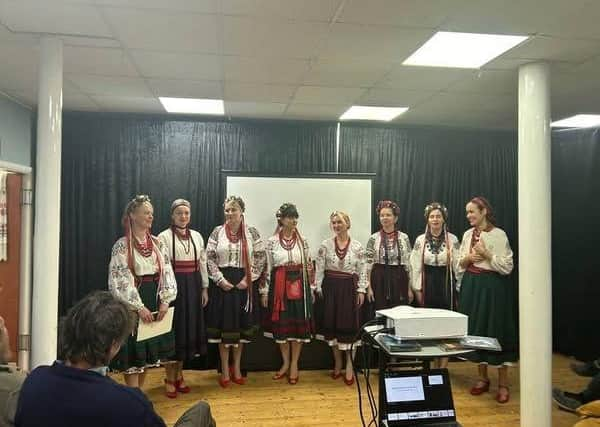
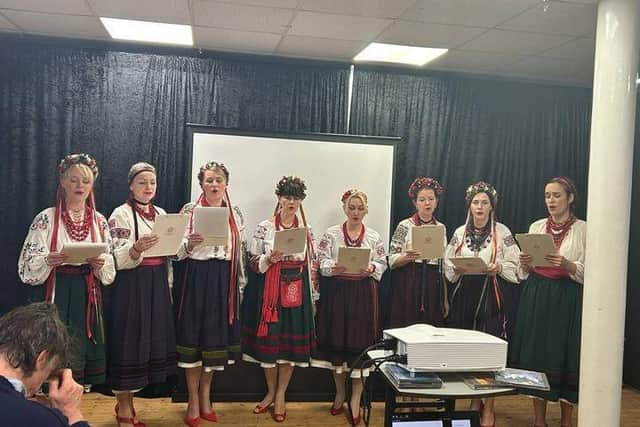
The legendary local Ukrainian amateur choir Volya Voices performed at the start of the event. The choir was the highlight of the evening, sharing Ukrainian culture with sincerity; their mission it to raise funds for Ukraine Charities. Please have a look at the important work they are doing on their Instagram and Facebook pages.
It was a real pleasure to see how the Ukrainian community came together for this event- volunteers came early to work in the kitchen, to produce delectable treats to feed the audience; other Ukrainians brought food items to donate to British food banks to highlight how important it is to share food with those who are short of it and in this way commemorating Holodomor, and also to give something back to the British community as a thank you for the immeasurable support Britain has given to Ukrainian refugees. We also received our very first book donation by Luba Powell, a book on Holodomor to the Ukrainian Library, which will also be hosted by His Place Church.
And finally, we must give our thanks to His Place Church which is the most inclusive venue in Hastings - they welcomed our community with open arms and did everything necessary for the event to be successful; special thanks to Nicola Roper.
The church hosts a number of community groups from Hastings, e.g. this Saturday, November 23, they are opening their doors to the single parents of Hastings peer support group (organised by Gingerbread charity; info on [email protected]).
Hastings Ukraine Support Network, who organised the Holodomor Memorial event, has also been running an inclusive discussion group of Ukrainian Literature in translation, popularising Ukrainian culture, and creating a welcoming space where people can talk about difficult issues such as wars and immigrant experience in a safe environment. For more information please contact [email protected]
Further information about Holodomor can be found here: Amazing Poverty Amid Glut of Gold by Gareth Jones (1932).