
Farm Diary: The government has underestimated the value of farming businesses across the UK
I started last week’s column by stating that it was difficult to take a dispassionate view of everything surrounding this government’s budget and that included the proposed farmers inheritance tax of course. I received a few calls from angry farmers on the back of this, with one or two who were in fact supportive.
I felt it is really important to look at this in the round and not get swept away by the rhetoric, a great deal of which makes little sense and I’m sure most of it is in the heat of the moment.
There are many reasons why farmers are angry and this has been brewing for a very long time and this seemingly hapless government pulled the trigger which has unleashed a tidal wave of real anger and the protest in London last week, whilst most of this pent up frustration is due to the last 14 years of Conservative government; a real own goal (again).
Emotions ran high in London and whilst farmers were very well behaved (as one would expect), there were calls of betrayal from the NFU the CLA and many others. This was due to Steve Reed (and Keir Starmer) telling farmers before the election that there were no plans to introduce an inheritance tax on farms.
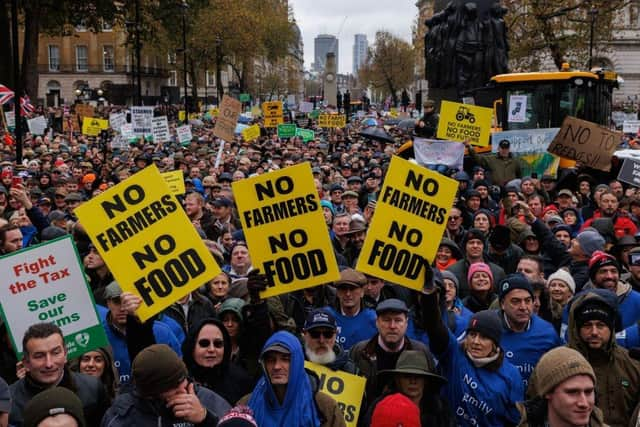

However, the black hole and so on has meant that unpopular things have had to be done (yawn), and many farmers are now threatening to go further in order to punish government.
There are threats to start behaving like the French farmers, blocking roads, burning tyres and also start blockading supermarkets distribution centres in order to bring chaos to the supply of food in our shops.
That would be a serious mistake, especially before Christmas and our incredible support from the general public would quickly evaporate; playing into government’s hands.
There are many grievances which make up this outburst of anger, farmers have been under huge pressure for some time now, with bad weather adding to the problems over the last two years.
Margins are very slim despite higher prices due to rising input costs, with many losing money, support is also falling in England year on year since Brexit, whilst in Wales, Scotland and Northern Ireland it still contributes to the bottom line.
Regulation and red tape has increased despite the promises that leaving Europe would put and end to all that, and that the Conservative government at the time ‘had the farmers backs’ was a cruel joke.
International deals have been struck to the detriment of agriculture, shortage of labour, higher wages, and overall country folk have seen their services diminish despite 20% higher council tax on average, than in urban areas; they have higher fuel costs, poor bus services (or none), and bad or non-existent mobile phone signal and internet services.
Add to this the environmental pressures on farming, any support money switched to schemes many farmers cannot access, and the sense of being undervalued and often misunderstood; it is quite easy to see why there is now an uproar.
There are two very serious problems here which need resolving, and I say that as I don’t see a U-turn on this policy any time soon.
The first is that government have grossly underestimated the value of farming businesses across the UK. The recent land prices have pushed up values enormously and far more family farms will be caught by this tax which the government says is not the intention.
Therefore there needs to be a substantial rise to where this tax kicks in.
The second problem is the peculiar attitude of our industry, as land values are very much secondary to passing farms on to the next generation, the very reason family farms exist is to keep on farming.
Tax us if we sell up by all means, they say, but do not prevent us passing on our business to the next generation.
The fact that farmers sit on assets worth several million is of no consequence to them, and the general public struggle to understand why farmers work all hours, in all weathers, struggling to make a profit each year, when they could cash in and retire very easily.
That is incomprehensible to family farms, protecting and growing the asset in order to pass it on to the next generation is why many of them exist; nothing is more important.
The biggest threat to the family farm is divorce! Son or daughter gets divorced and half the farm goes, a complete disaster.
That makes the older generation hang on in order to try and minimise that risk.
Many family farms have built cottages to house essential workers, adding to the asset value but little or no income from them.
Legal experts in this field tell me that the sudden change from no inheritance tax, where their advice has been for the older generation to hang on to the farm as long as possible, maybe starting a slow process of partnership as time goes on, is very unfair.
There is now no time for those who have not got their succession plans in the right place to employ the 7 year rule, and many are too old to survive such a rule anyway.
There needs to be a way out of this as I said last week, where extra time is given to those caught out by this sudden change, as desperate people do desperate things.
We already have a worrying rise in mental health problems on farms due to pressure, isolation, diminishing sense of self-worth, financial hardship and so on.
We had a farmer at the CLA Conference last week stating to Minister Steve Reed that the only way he could see out of this was to commit suicide before this tax arrives.
He will not be alone, and that is something we should avoid at all costs.
The NFU needs to step down from the grandstanding and enter serious negotiations with government.
Publicly stating that Defra has no say in this and demanding to speak to the Chancellor is not smart, whatever they think.
This is far too serious a matter to play politics, they must roll up their sleeves and get to work.
Two more points need to be made. The first is that all governments have had a cheap food policy for decades as it keeps wages in the country lower than they would otherwise need to be.
This has been achieved through agricultural support (using taxpayers money to fund a cheap food policy), but now farmers are getting almost nothing for food production, as any support there is goes on environmental benefits.
Many of these schemes are taken up by investors who have bought land with no intention of farming it or producing food, often to offset carbon and pushing up land prices.
The second point is that supermarkets and the supply-chain have known the average cost of production on farms for years, as they squeezed margins across the board.
They have also seen the price of land go up recently, and that is also factored in with pressure on prices increasing accordingly.
The irony for government is that as their plans on inheritance tax stands today, the protected farms produce very little food as they are too small and are often hobby farms.
The farms which will be massively hit by this are the larger family farms who are well run, have expanded over the years, are efficient and collectively produce the bulk of our food.
Let’s be sensible and get this sorted.