
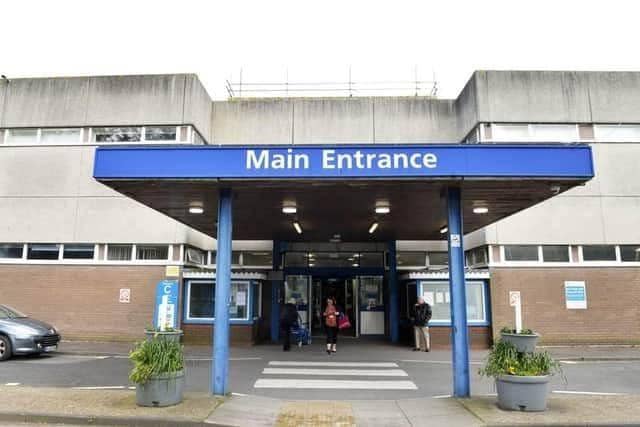

It follows an inspection in February.
Urgent and emergency care at the Conquest Hospital in Hastings has now also been downgraded from good to requires improvement.
The overall rating for the Conquest Hospital has changed from outstanding to good.
Both hospitals are run by East Sussex Healthcare NHS Trust.
The CQC again rated urgent and emergency care at Eastbourne District General Hospital as requires improvement, along with safe, effective and responsive.
Well-led was downgraded from good to requires improvement and caring was re-rated good. The service was in breach of three regulations relating to safe care and treatment, staffing, and overall management of the service.
The CQC has downgraded urgent and emergency care overall at the Conquest, and the ratings for safe, caring, responsive and effective, from good to requires improvement. Well-led was downgraded from outstanding to requires improvement. The service was in breach of four legal regulations relating to safe care and treatment, staffing, dignity and respect, and overall management of the service.
As a result of these inspections, CQC has told the trust to submit an action plan for each hospital, showing what action it is taking to make immediate improvements.
Amanda Williams, CQC deputy director of hospitals, secondary and specialist care in the South East, said: “When we visited the urgent and emergency care services at Conquest Hospital and Eastbourne District General Hospital, we found departments that were operating under sustained pressure and where staff were struggling to provide safe and effective care for people.
“We saw staff treating people with kindness and compassion, and this was reflected in positive feedback from people and their families. However, both emergency departments experienced significant overcrowding, primarily driven by issues with flow across the hospitals which leaders must look to address.
“For people needing urgent care, this too often meant long waits for treatment or transfer to a ward, and a risk of deterioration or prolonged pain. For example, one person with a potentially life-threatening condition spent more than six hours waiting for a scan because of delays in accessing diagnostics.
“Like many emergency departments, staff had to care for people in temporary escalation spaces (known as corridor care) to cope with demand and this wasn’t always safe. We saw people didn’t always have call bells to alert staff if they needed help and staff couldn’t always protect people’s dignity and privacy. One person described their care as undignified.
“Unfortunately, we found people with mental health needs weren’t always receiving the support they needed. The trust wasn’t ensuring people received an assessment from the mental health liaison team within an hour, which is the national standard, and at Eastbourne, we found around 60% of people with mental health needs were leaving the department before being seen.
“It was clear leaders were capable and committed but they weren’t identifying or managing risks effectively and hadn’t taken sufficient action to address persistent issues such as delays in accessing specialist beds.
“We’ve told leaders where we expect to see rapid improvements and requested action plans for both services.”
At Eastbourne District General Hospital, inspectors found:·Leaders weren’t ensuring people were triaged effectively. Although triage scores were recorded, staff didn’t use these to ensure people were seen in order of clinical priority and nurses weren’t always recording important information about allergies or clinical red flags.
Leaders hadn’t addressed confusion regarding which children and young people could be safely assessed and treated there, and who should be directed to the larger paediatric emergency department at Conquest Hospital. Children and young people often had to be transferred to Conquest Hospital, causing delays.
The service didn’t always provide a safe or therapeutic environment for people with mental health needs. Staff hadn’t identified a ligature risk in the mental health assessment room, which was also noisy and over stimulating.
The service wasn’t ensuring people at risk of sepsis received vital treatment within an hour. In August 2025, up to 33% of people didn’t receive IV fluids and 20-30% didn’t receive antibiotics, putting them at increased risk of organ failure and death.
The service had improved ambulance handover times. Between June 2024 and February 2025, 15-20% of people arriving by ambulance had to wait more than 30 minutes to be transferred. By September 2025, less than 10% waited that long.
Staff were confident reporting incidents and leaders ensured learning and trends were shared across the service.
The service had run a successful pilot to reduce pressure on the department by re-directing people to off-site GP appointments and was aiming to extend this.
At Conquest Hospital, inspectors found: Leaders hadn’t ensured the department had dedicated pharmacy support, so people didn’t always receive their regular medicines on time. One person was in the department for nearly 24 hours without critical blood clot and blood pressure medications.
The trust didn’t ensure the service still had access to 24-hour cardiology cover, which meant someone waited overnight before receiving a specialist cardiology review. Staff said they should have been transferred to specialist cardiology care sooner.
Leaders weren't ensuring there was sufficient paediatric nursing staff. There should have been a minimum of two paediatric registered nurses per shift, but the service regularly had just one and on 15 occasions in one month, there was no paediatric registered nurse at all.
Leaders had failed to effectively tackle risks that had been on their risk register for more than five years. These included poor sepsis management and overcrowding. As a result, people remained at risk of these known concerns.
Leaders had created a supportive and caring team culture, where staff felt comfortable raising concerns and reporting incidents.
Leaders had a clear vision for urgent and emergency care, and both staff and leaders felt positively about improvement plans.
The service was trialling an AI enabled patient tracking system and this had reduced the time people spent in the emergency department by 21%.
The reports will be published on CQC’s website in the coming days.
The trust has been approached for comment.