
Goodwood Health Summit 2025: Why the humble earthworm is revealing the secret to a longer, healthier life

The 2025 Goodwood Health Summit, presented by Randox Health, returned for its third year on Thursday October 2, bringing together leading experts to discuss crucial topics surrounding the connection between soil health and the human microbiome. Editor In Chief Gary Shipton, who has attended all three summits and has adjusted his own diet in the light of the emerging evidence from them, was at Goodwood House. These are his menu takeaways from the day.
Two carrots. Both orange. At a glance, almost identical. But are they?
One of the fundamental assertions at this year’s summit was that all vegetables are not made equal.
While carrots and a host of other food stuffs grown in the soil might look the same, appearances can be deceptive. One of them can have twice as many vital nutrients as the other.
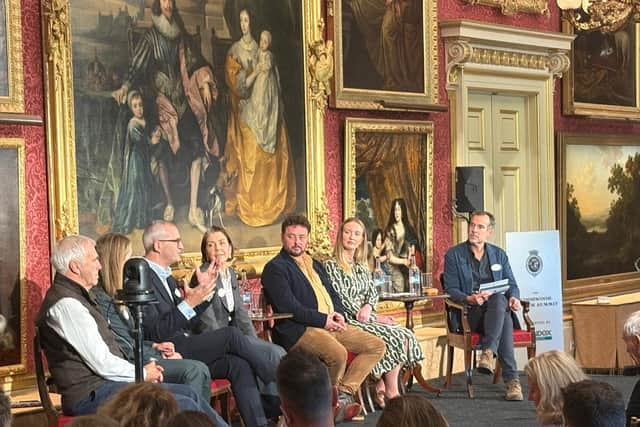

The first two summits have concentrated on the first essential step to improving our vital gut microbiome – breast milk from birth and then onwards a diet rich in fibre, fermented foodstuffs, fresh fruit and vegetables, and fasting – while avoiding ultra processed foods and snacks stuffed with cheap carbs and refined sugar.
This year’s summit went a giant leap further. Having persuaded us to abandon deep fried nuggets for tomatoes, broccoli, kimchi, kafir and the humble carrot … how do we know which of the many alternatives on the shop shelves contain the most nutrients?
The secret is in the soil itself.
The industrialisation of farming – heavy in machinery and overflowing in chemicals – has been essential in providing enough food for a rapidly expanding global population. But it has quite literally taken its toil on the soil as well.
So the best carrots will be grown in soil with its own potent microbiome.
If you are growing your own it was suggested by clinical nutritionist Stephanie Moore – who has been working with the Goodwood Estate on good gut health of some years now - that the most obvious indicator might be the presence of lots of earthworms.
Sterile soil that cannot even support the humble worm is unlikely to produce vegetables that will contribute as much to our own gut health.
And as was pointed out in a closing question at the summit – our gut health is not merely dependent on the soil microbiome but in turn plays a pivotal role in everything that defines not just the length of our lives but the quality of them too, especially our mental well-being.
We are what we eat.
Is it any wonder that in an age of the greatest urbanisation and industrialisation of our increasingly sedentary lives that so many people have forgotten what it’s like to feel really well? Mental and other health issues are now at crisis point, threatening vast numbers of people’s ability to work or even function at an acceptable level.
Not surprisingly, speakers at the summit were keen to encourage everyone to understand better where their food came from; for children to spend more time outdoors; and for people in urbanised communities to reconnect with the living world even if that is by simply caring for some potted plants at home.
There is a political imperative too.
The MP for Chichester Jess Brown-Fuller has attended both summits since elected. She urged people wherever they live to write to their MP.
It was a view echoed by the chair of the summit, renowned author and expert Dr Chris van Tulleken. He told me: “People need to write to their MP, and ask why unhealthy food that's so bad for their microbiome is so cheap and sold as healthy, and why healthy food is so expensive and hard to access.
"I think the question people should be asking themselves is, why is it so expensive to eat fresh fruit and veg? And what effect does it have on the planet when I buy food?
"So I guess the connection I really want people to draw is that what we've shown today is that there is this ecosystem in the soil, that is intimately connected with our ecosystem inside. And if we look after one then that must mean looking after the other. The foods that nurture us on the inside are the same foods that require us to look after the soil on the outside.”
It was clear from the debates that this remains an emerging area of knowledge and scientific exploration.
But good sense reinforces the message that if we want to be healthy we should eat wholesome, locally produced food – rich in fibre and low in added sugar. If that food is farmed and grown in high quality soil then it is likely to have much higher levels of good stuff within it.
But there is still a mountain to climb.
Too often, TV drama shows typical families drinking beer and wine and eating junk.
Healthy food can often be more expensive.
But enormous power lies with the consumer. The food industry’s agenda will be ultimately shaped by the products we buy.
And while it can be difficult sometimes to discern between the qualities of two similar carrots – our bodies can still have the power to judge more accurately than any labelling – simply by the taste.
That was the norm for previous generations.
The revolution to turn back the clock has started. Here in Sussex.
It is already making a huge difference.
The Duchess of Richmond and Gordon The Hon. Janet Gordon-Lennox is the pioneer and inspiration behind the summits. The Goodwood Home Farm is a global beacon of best organic practice.
Goodwood is renowned the world-over as an estate that makes things happen and the events that it stages – whether motor racing or healthy eating – are taken seriously by key decision-makers and the world’s media.
As the Duchess told me at the summit’s conclusion: “It’s most exciting that doctors really understand what good farming looks like, what healthy soil looks like, and how that interacts with physical health. They aren't trained in that and it was great to see the interaction between the medical and their farming sides.”
She said that for her perhaps three themes stood out from the summit:
- “that the link between the human and soil microbiomes is incontrovertible and vitally important, even if we still have much to learn about each;
- that both are imperilled but that there is action we can take at both individual and policy level to improve them;
- that there is real public desire for change in how we farm and feed, whether it comes top-down from regulators or bottom-up from public pressure.”
From my perspective, as economists and politicians struggle with an NHS that cannot cope, with a rapidly shrinking workforce curtailed by poor health, and a population increasingly disillusioned and seeking answers – the solution could literally be beneath our feet.
As the saying goes – it’s time for the worm to turn.