
MP left 'deeply disappointed' as cardiac cath lab set to relocate from Chichester to Worthing despite public petition

Chichester MP Jess Brown Fuller says she is 'deeply disappointed' that a hospital trust has 'decided to press ahead' with the relocation of a cardiac cath lab to Worthing Hospital.
A cardiac catheterisation laboratory, or ‘cath lab’, is a high-tech theatre where specialists perform minimally invasive heart or pacemaker procedures.
The facility at St Richard’s Hospital has been closed since the end of 2024 due to problems with its ventilation. More than 13,000 people signed a petition, calling on leaders of St Richard’s Hospital to keep the cardiac cath lab open.
The public appeal read: “The clock is ticking. We need to act now before the decision is made and help to keep this vital service open!
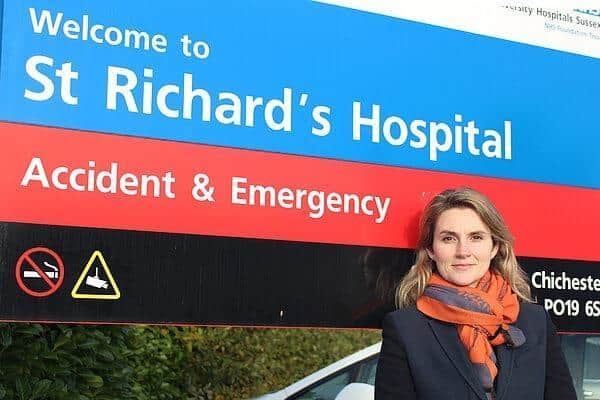

Mrs Brown-Fuller, Member of Parliament for Chichester, had called on decision makers – at The University Hospitals Sussex NHS Foundation Trust – to ensure that the lab re-opens in full following its renovations.
However, NHS Sussex Integrated Care Board and University Hospitals Sussex NHS Foundation Trust have ‘confirmed a modernisation’ of the cardiac catheterisation service in West Sussex. The plan is to ‘align local care with the latest national guidance from NHS England’.
The NHS statement added: “Until now, these patients have been treated at St Richard’s Hospital but in future will be treated at Worthing Hospital. There is no change to urgent or emergency heart attack care, or other cardiology services including the Cardiology ward and Outpatients clinics at St Richard’s Hospital in Chichester.
"This change follows new national guidance that recommends Cath Labs should be in hospitals with two or more labs to improve safety and efficiency. Worthing Hospital already has two state-of-the-art labs which can safely accommodate more patients.”
Mrs Brown-Fuller took to social media, to respond.
She wrote: "I am deeply disappointed that University Hospitals Sussex has decided to press ahead with the relocation of the St Richard’s Cath Lab to Worthing Hospital.
"I have sought assurances from the trust that this will not affect the status of St Richard’s as a district general hospital, and that the majority of cardiology care will remain onsite. There will be no change to existing emergency pathways.
"I am seeking assurances that staff currently working in the Cath Lab will have their roles protected.
"St Richard’s is a hugely valued part of our community, and I am determined to ensure it remains a cornerstone of our local healthcare system.
"Recent investment in the hospital, such as the new same-day emergency care unit and the creation of a state-of-the-art stroke unit, is welcome and will reassure local residents that St Richard’s remains a key part of the University Hospitals Sussex family and investment in the hospital will continue over their five-year plan.
"I will continue to engage with the trust to make sure that appropriate measures relating to this decision, such as travel mitigations for the vulnerable, are now put in place."
The NHS said its modernisation programme will affect ‘approximately 300 patients per year’, who require pacemaker procedures.
It pointed to new National Health Service guidance – published in February this year – which ‘further restricted the use or refurbishment of standalone cath labs’.
Professor Katie Urch, Chief Medical Officer of University Hospitals Sussex, said: “We know St Richard’s is a much-loved community asset, and we never take decisions regarding its services lightly. At the same time, our new strategy’s vision is to provide clinical excellence everywhere we provide care for patients. For cardiology, the national guidance is clear: specialised heart procedures should be performed in hospitals with two or more cath labs.
“This is the nature of modern medicine; ensuring patients are seen by larger integrated teams at specialist centres. It’s why other vital services will be centralised at St Richard’s. For example, our stroke department in Worthing will close next year and move into a new acute stroke centre at St Richard’s Hospital.
“Meanwhile, we will continue to invest in cardiology in Chichester, maintaining the cardiology ward and outpatients clinics for patients, as well as developing a modern non-invasive diagnostic CT scanning service, which is safer and faster for patients.”
Why did cath lab close?
In January 2025, an inspection revealed a ‘major issue with the air exchange system’ that ‘supported the safe use of the theatre’.
Prior to this, restrictions on its use as a standalone cath lab ‘meant it was being underused and open only three days a week’, the decision makers added.
They said: “As a result, most patients from the Chichester area who need treatment in a cath lab already travel to larger centres in Worthing, Brighton or Portsmouth to receive more complex, emergency, or high-risk care that the standalone Cath Lab at St Richard’s cannot provide.”
Professor Andrew Rhodes is the joint chief medical officer at NHS Sussex.
He said: “Recently published national guidance from the national clinical director for heart disease states that cath labs should only be commissioned or refurbished as part of a wider review of cardiology, reflecting the changing practice in diagnostic cardiology.
“Further, cath labs should be used for 40 hours a week to ensure good use of resources. By consolidating cath lab activity at Worthing Hospital and following the networked model, the trust is meeting safety standards for Cath Lab procedures, and also enabling new investment in modern, non-invasive heart diagnostics at St Richard’s.”
The Cath Lab modernisation programme received formal support from the West Sussex Health and Adult Social Care Scrutiny Committee (HASC) on March 4, 2026.
Independent clinical assurance was provided by the regional clinical lead for NHS England, consultant cardiologist Dr Yaver Bashir from Oxford University Hospitals who ‘supported the reconfiguration’ and made ‘series of other recommendations’ that the trust has ‘accepted in full’.