
Silent vigils to highlight major cancer campaign launched by Horsham couple
Three silent vigils are to be held in London in a bid to highlight a major cancer campaign launched by a Horsham couple.
Dr Susan Michaelis and her husband Tristan Loraine founded a campaign for research funding into lobular breast cancer – known as the Lobular Moon Shot Project – three years ago.
Sadly, Susan died from the disease in July last year but Tristan is determined to carry on the campaign and is frustrated at a lack of Government action despite support from hundreds of MPs, including Horsham MP John Milne.
Lobular breast cancer is the second most common type of breast cancer but rarely shows on a mammogram or ultrasound and has no specific treatment. Twenty two women are diagnosed with the disease in the UK every day.
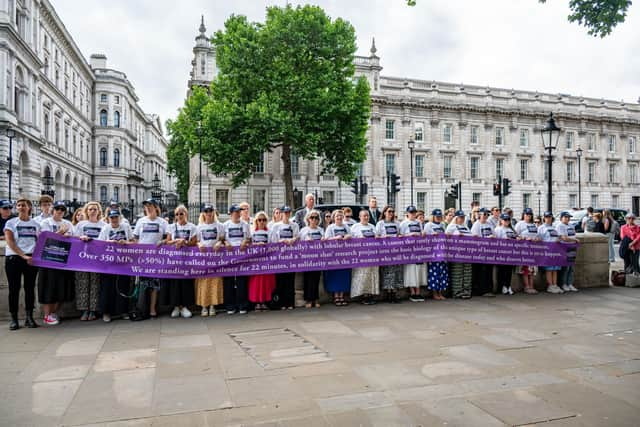

And to highlight that fact, three silent vigils will be held in London on April 22. “At each, 22 women living with lobular breast cancer will stand in silence for 22 minutes, representing the 22 women who will be diagnosed that day — and every day thereafter,” said Tristan.
“At one vigil, 22 schoolgirls in uniform will stand alongside them, symbolising the future generation that remains at risk if this inequality is allowed to continue.
“The silence is deliberate. It reflects both the voices lost to lobular breast cancer and the absence of response from those with the power to act.
“The Lobular Moon Shot Project is calling on anyone diagnosed with lobular breast cancer, anyone who has lost a loved one to it, and anyone concerned about democratic accountability to support the campaign, attend the vigils, and learn more about the proposal at lobularmoonshot.org.”
Lobular breast cancer accounts for up to 15 per cent of all breast cancer diagnoses but there is still no treatment designed specifically for it, despite, says Tristan, decades of evidence showing that it behaves differently from other breast cancers and often responds poorly to standard therapies. “This gap in knowledge has devastating consequences,” he said.
Susan herself underwent eight different generic breast cancer treatments. “None of them were designed for her disease. None of them stopped the cancer spreading,” said Tristan. “Her experience is not unusual; it reflects a systemic failure in how lobular breast cancer is researched and treated.”
The Lobular Moon Shot Project is calling for a £20 million, five-year investment to research the fundamental biology of lobular breast cancer.
“The economic modelling is deliberately conservative, yet it estimates that such an investment could generate £290–£330 million in long-term savings and additional tax revenue, primarily by reducing progression to incurable metastatic disease and enabling more patients to remain in work. In other words, the proposal is not simply compassionate — it represents sound stewardship of public money,” said Tristan.