
Chichester Cathedral named on Which? list of 'best UK days out for free' - here's a brief history on the West Sussex landmark

The historical Chichester Cathedral, located in West Sussex was featured on a recently published list from Which?
The Cathedral is bursting with a historically rich past. It dates back to 681, when St Wilfrid brought Christianity to Sussex. He originally established a Cathedral in Selsey, which is eight miles away. The See of Chichester was established in 1075 and that year, the works for the current Chichester Cathedral had started.
By 1108, Chichester Cathedral was eventually completed by Bishop Ralph Luffa, and consecrated.
Unfortunately, a series of catastrophic fires in 1114 and 1187 led to the destruction of the Cathedral’s wooden roof and eastern end. To replace these, Bishop Seffrid II constructed a stone-vaulted roof and extensively remodeled much of the structure. The cathedral was subsequently re-consecrated in 1199.

A crucial figure in the Cathedral’s history is Richard of Wych, who served as bishop of Chichester from 1245 to 1253. He was canonized by Pope Urban in 1262 for his holy works and miracles.
In 1276, when Richard’s body was moved, or ‘translated,’ from its initial burial place in the chapel of St. Thomas and St. Edmund to the Retroquire, the ceremony attracted large crowds, including the new king, Edward I.
The Chichester landmark has two architectural features that sets it apart from most other Cathedrals of its time. The first is a free-standing medieval bell tower. The other is two rare medieval sculptures and many modern artworks inside too.
In the early 1400s, the Cathedral's spire, cloisters, and Bell Tower were built. Chichester stands out for having the only remaining detached medieval bell tower, which is situated near the Cathedral’s western end.
The outbreak of the English Civil War in 1642 led to Parliamentary forces seizing control of the city and ransacking Chichester Cathedral. It wasn't until after the Restoration of the monarchy in 1660 that a restoration program was initiated to repair the damage.
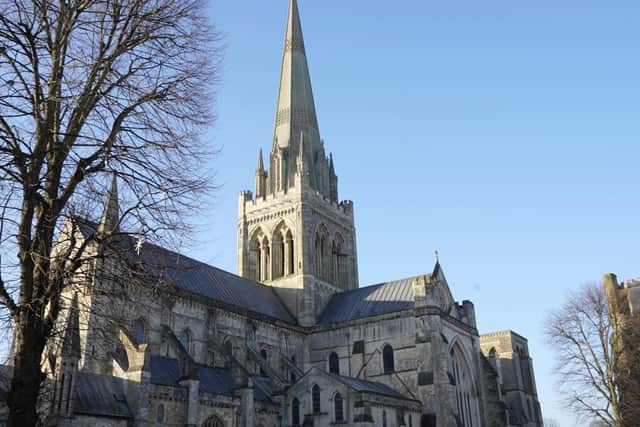
Significant cracks emerged in the masonry, resulting in the collapse of the Cathedral's Tower and Spire in 1861. Under the supervision of Sir George Gilbert Scott, a rebuilding program was undertaken and lasted over five years.
The Cathedral was fully restored and reopened for worship in 1866.
In the twentieth century, the Cathedral boldly embraced the world of modern art by commissioning pieces from esteemed artists. This includes a stained glass window designed by Marc Chagall, a tapestry woven by John Piper, and a painting executed by Graham Sutherland.