
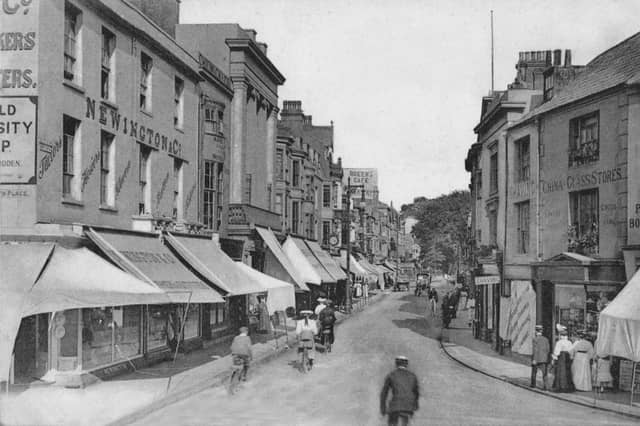


Local historian Ian Richardson has put together a superb film, Victorian Streets of Worthing Town Centre, showcasing more than 100 years of change.
He said: “We gallop through those remarkable years covering the Victorian reign, when Worthing began being described as an insignificant fishing village becoming a successful, respectful borough with a largely very happy community.”
In 1845, Worthing celebrated the opening of the railway, giving direct links to London and Brighton. In the 1860s, Worthing gained its own pleasure pier and in 1890, Queen Victoria formally granted Worthing borough status.
The Queen herself made three brief visits to Worthing, including stopping off with Prince Albert on February 21, 1842, on their journey from Brighton to Portsmouth, where she was to inspect the Naval armaments.
A newspaper report from the time painted the scene. “A comparatively large concourse of persons, both residents and non-residents, assembled in the neighbourhood of The Marine Hotel to pay their respects to her majesty on passing through the town westward.
“A great number of people stationed themselves along the road from the eastern entrance to the northern extremity, and in balconies and windows, whence a view of the Queen might be obtained.
“About half past eight, the approach of Her Majesty was indicated by the arrival of a party of Scots Greys and very shortly afterwards, being rather earlier than anticipated, the royal suite, accompanied by Her Majesty's bodyguard and a small mounted procession of townspeople wearing white favours, entered Worthing and stopped in front of The Marine Hotel to change horses.
“During the few minutes of Her Majesty's stay, the crowd, consisting of persons of all classes and ages from the highest to the lowest of our population and from the crowd the ages of three score and ten to the infant in arms, greeted their sovereign and their royal consort with the most enthusiastic cheers, which were graciously acknowledged by the illustrious pair.”
With horsepower being the main driver of transport, the town had stabling for around 400 horses, including Ann Street, The Albion Hotel in Montague Street, The Sea House Hotel on the seafront, where Princess Amelia stayed in 1788, and The Marina Hotel, where Oscar Wilde would go for lunch when he stayed in Worthing for two months in the summer of 1894.
Ian said: “In early Victorian times, before the London, Brighton and South Coast Railway came to Worthing, if you wanted to travel, you had to go by a coach. If you couldn't afford it, you left North Street travelling on a wagon.”
Ian has a complete timetable of Worthing coach journeys in 1828, which gives an idea of how busy South Street would have been, as the centre of the operation. There was a coach going to London from 7 South Street every morning at 9am and from 20 South Street at 10am, Brighton coaches left at 8.30am and 10am, and there was the Dart leaving 22 South Street at 10am daily to travel to Brighton via Shoreham. Other journeys included a Portsmouth service at 1.30pm, travelling via Arundel and Chichester.
Worthing Market, sandwiched between Ann Street and Market Street, opened in 1810. Every morning, beginning at nine o'clock, the town crier would stand in the centre of town to announce the various sales that were taking place in the market.
Ian said: “Butchers came from many villages, including Thakeham and West Chiltington, there were fishmongers greengrocers and fruiterers, poulterers came from Findon, Bramber and other local villages, and you could buy china and crockery.”
Ann Street had a theatre owned by Thomas Trotter from 1807 to 1855, the police station and Worthing’s first dispensary from 1829 to 1830, when it was moved to larger premises in Chapel Road.
The police station moved from Ann Street to High Street in 1922 and remained there until 1940. There was also the fire station on the corner of Charlecote Road and on the west side were barracks, built in 1905, which later became Prince & Sons corn, hay and straw merchants.
Thurloe House, on the corner of Union Place, was demolished around 1950 to make way for a new police station.
Colonnade House, on the corner of High Street and Warwick Street, dates back to 1803. It was originally owned by a Edward Ogle and run by Mary Spooner.
Ian said: “You could buy papers, books, games, lottery, music and cheap jewellery. Importantly, it was Worthing's first post office. Of course, we remember Queen Victoria for the introduction of postage stamps. Sadly, in 1888, there was a severe fire, which destroyed the building.”
Businesses began to appear in Warwick Street, like Blaker the ironmonger and the butchers. This was a period of transition from large, fashionable homes to a street of shops.
Ian said: “On the west corner was the large premises of Newington & Co. If you were a man of fashion in Victorian times, I suppose this was the place that you would come and shop. It was a gentlemen and boys outfitter, a tailor, hatter, hosier. If you wanted silk, felt or straw hats, this was the place to come and visit.”
The first Town Hall was built in South Street, on land donated by Sir Timothy Shelley, father of the poet Percy Bysshe Shelley, and this was opened in 1835.
Ian said: “The primitive condition of the road meant when it rained, I should imagine it was extremely muddy and difficult. Of course, all those horses added their contribution to this.”
There was a variety of architecture along South Street and the businesses deployed sunshades on a summer's day. There was also varied architecture in Montague Street, very different to today as this was before the Royal Arcade was built.
On the corner was The Wool Shop, a huge store advertised as a children's paradise selling toys, dolls and games, as well as stationery and photographic views.
Ford Ashdown was a millinery in Montague Street, selling hosiery and a range of underclothing, and just along from there was St James' Hall, a church that became a cinema.
The town centre was booming in the Victorian times but there were dark clouds on the horizon, due to a contaminated water supply.
Ian said: “On the request of the Worthing Board of Health, a splendid water tower in Gothic style was built in 1857 and this operated until 1893. The tower was 110ft tall and it housed 110,000 gallons of water.
“Sadly, in 1893 Worthing suffered a major typhoid epidemic and 194 people perished. Many hundreds were very, very seriously sick and just about every family in Worthing was affected.
“This was caused because of very poor drainage, particularly with heavy rain. The sewers just didn't work and it meant there was polluted drinking water. It was so bad, that all over England got to know about this and the London, Brighton and South Coast Railway went as far as stopping their services coming from London to Worthing.
“Soon afterwards, there was a new well bored at Lyons Farm and this achieved drinking water from the Downs, giving Worthing a safe water supply. Following the closure of this devastating outbreak, Worthing began to urgently upgrade the sewer system.”
Ian runs the Surfleet Worthing and District History Group, which meets monthly at East Worthing Community Centre on the third Monday of the month, 7pm to 9pm, and Steyne Local History Study at the Ardington Hotel, in Steyne Gardens, at the end of each month, meeting on a Tuesday, 10.30am to 12pm.
13. Victorian Streets of Worthing
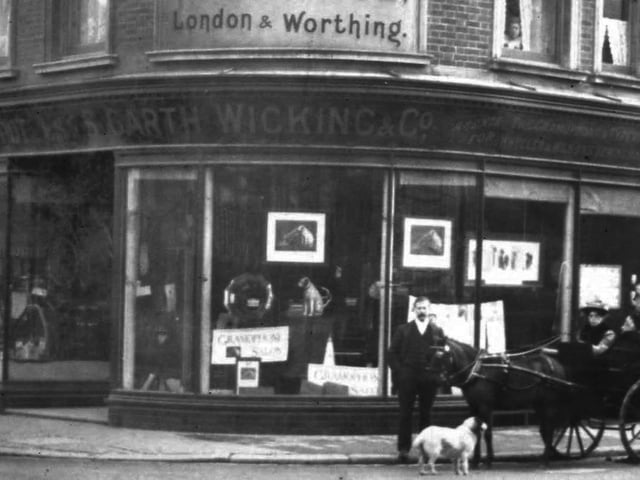
S. Garth Wicking & Co. was a prominent music warehouse on the corner of Rowlands Road and Thorn Road Photo: Ian Richardson