

The Ferring pillbox is one best preserved across the country and thanks to the hard work of volunteers, it has been fully restored and made safe for public viewing.
It was installed in 1940 and used to defend the south coast until Winston Churchill changed tactics. It then became a base for the Home Guard locally.
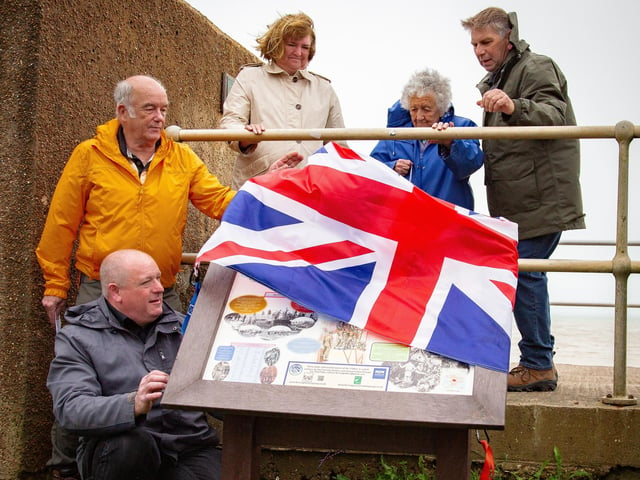
Home Guard family members Eva Grout, Peter Phillips and his cousin Ruth Arnold were asked to officially unveil the new interpretation board as part of the opening ceremony on Tuesday. Eva's late husband Frank was in the Home Guard and Peter and Ruth had three relatives, including their grandfather, in the Home Guard.
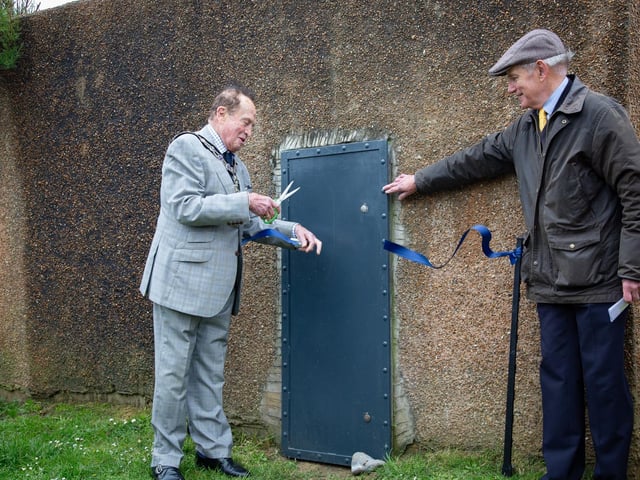
The pillbox itself was officially opened by Arun District Council chairman Dr James Walsh, who cut the ribbon before being shown inside.
Dr Walsh said: "This is a very important part of the totality of the UK's defences. It's fortuitous that it was sealed up because many of the pillboxes have either disappeared or been wrecked by vandals and the elements. We are lucky to have this one so well preserved.
"The fact that it was sealed up meant that the entire inside couldn't be vandalised and a great deal of effort has gone in from the two groups into restoring it."
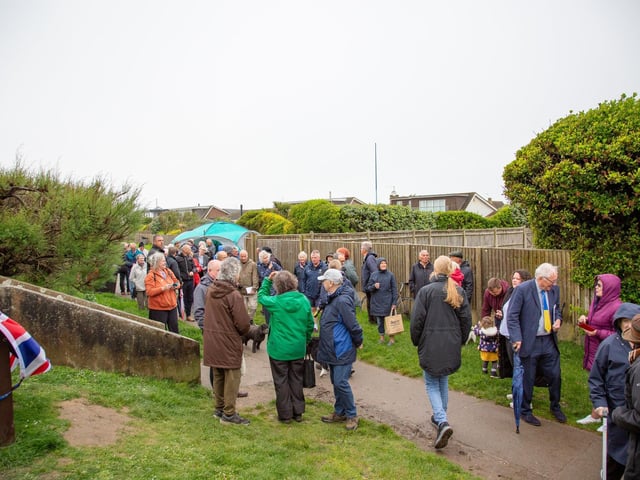
David Bettiss, secretary of Ferring Conservation Group, welcomed guests, including Sir Peter Bottomley and Ferring Parish Council representatives.
David said: "A great day for Ferring, I think. This is a joint project between Ferring History Group and Ferring Conservation Group. This is really important for Ferring, it is part of our local history. It is the only remaining pillbox locally and one of the very best preserved in the whole country, so we are very lucky to have it.
"It's a great educational resource for our youngsters to learn a bit more about how close we came to being invaded and it has already been used, with plans looking forward to continue that."
Project lead Pete Coe, a retired Royal Engineer, spoke about the history of pillboxes. He explained that 8,000 were built nationwide by July 1940, with 27 pillboxes and gun positions between, Sea Lane Café and Onslow Court in East Worthing, but Winston Churchill preferred a more mobile defence.
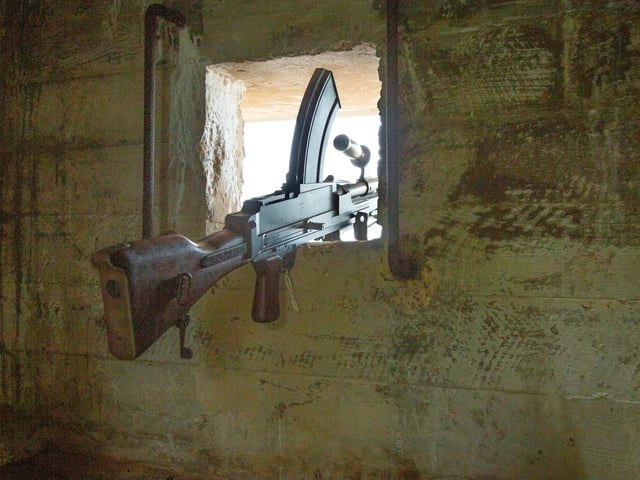
Pete said: "It is 6ft by 6ft inside, manned by probably three guys with weapons, and later on it was used by the Home Guard as a patrol post. When the guys were in there, the windows weren't blocked up and there was no door. It was pretty hideous to be in there on a wet and windy Ferring night."
Ferring beaches were reopened in 1944 following mine clearance and in 1945, Worthing Rural District Council removed the 27 pillboxes in its area. The Ferring pillbox and one at Lancing were the only ones left, though the Lancing one is now buried.
Having gained entry last year, the volunteers found nine inches of water, so a team of 'bucketeers' formed a human chain to clear it out in July 2023.
The interpretation board was put together, with support from Ferring Parish Council, to tell more of the pillbox's history, as it was discovered the plaque on the side has the wrong date.
Peter explained that it was only last January that an aerial photograph taken by the Luftwaffe came to light, revealing the pillbox in position earlier than the 1941 date on the plaque.
Just three weeks ago, Pete and fellow Royal Engineer Graham Cosham opened up the southern embrasure for the first time in around 70 years. On Tuesday, a gun supplied by Friends of Shoreham Fort was put in position to show people how it would have been in the Second World War.
Pete said: "Our main aim is to engage with local schools to utilise the potential of the pillbox as an educational asset and generally as a talking point for everyone, to keep our heritage alive and also to act as a reminder to how close we were as a nation to suffering at first hand the horrors of war."
A special event is planned for June 6, the 80th anniversary of D-Day. The Worthing Radio Event Group will be setting up a link to the Normandy beaches, with Juno Beach, where Canadians who were stationed in the village would have landed, being 102 miles due south of Ferring.
There will also be an event on September 15 for National Heritage Day, with a range of information and models to give more detail of the pillbox and its history.
1. Ferring pillbox official opening
A valuable part of Ferring's wartime history has been officially opened just days before the 80th anniversary of D-Day. The Ferring pillbox is one best preserved across the country and thanks to the hard work of volunteers, it has been fully restored and made safe for public viewing. Photo: Mary Coe
2. Ferring pillbox official opening
A valuable part of Ferring's wartime history has been officially opened just days before the 80th anniversary of D-Day. The Ferring pillbox is one best preserved across the country and thanks to the hard work of volunteers, it has been fully restored and made safe for public viewing. Photo: Mary Coe
3. Ferring pillbox official opening
A valuable part of Ferring's wartime history has been officially opened just days before the 80th anniversary of D-Day. The Ferring pillbox is one best preserved across the country and thanks to the hard work of volunteers, it has been fully restored and made safe for public viewing. Photo: Mary Coe
4. Ferring pillbox official opening
A valuable part of Ferring's wartime history has been officially opened just days before the 80th anniversary of D-Day. The Ferring pillbox is one best preserved across the country and thanks to the hard work of volunteers, it has been fully restored and made safe for public viewing. Photo: Mary Coe