
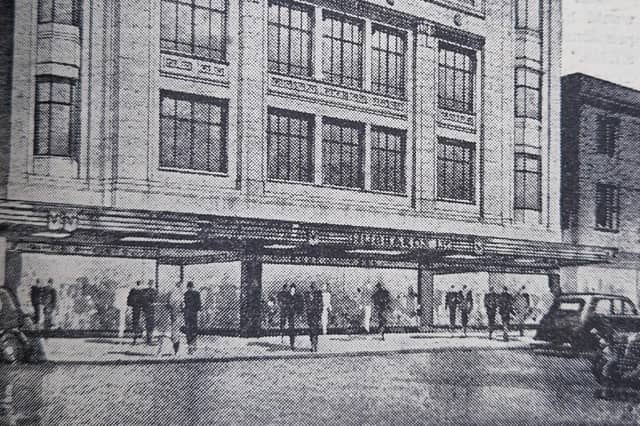


Delving into the Worthing Herald archives, we discovered an interesting article in the edition of April 29, 1938.
Popular department store Hubbards had been acquired in 1937 by Bobby & Co Ltd, which came within the group of stores controlled by Debenhams.
Mr J.K. Hubbard, who had been head of the family business, was reappointed to the directorate of Bobby & Co and remained as managing director of Hubbards, while Mr Ketton Hubbard was general manager.
The report said work had begun on the premises, which would mean an extensive alteration to the face of South Street.
The former Hubbards store was to be replaced by a 60ft-high building, faced in cream faience, with a bronze canopy running along its 75ft frontage.
The scheme cost more than £50,000 and was expected to take 18 months to complete. This included the acquisition of a piece of land from Marine Garage, on the south side of the shop.
The additional land meant the main premises could be extended through to Marine Place, over the whole width of the frontage.
The new building was to be set back by 4ft to enable the east pavement of South Street to be widened. The new canopy would give about 200ft of covered footway, taking in the Kinch & Lack's and Boots stores.
The scheme was to be carried out in four sections, so there would be no interference with business. The first section to be dealt with was the piece of land acquired from Marine Garage.
The new store would have four floors, including the ground floor, and there would be two lifts. One part of the scheme, the Herald revealed, involved the filling in of an old cellar, which was once the strongroom of Barclays Bank.
That building was a true landmark but it would not even survive a decade before disaster struck. On the morning of August 20, 1947, the alarm was raised by Miss Jackson, who worked in the soft furnishing department.
She and several other Hubbard’s employees had lodgings in Bedford Row, behind the store, and she heard the sound of crackling from outside her window as she awoke.
She ran to tell the housekeeper, Miss O’Brien, and together they peered towards the rear of Hubbards. To their horror, they saw flames flickering behind one of the store’s first-floor windows.
Police began warning nearby shop owners as firefighters sped to the scene. It was to prove the greatest battle Worthing Fire Brigade had fought since it had been formed in 1855.
Mr Hubbard stood at the front of the building and put his hands to his head in horror. Staff arriving for work were quickly mobilised into a line to save what stock they could. Everything was passed out of the shop and on to lorries to be stored.
All the china from the Hubbards restaurant was stored in a house in Grand Avenue, after the stains of smoke had been washed away. Other items were taken to The County, opposite Worthing Pier, where trade was able to continue for some departments.
The fire potentially put a vast area of the town centre at risk. Firefighters quickly realised that if it gained a hold, many of the town’s oldest properties could be caught up in it and parts of South Street, Warwick Street, Montague Street and even Chapel Road could be lost.
As dawn broke, every fire station in West Sussex became involved, and more besides – Brighton, East Preston, Findon, Bognor Regis, Chichester, Littlehampton, Storrington, Lancing, Arundel, Henfield, Guildford, Crawley and the Woking section of the Area Fire Fighting Force.
Never before had so many fire engines been called in from over such a wide area, battling the flames as the glass dome on Hubbards’ roof shattered and they mushroomed into the air.
Hubbard’s was encircled with walls of water to save the town centre from devastation and by 9am, the fire was officially under control, leaving the store a gutted shell at first, second and third-floor levels.
The final cost of the blaze was estimated to be £240,000 and the official report revealed the fire to be the second biggest incident of its kind in the entire country that August.
Hubbards did not reopen until 1952 and it was another year before the restaurant returned.
Seventy years later, after Debenhams had come and gone, that glass domed ceiling from Hubbards’ restaurant on the top floor remained. The new owners of the site even discovered original wooden parquet floor tiles from Hubbard's underneath the plastic flooring, the original balustrades and radiator covers.
They also found a boarded-up lift shaft that still had smoke damage from the fire.
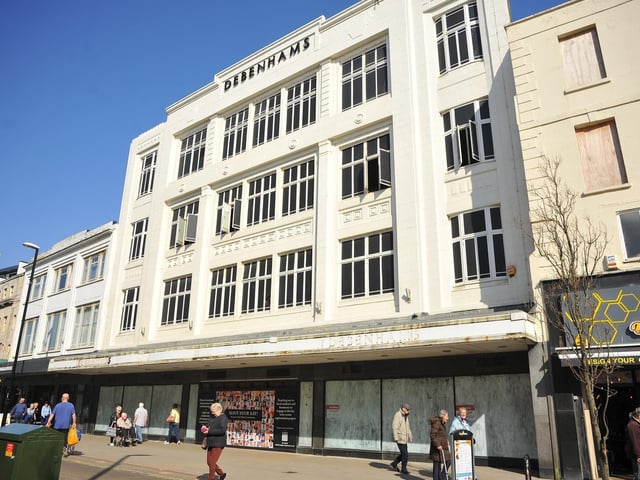
5. Debenhams
The familiar frontage after the closure of Debenhams Photo: Worthing Herald
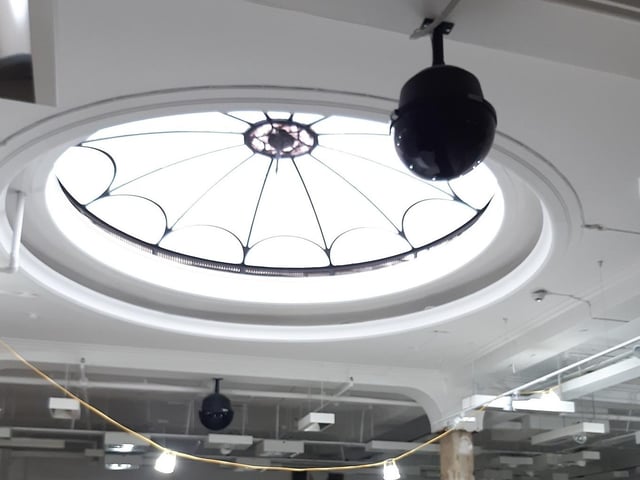
6. Debenhams
The glass domed ceiling from Hubbards restaurant on the top floor remains Photo: Worthing Borough Council
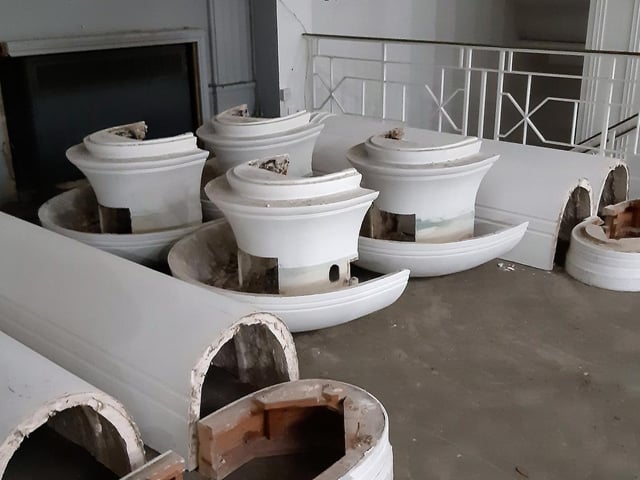
7. Debenhams
The new owners of Debenhams discovered some of the original features from Hubbards Photo: Worthing Borough Council