
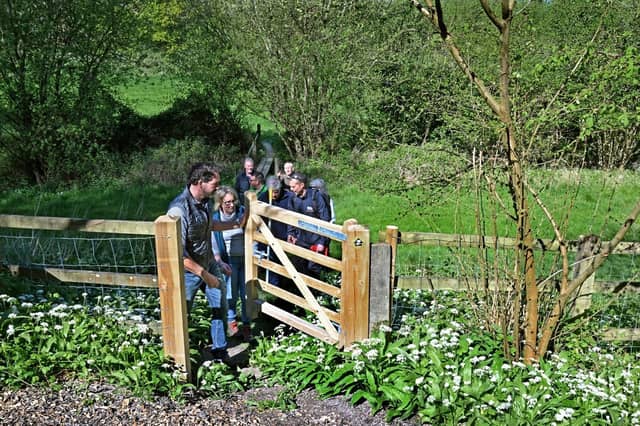


West Burton is a hamlet in West Sussex with no consecrated burial ground or church, so mourners used to carry the departed by hand using a bier or by horse-drawn cart along a 1.3-mile path to Bury.
It is a wonderful walk through quiet countryside with beautiful views along the way. Bury Parish Council has been striving to make its footpaths more accessible to more people over the past couple of years and opening up the Ancient Coffin Trail was part of the plan.
The South Downs National Park Authority provided a grant of £2,400 for new kissing gates on the Ancient Coffin Trail. The council, working in partnership with landowners and West Sussex County Council, was able to replace a total of nine stiles with gates and remove two stiles altogether, as part of the SDNPA Miles Without Stiles initiative.
The Ancient Coffin Trail runs between West Burton and the churchyard of St John the Evangelist in Bury. It was relaunched in May as an asset to be enjoyed by walkers, to enhance health and well-being, with new fingerposts and waymarks to guide the way.
Richard Champness, chair of Bury Parish Council, said: “We really appreciate the support of the South Downs National Park Authority, and indeed West Sussex County Council, in helping us improve and put the wonderful historic walks in our parish ‘on the map’, as well as enhancing the health and well-being opportunities for our community.
"At Bury Parish Council, we hope local people and visitors will enjoy walking the Ancient Coffin Trail and other local Public Rights of Way, including the South Downs Way. It is easy to access the trail in West Burton from the South Downs Way via a public footpath. Just a short detour from the trail, there are two potential pit stops in the parish – The Squire and Horse Pub and Charlie’s Farm Shop, both alongside the A29.”
The medieval route has an intriguing history. For almost 1,000 years, before motorised transport, the dead had to be carried along the path to the graveyard of their mother church, according to ecclesiastical law.
The route runs through the chalk downland of the South Downs and offers glimpses of streams, woodland, hidden vales, historic buildings and incredible views.
Ben Bessant, national trails and countryside access officer for the National Park, said: “The improvements have made the route far more accessible to more people and I hope many people from both the local community and further afield enjoy this really scenic walk.”
I started the walk in West Burton Lane, near the village signpost and noticeboard. The Ancient Coffin Trail sign can be found beside Cokes Barn, leading you through past the houses to a footpath into the countryside.
It's not long before you come to the first of the new kissing gates. Unfortunately, on the day I visited in August, there was a fallen tree blocking the path immediately after the gate.
I had no choice but to clamber through the branches, as beyond the tree, the path was clear. On the plus side, I could immediately see this would be a wonderful walk with glorious views. I also saw some gorgeous trees, including a spectacular weeping willow.
The gates are definitely easier to negotiate than stiles but there are still a few challenges en route, including a bit of a hill, a field of cows and a small wooden bridge.
Having said that, there is a bench en route which allows you to take a break and enjoy the absolutely stunning views over the countryside.
You learn a lot about the history of the area, too. At Dorset House School, there are boards explaining the extraordinary history of Bury Manor.
In 1066, the manor was owned by Countess Goda, sister of Edward the Confessor. In 1085, the Normans handed it over to the monks of Fécamp, a Benedictine order that farmed in Bury for centuries.
The Domesday Book records a village population of 70 households in 1086, making Bury one of the largest 20 per cent of settlements recorded at the time.
The Barn was built in Tudor times. The school moved in in 1964 but its origins date back to 1784, when it was first opened in Hertfordshire. After 80 years in Littlehampton, the Bury Manor School Trust was formed by parents, old boys and friends, allowing the purchase of Bury Manor.
At the end of the Ancient Coffin Trail, you can take the steps down from the churchyard to Bury Wharf, where another noticeboard gives the history of the land, now owned by Bury Parish Council.
Richard said: “The wharf is next to the River Arun, with amazing views across the brooks and of the Downs. It’s then just a 15-minute walk along the river bank to rejoin the South Downs Way, making the Ancient Coffin Trail a wonderful and historic detour from the national trail. When linked together, the South Downs Way and the Ancient Coffin Trail make for a 5.5-mile circular walk with spectacular views.”
For many years, the wharf was busy with goods being transported along the River Arun. There was also a ferry service for many centuries, linking Bury to Amberley. The Duke of Norfolk held the Right of Ferry and he appointed the ferryman, who was given a cottage and a boat.
Three barges, Neptune, Mayflower and Old Sixty-nine were used to bring timber and coal to the village and to take sand, chalk and lime from the works at the foot of Bury Hill.
The barges were also used for children's outings. Gaily bedecked horses would tow them along the river to The Black Rabbit in Arundel or to Climping on the coast.
There was a stream flowing to the river from the pond at Bury Manor, used as a sheepwash, and watercress once grew here. There was a wooden bridge to Ferry Hole, where Bob Dudden, the last ferryman, taught children to swim.
The area was often prone to flooding, so the river was dredged and embankments built in 1964, the same year Bob died. Having served in the Royal Navy, he went on to run the ferry service from 1927 to 1955.
During the Second World War, the wharf was used as a car park and Bob was in charge of collecting fees for the parish, receiving a 25 per cent commission for himself. The Royal Canadian Engineers were stationed in the area and they used to wash their vehicles there.
Before Bob, the ferry was run by Ada Marshall and she followed in the footsteps of her mother, Jane Shepherd, a mother to 13 children who was said to have 'worked the boat as well as any man'.
The car park was closed in 1960 due to the 'unseemly behaviour' of the public. The parish council landscaped the area for the Queen's Silver Jubilee in 1977 and restored the ferry steps 20 years later.
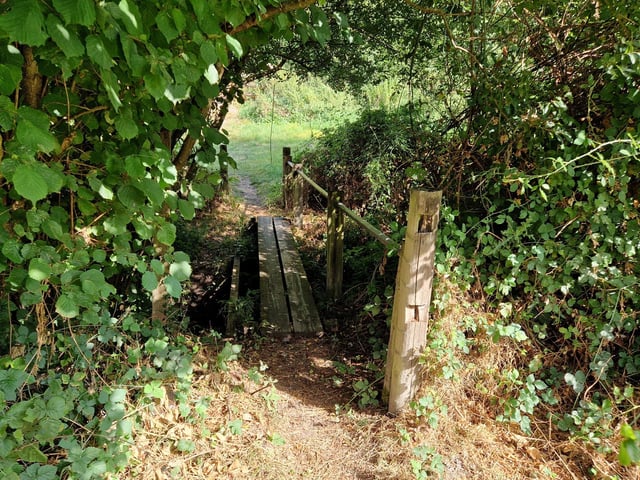
13. Ancient Coffin Trail
There is a small wooden bridge to negotiate Photo: Elaine Hammond
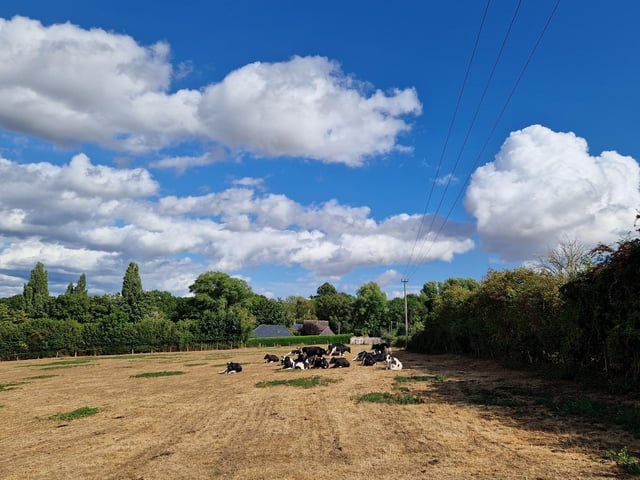
14. Ancient Coffin Trail
Take care in the cow field, where the trail crosses along the top Photo: Elaine Hammond
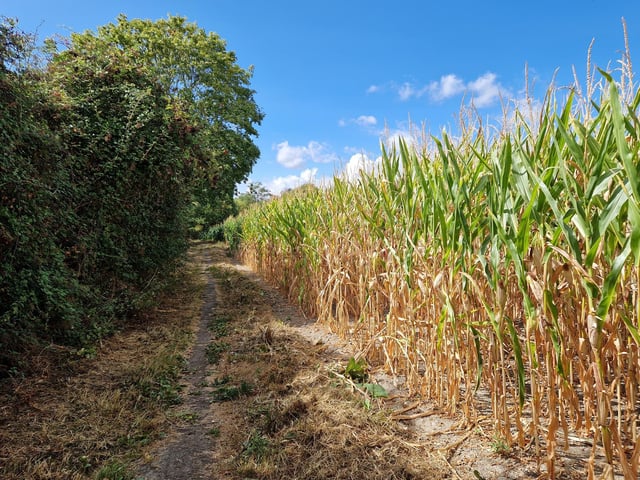
15. Ancient Coffin Trail
You walk alongside a field of sweetcorn Photo: Elaine Hammond
16. Ancient Coffin Trail
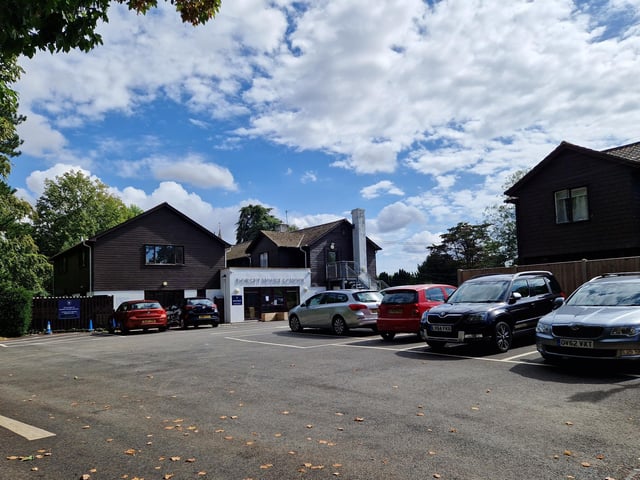
The end of the trail passes through the grounds of Dorset House School Photo: Elaine Hammond