
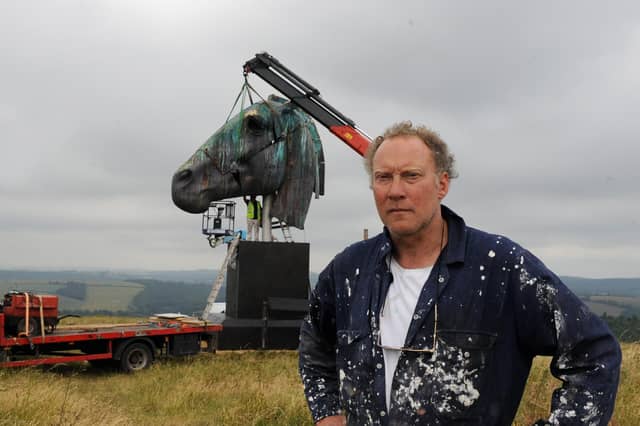


Inspired by an ancient sculpture, Nic Fiddian-Green's magnus opus had a huge impact when it stood on The Trundle, gazing out across the Sussex countryside, and at Goodwood racecourse 15 years ago.
The monumental horse’s head owed its inspiration to one of the Elgin marbles, the Horse of Selene, which Nic saw on a visit to the British Museum when he was a student at the Chelsea School of Art in the 1980s.
The impact was so great, it paved the way for his career as a sculptor – and ultimately for his own magnificent giant work of art, standing at around 30ft and made up of huge bolted plates of bronze.
The horse's head fascinated Nic and his aim was to capture every aspect of the animal's beauty and nobility, as well as its relationship to man, in his many sculptures.
As he completed Artemis in May 2010, Nic said it was probably the pinnacle of what he had been working towards for 30 years. Classical but linear, it gazed way out to the horizon 'to a distance somewhere else'.
Its proportions needed a landscape site and the full drama of the sculpture was evident once it was placed on the Trundle, just yards from the trig point on the hill to enable it to be seen from all sides.
Nic made finishing touches to the horse head shortly before the four-ton sculpture was put on to its plinth – an operation that took more than two hours to carry out.
There was the precarious journey up a steep track before the sculpture was reversed into place using a 60ft flat bed lorry.
The artist had just a few moments to decide in which direction he wanted the head to face – favouring south-west in the end, overlooking the steeple of Chichester Cathedral to the sea and across to the Isle of Wight.
As Artemis took its place at the highest-possible point, it was dubbed the south’s response to the Angel of the North, attracting national attention.
It was remained at the Trundle for three weeks and was then moved to the members’ lawn at Goodwood racecourse in July 2010 – a bold gesture, as, according to Nic, it was really too large for that space.
After Glorious Goodwood, it was moved to near Goodwood House for the Vintage at Goodwood Festival in August 2010, continuing to attract attention from far and wide.
Goodwood has always been linked with horses, from its rich history and early associations with hunting to international dressage, horse trials and carriage driving championships, to the public horse races established in 1802 and the celebrated Glorious Raceweek.
Come winter and Artemis was returned to its Trundle grazing spot in December 2010, where Nic hoped it would remain on the hill permanently to reflect the area’s artistic and historic heritage.
That dream was not to be. Artemis had to be removed in April 2011 after falling foul of regulations. Chichester District Council said planning permission was needed if it was to remain.
No such application was submitted and in the end, the sculpture was sold, reportedly for £1million, to a Fiddian-Green collector, the widow of Australian media mogul Kerry Packer, who had strong links to the equine world and West Sussex.
No longer named Artemis, it reverted to to the name Nic originally chose – I Look Beyond for a Distant Land. The sculpture was loaded on to a trailer and taken to Southampton docks for the start of its long sea voyage via the Panama Canal.
After arriving Down Under on December 27, 2011, the last leg of its journey took it to the family’s idyllic estate and its final resting place, beside the late entrepreneur’s graveside.
Nic began designing the contemporary piece in autumn 2009, with the support of Artemis Investment Management, to be finished in time for the flat racing season.
He worked on the sculpture in his studio near Godalming. It took him three weeks of hard physical work to create the imposing head, made up of 30 individual pieces.
The moulds were then sent off a foundry near Shrewsbury for the complex casting process, which took around three months. Nic was able to oversee the casting into bronze using the ancient 'lost wax' technique.
The alchemy of molten bronze pouring into his moulds at 1,200 degrees centigrade has been a process that has fascinated him throughout his career.
His awe-inspiring impact on Goodwood did not end there. In June 2012, the magnificent Fire, a powerful new work in bronze was unveiled. This 27ft-high sculpture depicted the head and neck of a horse turning, worked from life.
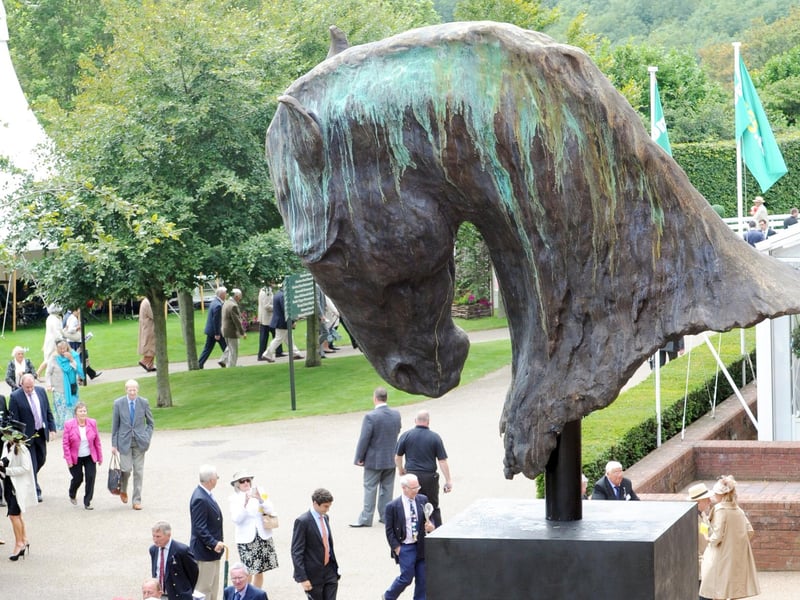
9. Fire
The sculpture is admired by visitors to Goodwood in July 2012 Photo: Kate Shemilt C120994-14