

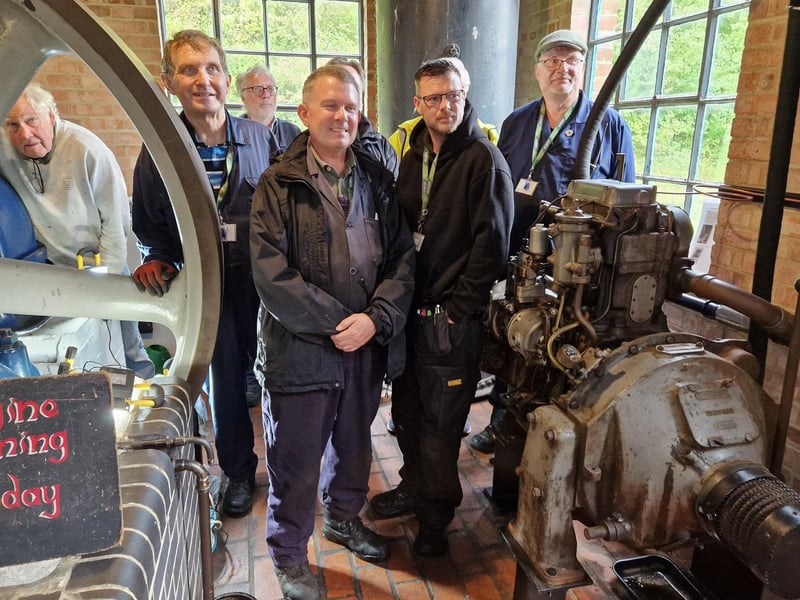
Members of the stationary engines group demonstrated the Gardner engine that powered the bridge's opening mechanism to the Friends of Amberley Museum and other guests at the official launch in the Littlehampton Municipal Engine House on Wednesday, September 10.
Katrina Burton, museum director, said: "This really does sum up what Amberley Museum is all about. What we've got here is an engine that was originally used on the Littlehampton Swing Bridge. It's a local story, it's something that people remember operating and we have a team of volunteers here at the museum who have worked really hard to get it up and running again, so we can demonstrate to visitors actually what it was like.
"Amberley really is a place where we want to see history brought to life. We want to see things working and moving, so it's fantastic to see this come back to operation and to be able to tell that local connection, that local story much more clearly."
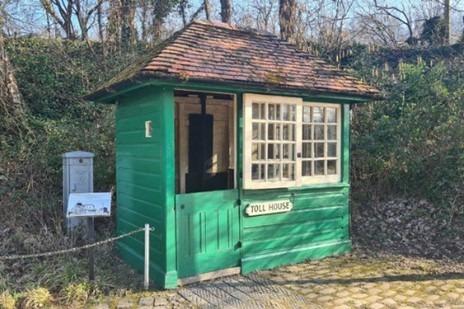
Guests at the launch were able to see, hear and smell the newly-restored engine up and running, as well as being able to see inside the swing bridge toll house, which is close by at the museum.
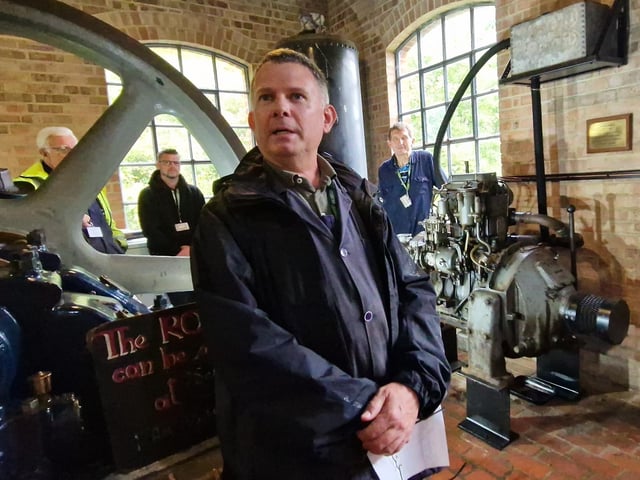
Nigel Stanley, who led the restoration project, said: "It's a wonderful piece of local history. Beauty is in the eyes of the beholder and I think this is a beautiful artefact, a piece of engineering history, British engineering history, with a huge local connection.
"It's been lying idle, and should I say unloved, for a while. And then a couple of years ago, a group of us got together and said, we need to give this a bit more love.
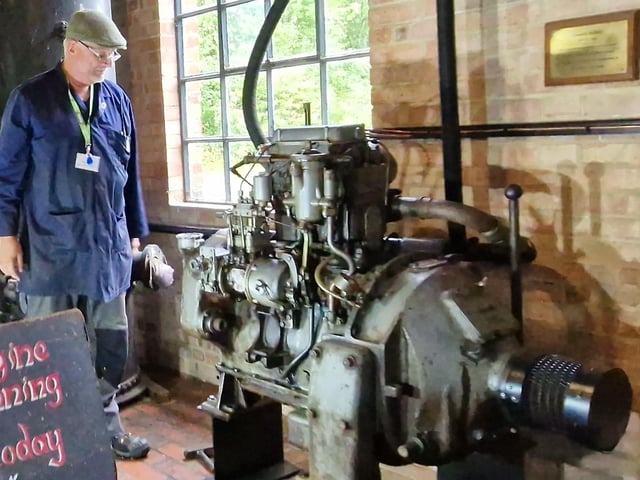
"This is a 1950s two-cylinder diesel engine, so it doesn't have spark plugs, like a petrol engine, it's a compression ignition engine. The engine itself was actually located right at the very top of the bridge.
"If you look at photographs of the Littlehampton bridge, you'll see a hut at the very top. This is where the engine was located, which we find quite perplexing, because we thought surely it would be down at the bottom. Actually, it was right at the very top, which is kind of an interesting thing.
"The two-year project was complicated because the engine hadn't been used for a number of years, so some of the elements of it, what we call the fuel rack, how we deliver the diesel fuel into the engine, had seized up and we had to do a lot of work to free that up.
"Luckily, the engine still turned over, which means you could rotate it by hand, which for us is a great indicator that all hope is not lost and it's something that we could actually make run. It needed a lot of patient skills and a talent from this just amazing team of stationary engine volunteers, who are just wonderful people to work with, really friendly, and I think really demonstrate the ethos of Amberley Museum.
"Now, we have this wonderful asset up and running. Because it's a compression ignition engine, it takes quite a bit of humph to get it going. There's a special drive mechanism that makes that a little bit easier but you have to start it on what we call low compression. Basically, there is a lever that reduces the amount of humph you need to do to get the engine going. It will make a bit of a racket but that's part of the fun and the excitement - the smell, the sounds and everything is exactly what we do here."
For centuries, the only crossing of the River Arun at Littlehampton was either by rowing boat or a perilous journey across a bar at low tide. Then a chain ferry went into service in June 1825 and this continued as the main river crossing for more than 80 years.
After long and often heated public debate, Royal Assent for the construction of a bridge was given in 1905 and the swing bridge was officially opened on May 27, 1908. Tolls were collected from a temporary hut at first but the toll house that now sits at Amberley Museum is known to have been in use by 1909.
The last tolls were collected in 1953, when the bridge was taken over by West Sussex County Council. A new fixed road bridge was completed in 1973 and the swing bridge was demolished in 1980.
For Amberley retail supervisor Bev Wallace, seeing inside the toll house brought back memories of childhood. Her father was the Littlehampton town planner and she recalled him sitting her on the stool in the toll house when she was about seven.
The toll house and the Gardner engine were moved to the museum in the early 1980s, after the bridge was demolished.
The building that houses the engine, now known as the Littlehampton Municipal Engine House, came from the Harwood Road council depot, along with the 1929 Robey oil engine that was kept there to provide the power to pump sewage up for discharge into the sea.
John Betts, museum curator, said: "The windows, the doors and the roof timbers are original. The bricks are replicas."
There was much excitement as the engine was started. Visitors will be able to delve deeper into the history at a Discovery Day on October 30, 2pm to 3.30pm. Tickets are an additional £5 on top of admission charges, with a maximum of 20 places.
1. Amberley Museum engine launch
The stationary engines group with the restored Gardner engine Photo: Elaine Hammond
2. Amberley Museum engine launch
Nigel Stanley, who led the restoration project, telling guests about the engine Photo: Elaine Hammond
3. Amberley Museum engine launch
Preparing to start the 1950s two-cylinder diesel engine Photo: Elaine Hammond
4. Amberley Museum engine launch
Littlehampton Swing Bridge toll house is also at Amberley Museum Photo: Amberley Museum