
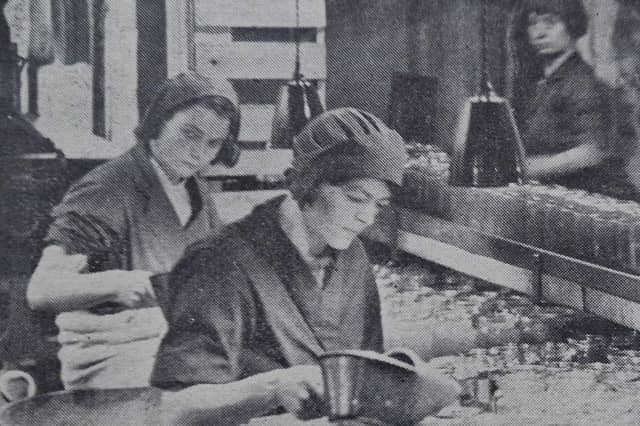


Factory workers in Shoreham must have been glad of the release from the less pleasant odours surrounding the nearby chemical plants.
A young mum's success with her jam making led to a family business that grew and grew, with at least three generations involved.
The fruit nurseries and factory of Messrs L. Cook & Co. Ltd were well known in Shoreham for decades. Louisa Cook founded the business by making jam at the back of her fruit shop in Queen's Road, Brighton.
Her sons then started a fruit garden and things prospered fast. Louisa lived to see the extensive works open in Shoreham and by the late 1930s, her grandson, Mr L.M. Cook, was manager.
When the Worthing Herald visited for a Behind the Scenes feature in March 1938, it evoked the sights and smells of the operation for readers.
Imagine the exotic scent of the half-chests as they arrived from Seville, oranges with their dark green leaves still attached piled up to the brim.
In the boiling room, the scent swirled in heavy, steamy clouds and finally, the sweet liquid was poured into jars.
Strawberries, raspberries, blackcurrants, apricots and many other kinds of fruit were turned into jam but in marmalade season, it was all about the oranges, converting half a million of the Spanish fruits into the English breakfast favourite.
The process of marmalade making was said to be ‘quite simple’. Half a million oranges a year were hand peeled at the factory. It was slower and more expensive than machine peeling but it ensured the essential oil, where the marmalade gets its piquant tang, was almost entirely preserved.
The orange peel was cooked in huge pans while the flesh was cooked in big wooden vats. In order to preserve the essential oil of the peel, the peel was cooked in large pieces and shredded later.
After cooking, the oranges were fed into an ingenious machine, which removed the pips, and then the peel and flesh were boiled together with liquid sugar.
An essential part of the process was cooking, sweetening and wedding the flesh of the oranges to their own peel to form the base of the marmalade.
Once the golden liquid had cooled, it was bottled. Everything in the bottling room was on the move, with bottles careering here and there until they were filled and capped. Up they went in a lift to the store room, into boxes and then for an apparently perilous run on a gravity conveyor.
With fingers moving like lightning, girls busily covered the jars, tying the covers on with string and neatly trimming them at the rate of four a minute.
Reporter G. Clarke wrote: “Those fragrant oranges, gathered from groves in Spain, seem to exhale as they are unpacked from the chests a breath of that sunny country. It is a most un-English scent, yet an hour or two later the oranges will become an essential and characteristic part of the Englishman's breakfast table. As the roll is to the Frenchman, so is marmalade to the Englishman."
While L. Cook and Co Ltd manufactured jams and chutneys from its small factory in Dolphin Road, much of the fruit used was grown on land on the south side of Middle Road. Production ceased in the early 1950s and the land was taken over by Middle Road Secondary School.
9. Cook and Co
Fingers fly to slip on a cover and whip a couple of turns of twine around to hold it in place before the label is added to finish the marmalade Photo: Worthing Herald