

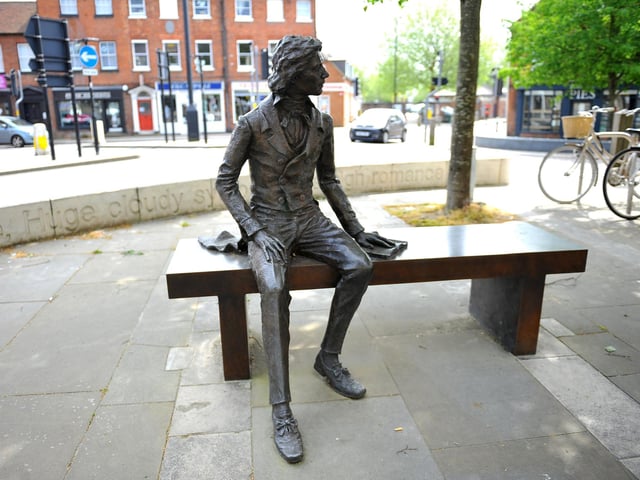
Chichester sculptor Vincent Gray, who has a number of works in the city, explained the distinction between statues and sculpture at the unveiling of his John Keats seat in Eastgate Square.
Statues are lofty, remote, untouchable figures on plinths. Sculptures are works which demand and encourage interaction.
The fact you can take a seat with the poet and interact with him makes Vincent's piece a sculpture, placed just over the road from the house where Keats started writing his celebrated work The Eve of St Agnes, one of the nation’s finest poems.
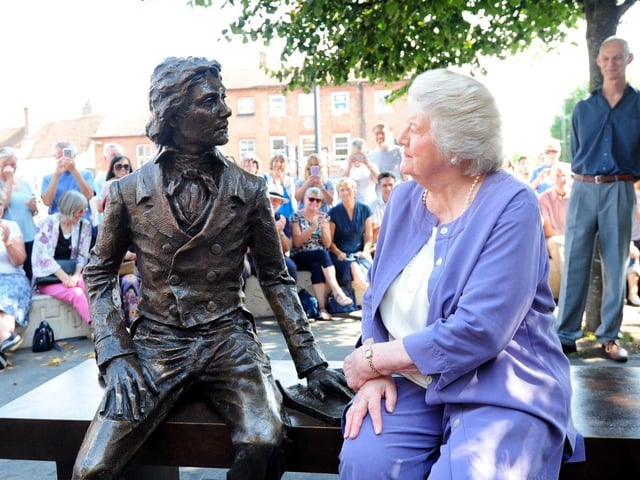
The seat was unveiled in August 2017 by actress Dame Patricia Routledge. Vincent said he wanted people to sit next to Keats, sense his presence and follow his eyes as he looked down East Street towards Chichester Cathedral and other Chichester landmarks mentioned in The Eve of St Agnes.
The story behind the poem is one of depression and bereavement. Keats came to Eastgate Square in 1819 just weeks after his younger brother had died. His poetry had not sold well and he was very depressed, so it was arranged that Keats would stay with his good friend Charles Dilke's parents, Mr and Mrs Charles Wentworth Dilke, in Chichester.
Although he was there for only a couple of days, the friendly welcome lifted his spirits. He then took a holiday with his friend Charles Brown in Bedhampton and finished the poem he had begun in Chichester, inspired by the historic architecture in the city.
At the unveiling, Vincent said: "Cynics might say ‘Why Keats in Chichester? He was only here for a brief period’. But it was here he started writing the poem and in it he referred to various architectural landmarks in Chichester – which he is looking towards as he sits on his bench.”
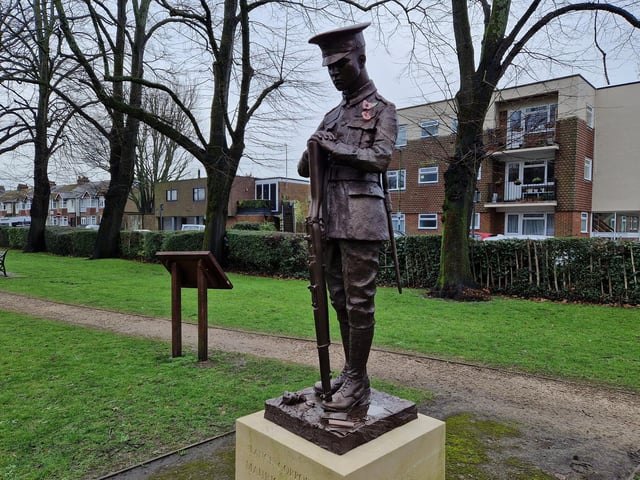
Other statues by Vincent include a soldier in Litten Gardens, Lance Corporal Maurice Patten of the Royal Sussex Regiment, which was unveiled on Remembrance Sunday in November 2019.
A brief account of Maurice’s life was read by his great nephew, Simon Ulrich. A resident of Eartham, Maurice Patten died in January 1916 at the age of 24, as a result of injuries he sustained during the First World War.
Vincent had begun working on his life-sized sculpture of a soldier while taking part in Art in Action during the Priory Park 100 celebrations in 2018 and later gifted it to the city.
Chichester City Council put him in touch with Simon, as he is an expert in military attire and could offer advice about the correct stance, uniform and equipment for the sculpture.
At that point, it was a statue of a Tommy, the name for a common soldier in the British Army dating back to 1815, but as 'payment', Simon asked Vincent to specifically honour his uncle. Maurice was shown to be standing in the traditional mourning stance, with his weapon held upside down.
Murray or None, adjacent to the Assembly Rooms, in North Street, is another of Vincent's works. Richard Plowman, mayor of Chichester in 2013, asked him to produce a life-size sculpture of Horatio Nelson and George Murray for the city.
Murray was born and lived in Chichester. A high-ranking naval officer, he served alongside Nelson in various campaigns, including the Battle of Copenhagen. He was captain of the fleet during the blockade of Toulon, between 1803 and 1805, and the subsequent chase of French Admiral Pierre Villeneuve and his fleet to the West Indies and back.
When the fleet returned to England in August 1805, Murray learned that his father-in-law had died. As executor of his estates, he had to remain to handle the affairs while Nelson set sail for Cadiz. Nelson rated Murray so highly, he coined the phrase 'Murray or None', meaning there was therefore no captain of the fleet at the Battle of Trafalgar.
The Murray or None sculpture was unveiled by Sir George Zambellas in 2020 and the site chosen was a stone's throw from Murray's house, the former Ship Hotel.
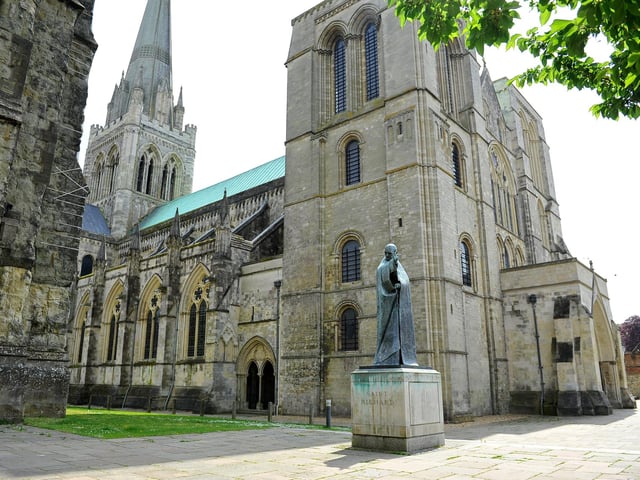
The statue of Saint Richard outside Chichester Cathedral was commissioned for the Millennium by Midhurst-based Philip Jackson, a Scottish figurative sculptor responsible for major works like the Queen Mother Memorial Sculpture in The Mall, the Bomber Command Memorial in Green Park and Mahatma Gandhi in Parliament Square.
He was chosen for his ability to convey the human condition through skilful use of body language. The Saint Richard statue is lit up at night, so that it casts a very long shadow.
Chichester Cathedral says: "In this imposing bronze sculpture, Jackson uses meticulous posturing to create a powerful sense of drama. The sculpture has been made one-and-a-half times life size, making the Saint 'larger than life'."
Richard de la Wyche was Bishop of Chichester in the 13th century and nine years after his death, he was canonized as Saint Richard of Chichester.
Medieval pilgrims came to the cathedral in great numbers to pray at the Shrine of St Richard. Some would play the game of Nine Men’s Morris while they queued and you can still see where one of the pilgrims carved a gameboard into one of the cloister stones.
Today, the pilgrimage from the west door to the historic shrine is an opportunity to discover more about the history of the many chapels, objects and art along the way.
St Richard's relics lie behind the High Altar and the shrine of is considered by some to be the third most important in the land, after the shrines of St Thomas à Becket at Canterbury and Our Lady at Walsingham.
Another Philip Jackson work, Christ in Judgement, can be found in the Retrochoir, above the entrance to the Lady Chapel. This bronze statue replaced a badly-damaged Victorian plaster of Christ in Majesty in 1998 and is the only sculpture at the Triforium level which does not date back to the 13th century.
Describing his art, Philip says: "My sculptures are essentially an impressionistic rendering of the figure. Where you see the figure seemingly grow out of the ground, the texture resembles tree bark, rock or lava flow. As the eye moves up the sculpture, the finish becomes gentler and more delicately worked, culminating in the hands and the mask, both of which are precisely observed and modelled.”
Philip also created the Minerva sculpture for Chichester Festival Theatre. This bronze was commissioned to commemorate the founder Leslie Evershed Martin and unveiled in 1997 by Carol Evershed Martin.
Nearby, in Oaklands Park, you can see the bronze statue Spartacus by sculptor Tom Merrifield. This was inspired by a Bolshoi Ballet performance of Spartacus by Aram Khachaturian and given to Chichester Festival Theatre on permanent loan in 1988.
For something much older, head to Priory Park to see the historic Coade stone figure The Druid. This statue has been in Priory Park since 1873 but had previously had a number of different homes across the city.
It dates back to 1776, when it was cast in Lambeth before being placed on a plinth above a public water supply in South Street, Chichester. At some point, it was sold to William Guy, a surgeon, and for nearly 50 years, it was kept in the family vault at Chichester Cathedral.
Having finally found a home at Priory Park, it suffered from weathering and vandalism over the years, and the right arm became a shattered stump. After the Chichester Observer and others campaigned for The Druid's preservation, the statue was removed in 2019 to be repaired and restored, meaning the lost staff has now been replaced by an oak stave.
Also in Priory Park is an attractive Welsh stone feature, in the centre of the sensory garden created by Chichester’s three Rotary Clubs to mark the Rotary centenary in 2005.
The aim was to offer a place of peace and tranquillity for the people of Chichester. Cherry Burton from Manor Nursery in Runcton designed a circular seating area and chose aromatic flowers and foliage with interesting leaf textures and shapes.
1. Statues and sculptures of Chichester
The statue of Saint Richard outside Chichester Cathedral was commissioned for the Millennium by Midhurst-based Philip Jackson Photo: Steve Robards
2. Statues and sculptures of Chichester
The John Keats seat in Eastgate Square Photo: Steve Robards
3. Statues and sculptures of Chichester
Dame Patricia Routledge enjoying the John Keats seat, watched by the sculptor Vincent Gray Photo: Kate Shemilt
4. Statues and sculptures of Chichester
Lance Corporal Maurice Patten of the Royal Sussex Regiment in Litten Gardens Photo: Elaine Hammond