
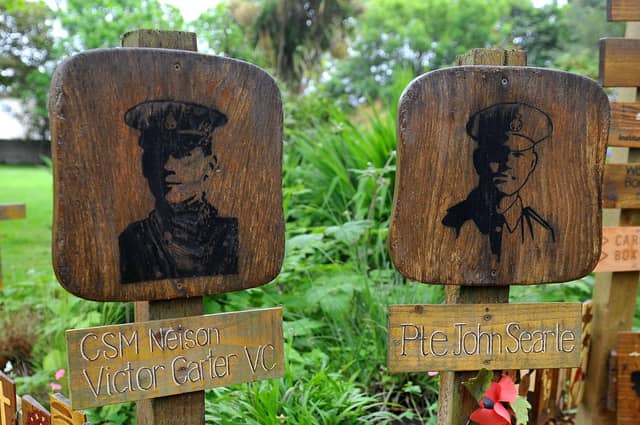


The Battle of the Boar's Head on June 30, 1916, became known as The Day Sussex Died. The Royal Sussex Regiment was in the thick of it and although the battle lasted less than five hours, 366 Sussex men lost their lives and more than 1,000 were wounded or missing.
An extract from the War Diary of the 13th Battalion, printed on an information board at Worthing's memorial site in Beach House Park, gives a detailed account of the attack.
“The battalion assembled at 1.30am on the morning of the 30th June in readiness for the assault, with all four platoons of each coy in the front line. The preliminary bombardment on the morning of the attack opened at 2.50am and at 3.05 the leading wave of the battalion scaled the parapet, the remainder following at 50 yards interval.
“At the same time the flank attack under Lts Whitley and Ellis gained a footing in the enemy trench. The passage across NO MAN'S LAND was accomplished with few casualties except in the left companies, which came under very heavy machine gun fire. The two right companies succeeded in reaching their objective, but the two left companies only succeeded in penetrating the enemy's wire in one or two places.
“Just at this moment, a smoke cloud, which was originally designed to mask our advance, drifted right across the front and made it impossible to see more than a few yards ahead. This resulted in all direction being lost and the attack devolving into small bodies of men not knowing which way to go.
“Some groups succeeded in entering the support line, engaging the enemy with bombs and bayonet, and organising the initial stages of a defence. Other parties swung off to the right and entered the trench where the flank party was operating, causing a great deal of congestion.
“On the left, the smoke and darkness made the job of penetrating the enemy wire so difficult that few, if any, succeeded in reaching the enemy support line, where they were subjected to an intense bombardment of HE. and whizz-bangs.
“Capt. Hughes, who was wounded, seeing that his company was in danger of being cut off, gave the order for the evacuation of the enemy trenches, and the remainder of the attacking force returned to our trenches.
“The enemy, who was evidently thoroughly prepared, now concentrated his energies on the front line and, for the space of about 2½ hours, our front and support lines were subjected to an intense bombardment with heavy and light shells, causing a large number of casualties... The enemy casualties are also considered to have been considerable, large numbers of dead being seen in the enemy trenches.”
During the attack, the majority of officers were killed or wounded, leaving platoons, if not whole companies, to be led by NCOs. The South Downs Brigade lost 17 officers and 349 men. The 13th Battalion was all but wiped out and as a result of the losses, June 30 became known as The Day Sussex Died.
To mark the 110th anniversary of The Battle of the Boar's Head, the Commonwealth War Graves Commission has been working with three schools in Worthing to tell the stories of the soldiers and help children discover the history of their town for themselves.
A new history podcast featuring pupils from Bramber and Homefield primary schools was launched on Monday, June 29, and later that morning, the children involved shared their research work in an exhibition at Worthing Town Hall, alongside artwork by pupils from Springfield Infant School.
The children learned recruitment campaigns at the start of the First World War had encouraged men to enlist with people they knew, friends, relatives, workmates and neighbours. The idea for the Pals Battalions was simple and proved an effective way to raise Britain's volunteer army.
The Pals trained together, lived together in camp and formed strong bonds. Sadly, as the children found, this tactic also meant that when a battalion suffered heavy losses, entire streets, workplaces and families were left to grieve.
The children discovered Conservative politician Claude Lowther, who lived at Herstmonceux Castle, was given permission by Lord Kitchener to recruit three new battalions for the Royal Sussex Regiment.
The men answering the call came from Worthing, Littlehampton, Eastbourne, Bexhill and Hastings, as well as other towns across Sussex. They were known as Lowther's Lambs, forming the 11th, 12th and 13th (South Downs) Battalions, and Peter the Sheep became their beloved regimental mascot.
The recruits were all trained at Cooden Camp in Bexhill before sailing to France in March 1916. Their first major battle was at the Battle of the Boar's Head on June 30, 1916. For many, it would also be their last.
The children found out Peter had been with the men at Cooden Camp, a comforting reminder of the Sussex countryside and the homes they had left behind. “He marked in parades, posed for photographs and brought smiles during a time of uncertainty.”
Before dawn on June 30, 1916, the South Downs Battalions began their preparations to attack the German trenches near the village of Richebourg in northern France.
Their objective was to capture the German line known as Boar's Head, a key position on the enemy's defence. The attack was part of a plan to distract the German forces from the much larger Battle of the Somme, due to begin the following day.
As the men advanced across open ground, they were met with ferocious machine-gun fire and bombardment. Within just a few hours, hundreds were killed, wounded or taken prisoner.
News of the terrible losses spread quickly across Sussex. Almost every town and village knew someone who had fallen. The scale of the tragedy was so great, the battle became known as The Day Sussex Died.
The children looked into the lives of some of the men who died to get a better idea of their lives and what Worthing was like at the time.
George Azzopardi was born in London in 1896 but he grew up in Worthing. His father, who was Turkish, died when George was five, leaving his Australian mother to raise the family alone. When he left Sussex Road School in Worthing, George became a golf caddy. He was aged 20 when he died.
Reuben Bashford was born in 1884 and baptised at Christ Church. He worked in a sweet factory before becoming a fisherman, like his father. He helped to support his family after his father died in 1909, when Reuben was 23. He was killed in action at the age of 32.
Leonard Blaker was born in Worthing in 1887 and baptised at Broadwater Church. He was one of three children. Leonard worked in the printing trade after leaving the National School and was 29 when he died, serving with the 13th Battalion.
His younger brother, Frank Blaker, enlisted with the 12th Battalion. Frank was born in 1889 and also baptised at Broadwater Church. He worked as a painter and plumber for a local firm of builders.
Edwin Blight grew up in Worthing and worked as a gardener. He joined the army with his brother and they trained together but his brother fell ill and he was sent home before the Battle of the Boar's Head, effectively saving his life. Edwin died during the battle and is buried in France.
Frederick Cawte was born in Worthing in 1896 and attended Elm Grove School. He worked as a bricklayer's labourer before joining the Royal Sussex Regiment.
Samuel Charman was born at Ransoms Farm in Salvington. He worked as a gardener and married Winifred Edney in 1915 at the age of 24. They couple had no children.
Ernest Collins, known as George, grew up in a large family in Worthing and worked as an ironmonger's assistant before the war. He was also a member of the Salvation Army Band. During the battle, he tried to help another soldier nearby who was wounded but he was struck by shellfire and died aged 20.
Hugh Etherton, 29, had not long become a father to a baby girl when he died. His father and brother were also serving in the armed forces but they survived the war.
Edward Farnden was the eldest of five children. He moved to Worthing when he was 19 and worked as a chemist's assistant. He married Edith, a teacher at Christ Church School, in 1914. He enlisted in Wimbledon and was 34 when he died. His body was recovered by German soldiers and later buried in Cabaret-Rouge British Cemetery in France.
Harold Fletcher was only 18 when he died. He had joined the army at the age of 16 as he wanted to serve his country.
Hubert Garbett was the son of a retired merchant naval officer and grew up in a comfortable home with multiple servants. He and his twin brother Christopher were the youngest sons, born in May 1888. Hubert worked as a nurseryman and was 28 when he died.
Albert Grenyer was a market gardener who joined the army with his brother. He died aged 24.
Reginald Manwaring lived in Broadwater and attended St Andrew's School. His father died when he was only three years old. He joined the Royal Sussex Regiment in 1914.
Charles Pannell, 39, was the eldest of four brothers to join the regiment. He worked as an agricultural labourer, like his father. He and his wife Kate had three daughters.
Sadly, three of the brothers died in the battle and all are remembered on the Loos Memorial, as their bodies were never found. William Pannell, 33, left behind his wife Rose and five children, while agricultural labourer Alfred Pannell, 29, the youngest of the brothers, left behind his wife Lucy and their children.
John Searle was only 16 and one of the youngest soldiers to die, having joined the army at the age of 14. He lied about his age when he signed up. His mother even wrote to newspapers in a desperate attempt to find out what had happened to him.
The other Worthing soldiers killed in the battle were Frederick Perkins, George Saville, Leonard Slaughter, Albert Street and Richard Webb.
The children discovered that with the fierce and relentless fighting, not every soldier who died was found or identified. Widows knew only that their loved ones were 'missing, presumed dead'.
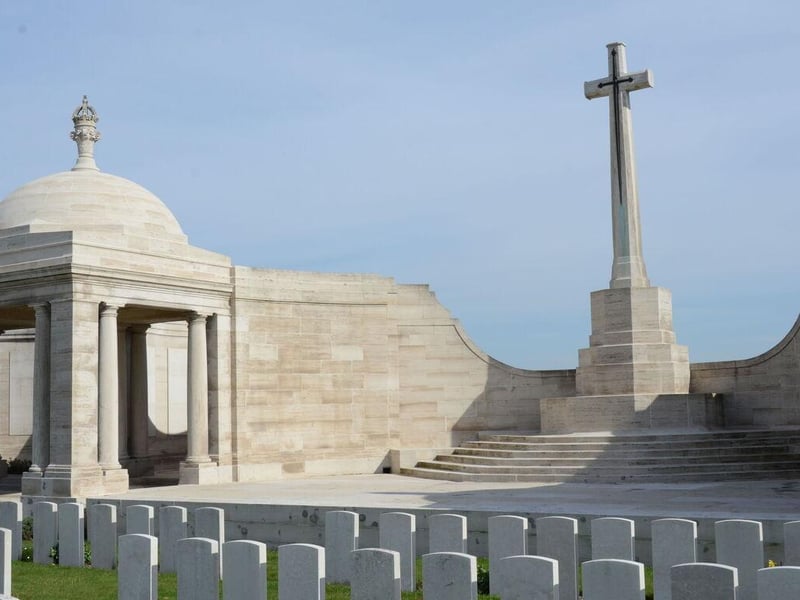
The Commonwealth Graves Commission unveiled the Loos Memorial, designed by Sir Herbert Baker, in 1930 to honour the missing men with no known grave.
9. The Day Sussex Died
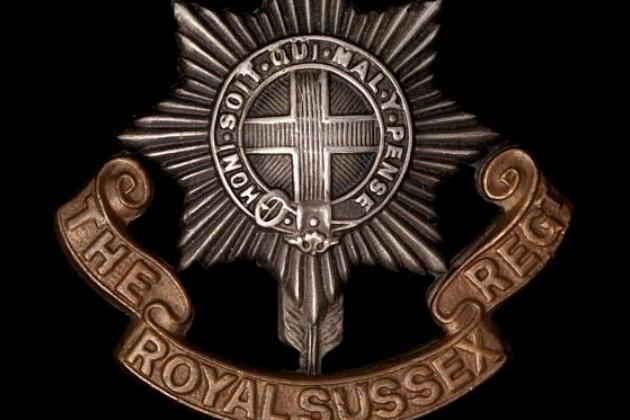
A Royal Sussex Regiment cap badge Photo: Worthing Borough Council
10. The Day Sussex Died
The Commonwealth Graves Commission unveiled the Loos Memorial in 1930 to honour the missing men with no known grave Photo: CWGC