
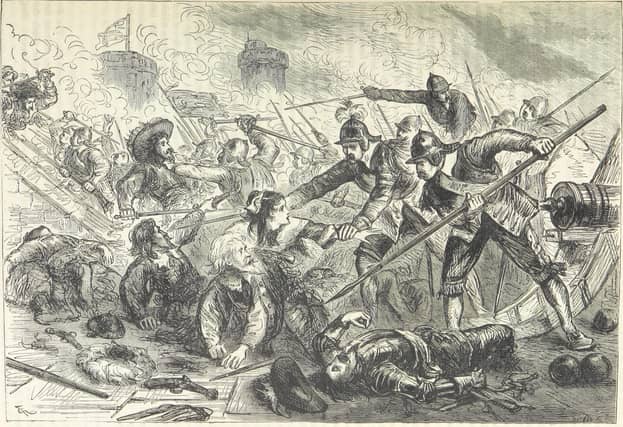


Local historian Chris Hare has all the facts and he will be giving an illustrated talk on the Siege of Chichester at Chichester Arts Centre on Wednesday, June 25, at 7pm, as part of the Festival of Chichester.
"People are a bit dumbfounded when I tell them I am giving a talk about the Civil War in the South Downs, as they have never heard of such a thing," Chris said.
"When I explain that this conflict was part of the wider one between King Charles I and parliament in the 1640s, they understand a bit more but then often express surprise that anything significant ever took place in Hampshire or Sussex.
"Yet, the truth is that many major engagements took place in our region. Chichester was besieged, as was Arundel, and the Battle of Cheriton in 1645 was a significant turning point in the war, giving a big advantage to the parliamentary cause."
Chris tells us the siege of Chichester in December 1642 was a consequence of royalist gentlemen in the city, conspiring with the High Sheriff of the county, Sir Edward Ford, to capture the city in the king’s interest.
To do this they had seized the armoury from the control of Henry Chitty, who was then Captain of the Trained Bands of Chichester. The trained bands were rather like the home guard of their day, except they were made up of local men of fighting age, not their elders.
Having seized the city, royalists, led by Sir William Morley of West Dean, who also owned a residence in the city, opened the city gates in the dead of night, allowing Sir Edward Ford and the county militia to occupy the city.
It was a daring escapade that seemed to have been carried out with success. However, the Chichester royalists had achieved a pyrrhic victory – they were isolated from other royalist enclaves and Portsmouth, home to the Royal Navy, had just declared for parliament.
It was not long before a large parliamentary army, led by General Sir William Waller, was besieging the city. Cannon were mounted on rising ground north of Chichester, and fired over the walls and into the city, causing consternation and panic.
The surrender of the city was inevitable, and Waller’s triumphant entry into Chichester was met with delight and enthusiasm among those with parliamentary and puritan sympathies.
However, sympathy of all but the most zealous of believers must have been tested when troops under the command of Sir Arthur Haselrig MP ran amok in the cathedral and the cathedral close; plundering and despoiling as they went.
Hardly a silver candle stick or gold plate remained after Sir Arthur’s rampage. The old clergy, who had served in happier times, could only look on in misery and bewilderment – how had it come to this?
A year later, another royalist rising, this time centred on Arundel, ended in failure for the King’s men. They had been cut off from supplies and all hope of reinforcements.
What had begun as a bold and daring incursion into Sussex – a county held by parliament – ended dismally. The royalist troops, consisting mainly of men from Ireland and Cornwall, had no stomach for a fight so far from their homes and the things they knew, while the puritan militia men of the east county were full of religious zeal and native pride.
At the start of the conflict most of those who sided with Parliament in Sussex, did so, not because they were republicans, or puritans, or indeed (in their hearts), rebels at all.
Sir Thomas Pelham at Lewes hoped Parliament’s stand would encourage King Charles to change his ways and that it was 'a demonstration against the King which would persuade him to govern with greater respect for the desires of men of property'.
However, Pelham’s young protégé, 27-year-old Colonel Herbert Morley, who captained the Lewes-trained bands, was far more dedicated to the puritan cause, and, as time went on, he became a convinced republican.
As the winter of 1643/ 44 approached, Morley was aware that the royalist, General Sir Ralph Hopton, was active in Hampshire, and while many of his brother officers believed only a fool would march an army across the deep mud of Sussex in winter, Morley was alert to the danger.
He wrote: “This approaching cloud [Hopton] may raise a storm in Sussex, which county is full of neuters [neutrals] and malignants; and I have ever observed neuters to turn malignants upon such occasions.”
Morley was right to apprehend the ‘approaching storm,’ for Hopton took advantage of a deep and prolonged frost, and marched his men across the frozen ground, surprising and overwhelming small parliamentary garrisons as he went.
He quickly fell upon Arundel, seizing the town and the castle. He then pushed on towards the east. His goal was to capture Lewes and thereby decapitate the pro–parliament cause in the county.
However, on 12th December, his great army – some say 4,000 men – was halted at Bramber Bridge by a detachment of no more than a few hundred militia men, whose resistance was so fierce, that, in the gathering dark of a mid–winter afternoon, Hopton was forced to retreat for the night.
That force of militia men was led by 23-year-old James Temple, who was visited later that night be a Puritan preacher, Dr Francis Cheynell, who could not praise the young man too highly.
“Upon the 12th of December I visited a brave soldier of my acquaintance, Captain James Temple, who did that day defend the fort of Bramber against a bold and daring enemy to the wonder of all the country; and I did not marvel at it, for he is a man that hath his head full of stratagems, his heart full of piety and valour, and his hand as full of success as it is of dexterity.”
Temple had indeed saved the day. Throughout the night reinforcements poured into Bramber from the east of the county. The Mayor of Rye led a detachment of men, marching without sleep, in order that they should join their comrades at Bramber. Overseeing all and giving constant encouragement and morale–raising speeches, was Colonel Herbert Morley.
Thereafter, all turned to dust for Hopton – his nemesis, General Sir William Waller, was urgently dispatched to Sussex to counter the Royalist incursion. But Parliament need not have worried – Morley was already pushing Hopton back towards the west.
Soon Morley’s militia men were on the outskirts of Arundel. Hopton also had to contend with a mutiny in his own ranks, when the Cornishmen among his troops began fighting the Irish contingent.
By the time Waller reached Arundel, Hopton had retreated to Petersfield and the town was back in Parliamentary hands. The siege of the castle dragged on into January 1644, until the Royalist garrison was starved into submission.
Rather incongruously, General Waller, invited the wives of Sir Edward Ford and Sir Edward Bishop, who were besieged with their husbands in the castle, to join him for dinner during the siege.
No doubt this ‘gallant’ gesture was also undertaken to impress upon the ladies the futility of continuing the siege – not to mention the abundance of food available in the General’s camp.
The garrison finally capitulated on January 5. One witness to the surrender described the condition of the Royalist troops as they surrendered: “I never saw so many weak and feeble creatures in my life, for almost all the common soldiers were half starved, and many of them hardly able to set one foot before another.”
Booking for the talk Siege and Plunder: the Civil War comes to Chichester in 1642 and all Chris’ other talks and guided walks can be found at www.tickettailor.com/events/historypeople
5. Siege and Plunder: the Civil War comes to Chichester in 1642
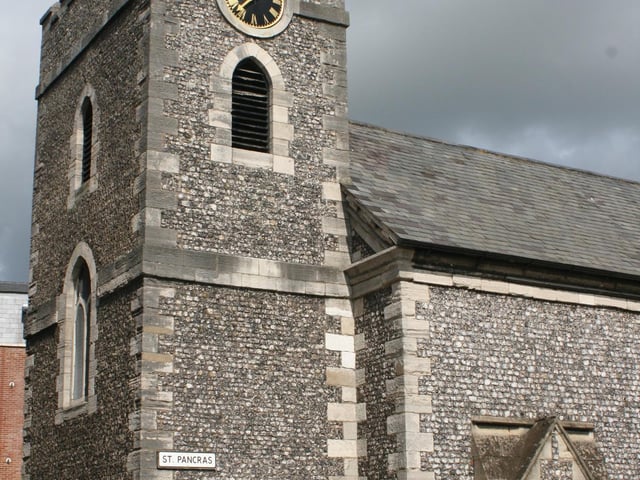
The Church of St Pancras in Chichester was destroyed by artillery fire during the siege of the city in 1642 Photo: Chris Hare