

Details of the crash were kept secret for decades, as it happened at the height of the Cold War, but over the past few years, the Southwick Society has been able to reveal what happened.
An information board was placed on Southwick Recreation Ground in 2023 and Mary Candy, chair, has again paid tribute to the three men who were killed, to mark the anniversary of the crash.
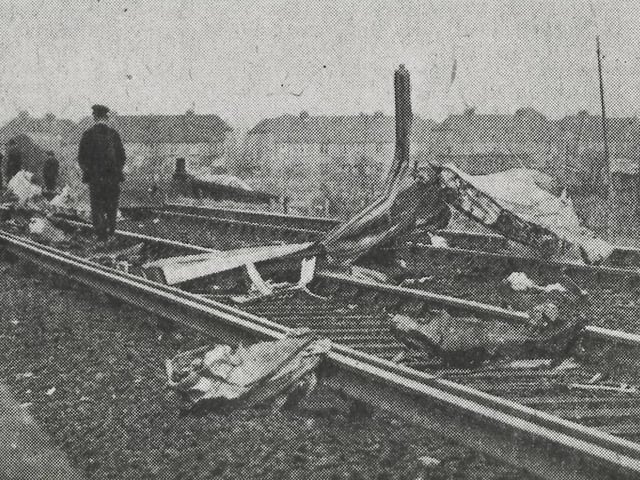
She said: “At lunchtime on May 11, 1956, Southwick suffered a tragedy when an RAF Valiant bomber crashed on the railway line just south of Croft Avenue, killing three of the crew.
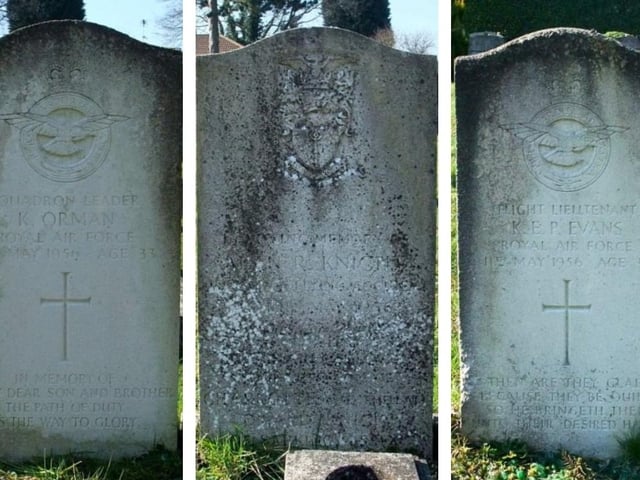
“The aircraft had been on a test flight from Farnborough Airfield. On board were the pilot, Squadron Leader Kenneth Orman, the co-pilot, Flight Lieutenant Colin Preece, the navigator, Flight Lieutenant Kenneth Evans and a Ministry of Supply technician, Mr Alan Knight.
“Once the aircraft had taken off, it was realised that the test equipment was not working. The plane couldn’t land again with a full fuel load and so the pilot decided to fly backwards and forwards along the coast, where the weather was clearer, to burn up fuel.
“As he was approaching Shoreham from the west, the electrics on the plane failed completely and it became uncontrollable. The plane was flying too fast and too low for the pilots to be able to control it using the manual controls, as they had lost their essential power-assistance, and it crashed on to the railway line.
“Houses in Croft Avenue were seriously damaged and the wreckage was flung all over the nearby recreation ground. The co-pilot, Flight Lieutenant Preece, managed to eject at very low level, hitting the roof of the railway station before landing in some allotments.
“The navigator, Flight Lieutenant Evans, and technician Mr Knight did not have parachutes and died, along with the pilot, Squadron Leader Orman.
“Miraculously, no one on the ground was seriously injured, despite the accident happening at lunchtime, when children were going home from school for their lunches.
“If the aircraft had crashed a little to the north, it could have obliterated Manor Hall Road Junior Boys School and adjacent houses. A little to the east or west, it would have crashed on to houses.
“Just to the south, there were more houses and the busy harbour, where the new Brighton B power station and major port installations were under construction. Many more people could have been killed or injured.”
The society has also published two books about the crash, Southwick’s Miraculous Escape by Mary Candy and Those Valiant Men by John Young.
The books and more information are available at the Manor Cottage Heritage Centre in Southwick or by emailing [email protected]. Visit the Southwick Society’s online shop at Southwicksociety.org.
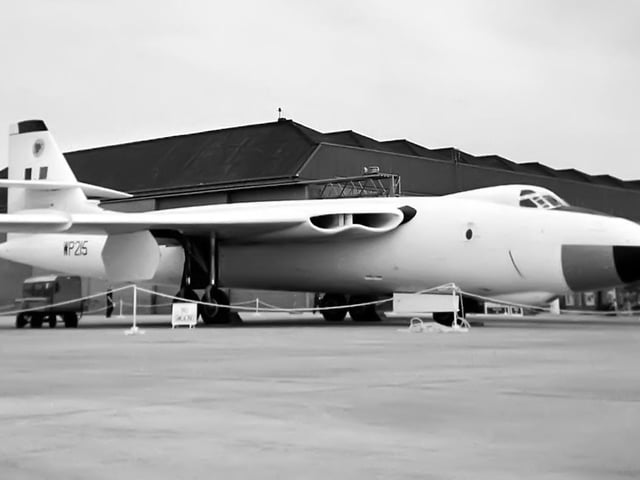
The plane was built to carry nuclear weapons and the details of the crash were shrouded in mystery due to Cold War security.
John spent years researching his book and used eye witness accounts to throw light on the details. He had been close to the crash site and his narrow escape at the age of ten haunted his life until retirement gave him the opportunity to investigate what happened.
The bomber landed on the railway, in the path of an oncoming train, narrowly missing his school, his home and other houses in Croft Avenue, and Whiterock Place.
The Cold War was at is height and the newly-developed Valiant was a vital part of the UK's nuclear deterrent, built to deliver atom bombs deep into the Soviet Union in the event of war.
The Southwick plane was on a test flight from Farnborough with experimental equipment on board. The burning wreckage was spread over a wide area, especially in Croft Avenue, where John was having his lunch.
In no time, the area was thronged with police, Civil Defence rescue personnel, local people helping their neighbours, RAF and government investigators and press reporters. Yet the secrecy afterwards meant many Southwick residents remained blissfully unaware for decades.
The interpretation boards on Southwick Recreation Ground honour the crew.
1. 70th anniversary
The RAF Valiant jet bomber crash landed on the railway in Southwick, in the path of an oncoming train, at the height of the Cold War Photo: Southwick Society
2. 70th anniversary
Vickers Valiant WP 215, the second prototype had its maiden flight on April 11, 1952 Photo: Southwick Society
3. 70th anniversary
The navigator, Flight Lieutenant Kenneth Evans Photo: Southwick Society
4. 70th anniversary
The graves of Squadron Leader Kenneth Orman, Ministry of Supply technician Alan Knight and Flight Lieutenant Kenneth Evans at Ship Lane Cemetery in Farnborough Photo: Southwick Society