

On Friday, October 17, I am giving an illustrated talk on the life of John Wilkes at the Coronation Hall, Slindon, just a couple of miles from a pub that still bears his name.
There was a time in English history when everyone in the country would have known the name John Wilkes – politician, English patriot, rabble-rouser and hell-raiser like no other. To some, he was the man who saved England from tyranny, to others, he was a rogue and a charlatan, who fanned the flames of civil unrest, bringing the country to the brink of revolution.
It was as the editor of the North Briton, a publication that mixed politics with lurid and obscene attacks on Britain’s ruling class during the mid-18th century, that first brought Wilkes to public attention. To those dissatisfied with the two-party system of the day – the Whigs and the Tories – Wilkes was the champion they had been looking for, and few places in the country seemed more keen to rally to his cause than the county of Sussex.
Wilkes was born in Clerkenwell in London on October 17, 1725. His family were moderately prosperous and able to pay for John to have an education in Holland, as well as in this country. Indeed he was still in the Netherlands in 1745 when the last and greatest of the Jacobite rebellions broke out, led by the hopeless yet romantic figure of Charles ‘Bonnie Prince Charlie’ Stewart.
Wilkes immediately rushed back to England to find London in turmoil and panic. The Jacobites had marched as far south as Derby and London appeared to be in imminent danger.
Wilkes would have breathed in the heady mixture of fear but also of heightened English patriotism. This was the time when both Rule Britannia and God Save the King where written and sung. The Jacobite rebellion ultimately failed but its legacy remained, especially on Wilkes, who decided to devote his political energies to the English cause. He saw the Tories as being too close to the Scots and the French, while the Whigs, who had been in power for decades, had become idle and corrupt.
It was the succession to the throne in 1760 of George III that galvanised Wilkes into action. The new king appointed the Scottish aristocrat and Tory, John Stuart, Earl of Bute, as his prime minister. Wilkes chose to call his newspaper, the North Briton, to draw readers’ attention to the fact, as he saw it, that England was now run from Scotland – from ‘North Britain’ – and that England was losing its identity and independence.
Wilkes fulminated against Bute’s administration, accusing it of making far too many concessions to the French to end the Seven Years’ War, and squandering all the gains made by English forces. He claimed to expose corruption in high places and had no qualms in detailing the sexual habits of some of the most powerful people in England, including royalty.
Amidst this gathering storm, an election was called, and Wilkes was returned to parliament as the member for Aylesbury. He was later elected for Middlesex. In those days there was not a uniform voting system across the country. Some towns limited the electorate to a few wealthy people, while others had a much broader franchise. Aylesbury and Middlesex were in the latter category, allowing Wilkes to exploit his popularity with the people and be retuned with big majorities.
In edition 45 of the North Briton, Wilkes surpassed all his previous attacks on the Earl of Bute, the royal family, and other aristocrats. One of those offended by Wilkes, the Earl of Talbot, challenged Wilkes to a dual, which he accepted. On this occasion, although both men fired their weapons, neither hit their target.
Wilkes was undaunted, claiming in the House of Commons that the Earl of Bute and not the king had written the King’s Speech at the opening of parliament, and that Bute’s decision to raise revenue for the exchequer by taxing cider, was an attack on the drink of Englishmen.
The King could bear Wilkes no longer and had general warrants issued for Wilkes and 48 of his supporters. Wilkes was thrown in the Tower of London. His supporters poured onto the streets. They chanted ‘Wilkes and Liberty!’ They scrawled the number ‘45’ (the edition of the North Briton that had caused such offence) on walls and on the carriages of the wealthy.
It seemed as if the mob and Wilkes had taken over London. The Earl of Bute was forced to resign and Wilkes freed.
We know that the North Briton was being read in Sussex, because the celebrated diarist and shopkeeper of East Hoathly, Thomas Turner, refers to Wilkes and his newspaper in an entry for July 13, 1763: “In the even read several political papers called the North Briton, which are wrote by John Wilkes, Esq., member for Alsbery [Aylesbury] in Bucks, for the writing of which he has been committed to the Tower…I really think they breath[e] forth such a spirit of liberty, that it is an extreme good paper.”
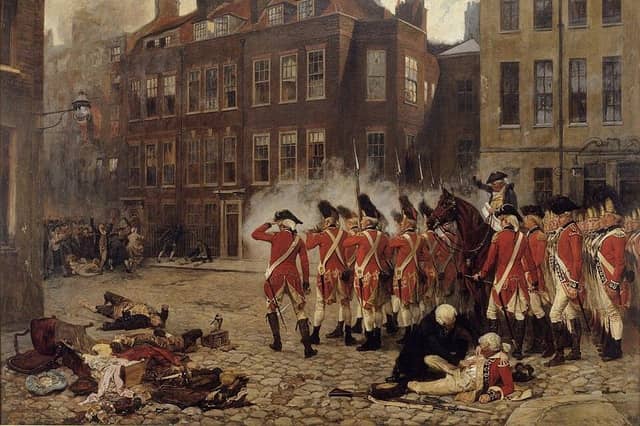
Later that same year, in November 1763, Wilkes was challenged to another dual, again he accepted; but this time his opponent shot him in the belly and he was lucky to survive. Learning that the king planned to have him arrested on a charge of seditious libel, Wilkes fled to France, where he remained for the next five years. At St. George’s Fields in London, troops fired on a Wilkes and Liberty demonstration, killing several people and wounding many more.
On his return in 1768, Wilkes was again elected and asserted that parliamentary privilege protected him from the charge of seditious libel, a claim that he successfully tested in the courts. Wilkes was now at the high point of his power and popularity. In the House of Commons he spoke in favour of parliamentary reform and in support of the American colonists who were growing restless under the burden of taxation imposed on them by George III’s government.
"I wish, Sir, an English parliament,” declaimed Wilkes, “to speak the free, unbiased sense of the body of English people.” By “English” he included the Colonists in America as well as the English in England.
Wilkes was elected an Alderman of the City of London and in 1774 he was chosen to be Lord Mayor.
Wilkes was a frequent visitor to Sussex, finding congenial company and relaxation at Brighton. In August 1770, the Sussex Weekly Advertiser (at that time the only newspaper in the county), reported on Wilkes and his beloved daughter, Polly, visiting Lewes.
As news of his approach reached Lewes, his supporters caused all the church bells in the town to be rung. Huge numbers of people came out to greet him.
The newspaper reported: “vast crowds of people assembled to see the great patriot, at whom they expressed their pleasure by joyful acclamation.” Wilkes and his daughter stayed the night at the Star Inn and the next day visited the castle, where “prodigious” throngs of people strained to get a glimpse of “the object of their adoration.”
Not everyone was enamoured with Wilkes. Apart from his obvious foes in government, there were other critics too. The great evangelist, John Wesley, denounced Wilkes as a ‘mercurial rake’.
Dr Samuel Johnson thought Wilkes an abusive chancer, and that his appeal to English patriotism was ‘the last refuge of a scoundrel’. A phrase that has since become famous and is still often quoted.
Wilkes himself could disarm opponents with his charm and wit. One furious elector told Wilkes that he would support the Devil rather than him, to which Wilkes immediately retorted: “And if your friend decides against standing can I count on your vote?”
As a member of the notorious Hellfire Club that met in caves in High Wycombe, Wilkes once caused mayhem, terrorising members, when, during the middle of an occult ritual, he silently arrived with a monkey dressed as a devil, with burning phosphorous on its horns and threw the beast among the devotees.
The Earl of Sandwich, a senior government minister, in one terse confrontation told Wilkes: “Sir, I do not know whether you will die on the scaffold or of the pox.”
To which Wilkes replied: “That depends, my lord, on whether I embrace your principles or your mistress.” The Duke of Norfolk, himself no stranger to controversy, as an old man, greatly enjoyed recalling this anecdote to his guests at Arundel Castle.
However Wilkes, Lord Mayor and City Alderman, was gradually being absorbed into the establishment. When the London mob, that he had so often encouraged and who thought him their leader and advocate, took to the streets in the so-called Gordon Riots of 1780, Wilkes was horrified, leading a detachment of militia men to protect the Bank of England, a principle target of the rioters. Wilkes ordered his men to fire on the crowds. The people’s friend and become their executioner.
In old age, Wilkes mellowed even further. He was horrified by the French Revolution and gave no support to Thomas Paine and ‘The Rights of Man.’ He even supported the corrupt and discredited East India Company in parliament against its many critics. As a London magistrate, he did however tend towards leniency, showing compassion to servants in particular, whose life was hard and whose wages were meagre.
When he died on Boxing Day 1797, aged 72, he was a largely forgotten figure. His funeral, which had it been held 30 years earlier, could have attracted half the population of London, was a modest affair. Yet his name still lingers on in England. As well as the Wilkes Head at Eastergate, there is still a Wilkes Head at Leek in Staffordshire. But it is the United States where he is best remembered, in Wilkes County, Georgia, and Wilkes County, North Carolina.
You can find full details of Chris Hare’s illustrated talk about John Wilkes and all his other autumn and winter talks at www.tickettailor.com/events/historypeople
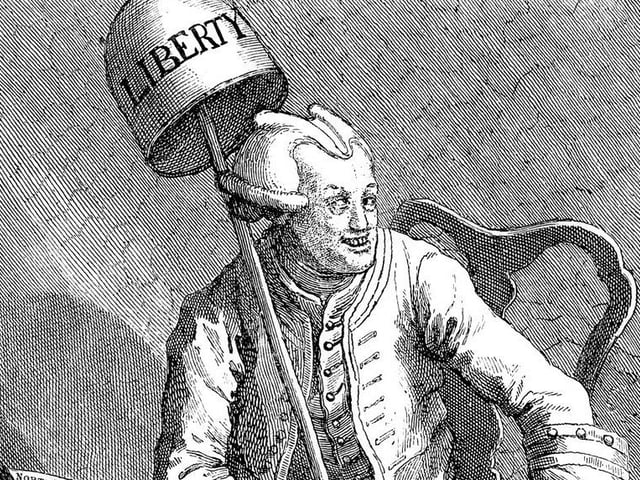
5. John Wilkes and the Fight for Liberty
William Hogarth's John Wilkes caricature Photo: Chris Hare
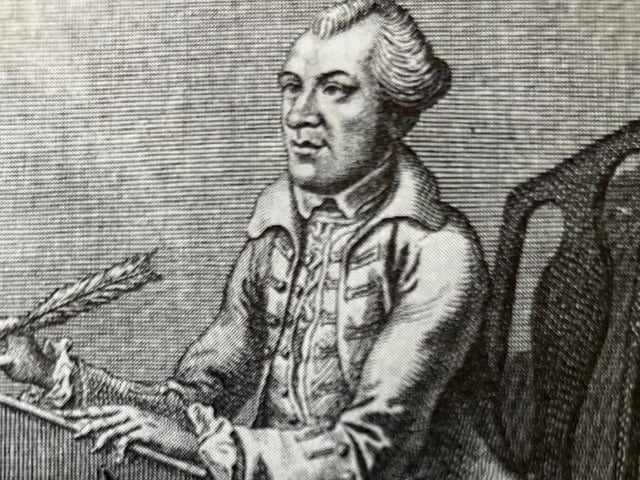
6. John Wilkes and the Fight for Liberty
Politician, English patriot, rabble-rouser and hell-raiser John Wilkes writing Photo: Chris Hare
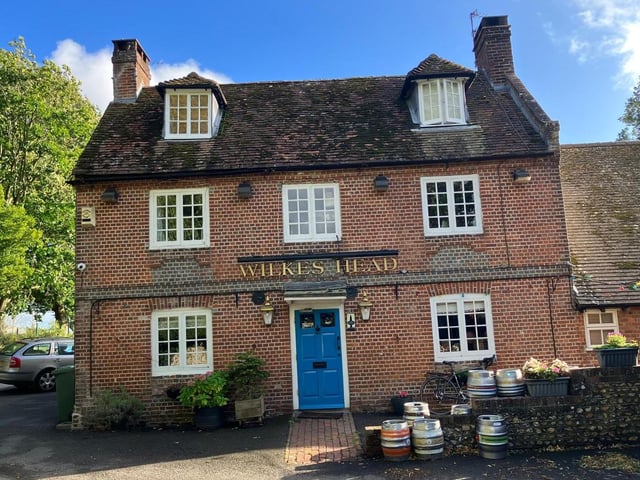
7. John Wilkes and the Fight for Liberty
The Wilkes Head is situated half way between Chichester and Arundel in the village of Eastergate Photo: Chris Hare