
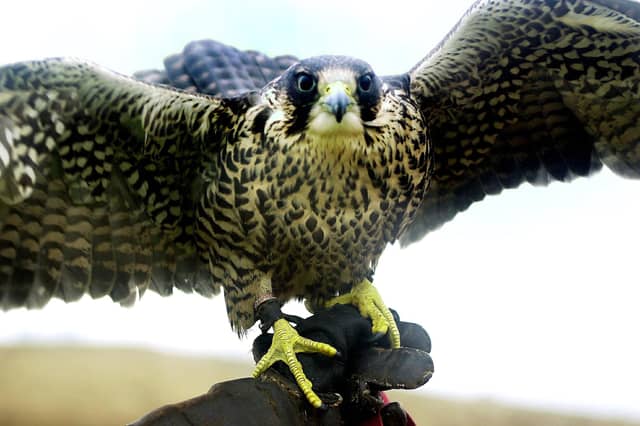


Their natural habitat would usually be a natural cliff ledge or inland crag but the cathedral replicates that, as the spire is 277ft tall with panoramic views and there is lots of prey nearby.
Peregrine populations were decimated all over the world by organochlorine pesticide poisoning in the 1950s. These birds were badly affected as they were at the top of the food chain.
By 1963, they were rare, with just 360 pairs in Britain, and hardly any in the south-east, but populations started to recover from the 1980s. Peregrines were spotted on the cathedral tower in the mid-1980s by a maths teacher at The Prebendal School.
The peregrine falcon’s scientific name is Falco peregrinus. Mating begins a lifelong pairing but if one of the pair dies, the surviving bird will take a new partner. While they may be mates for life, they are not equals as the female is bigger and more powerful and takes the dominant role in the nest.
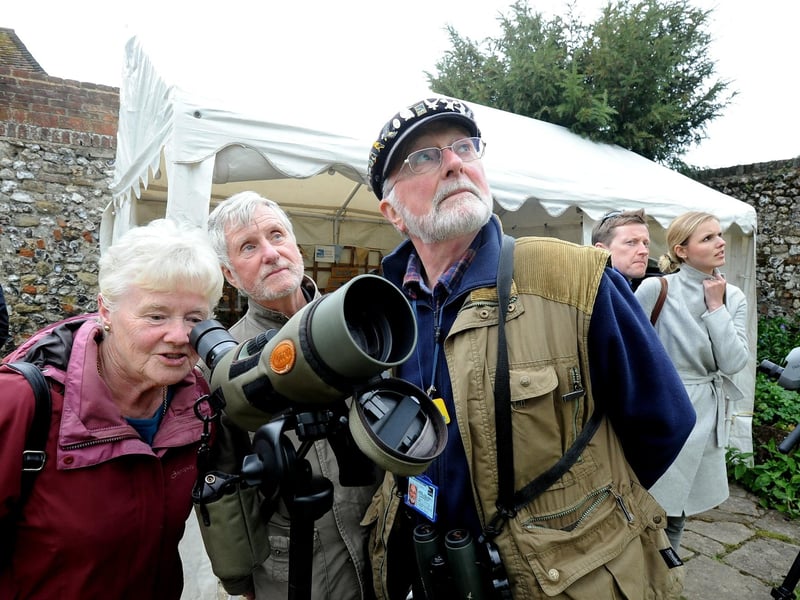
The Sussex Ornithological Society installed a nestbox at Chichester Cathedral in 2001 and the same pair began breeding there successfully year after year. Once the peregrines became established, a telescope viewpoint was introduced each summer to allow visitors to get a closer look.
The RSPB installed cameras in 2006, so people could watch all the action in the nest on a new internet link. Live footage was also beamed to visitors in the tearoom.
By 2009, 30 young, called eyas, had been raised since monitoring began. The peregrines were filmed round-the-clock for their own reality TV show and the antics of the four chicks born that March had hundreds of visitors glued to the screen.
Experts attached identity tags, having determined three of the 2009 chicks were female and one male. Two of these chicks took their first flight in June 2009. The male started flying first, taking off well and landing high on the top tracing of the spire, where the dad normally sat.
He flew around the spire a couple of times and after a few attempts landed successfully. This was a pretty brave move for a first flight as it was very high up and the perch was tiny, so it made for a tricky landing.
The male chick sat there for well over an hour, turning around occasionally and almost falling off once or twice. Then he took off again and flew well, flapping his wings a lot more than the adults would do.
He gave up after a few attempts at landing on one or two more difficult spots and went back on to the top tracing. One of the females had also started flying and the other two were not far behind, as they were starting to flap their wings.
Adult peregrines can fly at up to 247mph while hunting. They fold their wings and dive through the air, striking pigeons in the city and gulls in Chichester Harbour with clenched talons, killing their prey by impact to keep their offspring well-fed.
The parents have to teach their chicks these specialised hunting skills, as they have to catch their prey on the wing. They start by feeding the eyases with delicate little pieces of meat and feather. After a few weeks, they simply drop the food parcel – usually a pigeon or dove – into the nest and let the chicks get on with cutting it up.
Once the young start to fly, they are ordered to pay attention by their parents before the food is dropped in mid-air. The food may be almost handed over in flight or it may crash to the ground, to be left for other creatures. The Chichester peregrines visit Pagham each October to continue teaching their young to feed themselves.
The young need to practise connecting with moving targets on their own. Perhaps they spot a white dove perched tantalisingly on a roof gutter. They will nod their head up and down, in typical bird-of-prey preparation, checking the variables of perspective before making their dive.
Wildlife enthusiasts David and Janet Shaw have followed these rare birds at Chichester Cathedral since the beginning of the project and have been the main funders since 2018.
They say it is ‘a labour of love’. They run the website www.chichesterperegrines.co.uk for the benefit of all peregrine lovers, as well as a blog and social media, plus five weeks of open days on the lawns at the Cathedral, supported by volunteers.
They say: "From March to August, it is possible to stand in the centre of Chichester around the cathedral and watch these amazing birds. We know that peregrines have been nesting on the cathedral since 2001 and have now fledged around 80 chicks.
"Sometimes a juvenile will hang around the parents hoping for a free meal but by the time the next nesting season comes around, they will usually have been chased off to find their own place in the world. We do not know where all the offspring go but we know several live in Sussex and they have been seen in Brighton, Cambridge, Canterbury , Norwich, Hull, Newbury, London ,Dorset and as far afield as Holland, France and Belgium."
From April to August, the peregrines can be seen from the gardens and grounds. Two new webcams were installed in 2025 to share live views of the nest in real time across the world.
The cathedral is looking forward to an exciting season in 2026, celebrating the 25th anniversary of the collaboration. David said there will be events taking place during June and the beginning of July to raise awareness of the project.
The aim is ‘to help spread the word and make members of the public aware of these amazing birds and to educate them of how important they are in our Sussex towns and countryside’.
9. Peregrine falcons
volunteer Nick Goulden with Jo Knight and Ray Webb, watching the peregrines from the Chichester Cathedral café garden in April 2016 Photo: Kate Shemilt