
Letter to the editor: Institutional lunacy west of Ifield - is this rational?
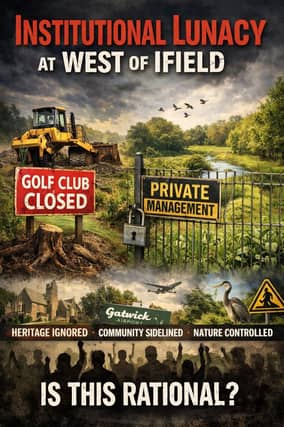

Philosopher and political analyst Noam Chomsky once observed: “If you accept the institutional lunacy, then the policies are rational.” Few recent planning controversies illustrate this more clearly than Homes England’s conduct at West of Ifield [‘Golf club must make way for development’, Crawley Observer, Front Page, Dec 17].
Viewed from within Homes England’s institutional framework, the decision to close Ifield Golf Club and to propose private management of Ifield Brook Meadows can be presented as sensible, efficient, even responsible. Land is treated primarily as a financial asset. Community use is reclassified as under-performance. Democratic objection becomes a technical obstacle to be managed rather than a signal to be heeded. Once those assumptions are accepted, the resulting policies appear rational. But step outside that framework and the picture changes sharply. Ifield Golf Club is not merely a parcel of land awaiting “unlocking”. It is a long-established community asset embedded in the historic fabric of an ancient parish. Its closure, pursued in advance of a sound and legally compliant Local Plan and in the face of serious objections from both Gatwick Airport Ltd, Crawley Borough Council and major environmental and ecological bodies, raises fundamental questions about governance, accountability, and the proper use of public land - and public money.. The same institutional logic underpins suggestions that Ifield Brook Meadows — a much-loved Local Green Space — could be placed under private management. This is framed as professional stewardship. Yet for local people it feels uncomfortably like control without consent: the gradual enclosure of a public landscape through management structures, access routes, and oversight mechanisms imposed from above, rather than through community-led stewardship. None of this is accidental. It reflects a deeper pattern in which strategic control is secured first, with democratic consent expected to follow later - if at all. Within such a system, policies are not irrational errors. They are the predictable outcomes of an institutional mindset that reduces heritage, ecology, and community life to secondary, low-priority considerations. That is why the debate about West of Ifield cannot be confined to planning technicalities alone. The real issue is whether a government agency should be permitted to operate within a framework that treats living communities and landscapes as expendable variables in pursuit of abstract targets and financial assumptions. Chomsky’s warning matters here because it reminds us that the most dangerous decisions are often those that are procedurally rational but morally hollow. If the institutional lunacy goes unchallenged, the policies will continue to make sense — right up until the damage is irreversible. Richard W. Symonds. MCIPD Ifield Street, Ifield Village Crawley, West Sussex