
Sussex Heritage: Moments in the story of our nation captured in 18th century porcelain figures
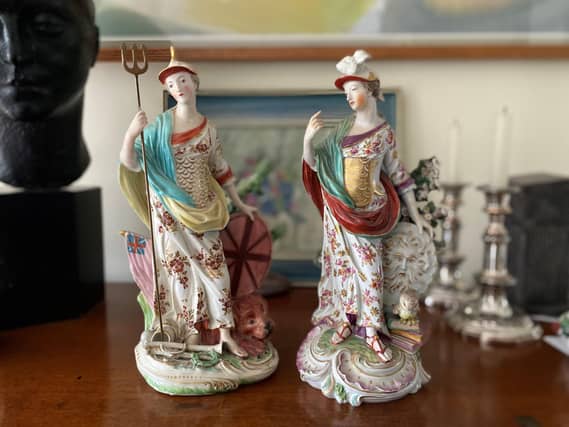

By the 18th century Britannia had become a powerful allegory of British patriotism and imperial power. The Romans had called the British Isles Britannia in Latin. During the reign of Emperor Hadrian Britannia was personified on coins as a female goddess with a shield and spear.
Between 1756 and 1763 the European great powers fought the Seven Years War across the globe in India, the Americas and Europe. France under Louis XV, the Sun King, allied with Austria and Spain against Britain and Prussia. Other nations, too, joined these alliances. At its end Britain had established its commercial dominance in India over France. France had also lost its possessions in America.
The Georgian middle classes loved to collect pieces which spoke of their own times and classical antiquity. William Duesbury was a celebrated London enamellist decorating figures and pieces he bought in from Derby, Bow and Chelsea in the white adding colour and detail. He joined Andrew Planche and the financier John Heath at their porcelain manufactory in Derby where he oversaw production.
In response to Britain’s success in the Seven Years War William Duesbury & Co produced a number of depictions of Britannia at their Derby manufactory. Here she is depicted as a classical woman with helmet and trident. She personifies the nation and embodies the qualities of perseverance, courage and wisdom. A recumbent lion at her feet symbolises British strength and vigilance, whilst the Union Jack speaks of the union of England, Wales and Scotland. A union Ireland would join later in 1801. The figure of Minerva was also made by William Duesbury & Co in Derby. Minerva was the Roman goddess of wisdom, strategic warfare, victory, the arts, justice and law. The Derby figure gives voice to her wisdom with a stack of books and her owl beside her. Her shield is decorated with the mask of Medusa. It was Minerva who turned Medusa from a beautiful woman into a monster with snakes for hair and a gaze which, if looked into, would turn anyone to stone. Both figures date from around 1765-1770.
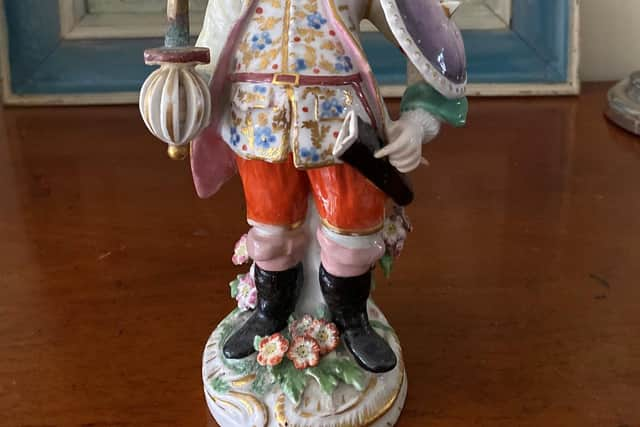
Shakespeare is central to our nation’s identity. Sir John Falstaff is one of the most popular figures in Shakespeare’s plays. He acts as a foil to Prince Hal in Henry IV parts 1 and 2 and stars in the Merry Wives of Windsor. Larger than life, a scoundrel with wit and a lust for life, his character endeared him to Queen Elizabeth I and audiences ever since. The actor James Quinn was celebrated for his depiction of Falstaff in the early 18th century and inspired numerous figures of the character like the one seen her by Bow.
18th century porcelain figures which capture the history our nation.