
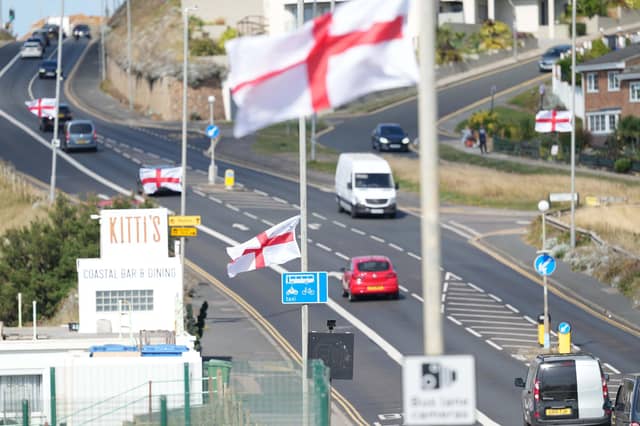

Brighton and Hove City Council said, on Friday, August 22, that staff would remove unauthorised St George’s flags placed on the A259.
The flags have been placed on lampposts along the major road in Saltdean and Rottingdean.
It comes amid an online movement which has seen St George’s flags springing up across the country.
In response, a spokesperson for Brighton & Hove City Council said: “We have been made aware of flags being displayed on some of our highways.
“These have not been authorised and, as such, will be removed in line with the 1980 Highway Act.”
However, removal work had to be stopped after contractors faced verbal abuse.
Asked to comment on the reports of abuse, a spokesperson for the city council said, on Tuesday, August 26: “Removal work had to be paused but will be resumed this week.”
Meanwhile, more flags have appeared in the Eastbourne area – and roundabouts were spray-painted.
Why are the flags appearing?
According to the BBC, groups responsible for putting up the flags say they are ‘motivated by pride and patriotism’. On the contrary, it has been suggested that the posters are provocative – with tensions high across the country amid immigration protests.
‘Patriots’ were opposed by counter protesters in Chichester on Friday, amid nationwide demonstrations against hotels being used to house migrants.
Towns and cities across the UK are this bank holiday weekend braced for protests outside hotels believed to be housing asylum seekers – and counter protests at the same sites.
It is currently illegal to attach posters, flags, or notices to any public street furniture.
As reported by our sister title, the Northamptonshire Telegraph, a Reform councillor said the local council had signed a ‘pledge’ to apparently over-ride the law and would not enforce the rules in the cases of union flag and a the St George’s cross.
A UK Government website posting read: “Flags are a very British way of expressing joy and pride – they are emotive symbols which can boost local and national identities, strengthen community cohesion and mark civic pride.
“The government wants to see more flags flown, particularly the Union Flag, the flag of the United Kingdom. It is a symbol of national unity and pride. The government has recently issued guidance encouraging the flying of the Union Flag on all UK government buildings throughout the year, alongside other national and local flags.
“We are keen for local authorities and other local organisations to follow suit. We have made it easier for the Union Flag to be flown alongside other flags, so organisations can highlight their local identities, as well as their national identities, and celebrate special days or events which champion civic pride.
"In England, the flying of flags is treated as advertisements for the purposes of the planning regime to ensure the flags do not impact on safety or amenity. Some flags require formal consent (permission) from the local planning authority, whereas others like the Union Flag do not. The detailed controls over flag flying are set out in detailed regulations (see links below).
“This plain English guide provides a brief summary of the regulations so that individuals and organisations can easily understand when they can fly a flag in England without the need for consent. It incorporates the latest changes to the regulations introduced in June 2021. These regulations now allow for the Union Flag to be flown with another flag from the same flagpole, provided certain conditions are met.
“If you are unclear about whether consent is required for flying a flag, you should contact your local planning authority who can provide detailed advice.”
The government dictates that all flags must be:
– Be maintained in a condition that does not impair the overall visual appearance of the site;
– Be kept in a safe condition;
– Have the permission of the owner of the site on which they are displayed (this includes the Highway Authority if the sign is to be placed on highway land);
– Not obscure, or hinder the interpretation of official road, rail, waterway or aircraft signs, or otherwise make hazardous the use of these types of transport;
– Be removed carefully where so required by the planning authority.
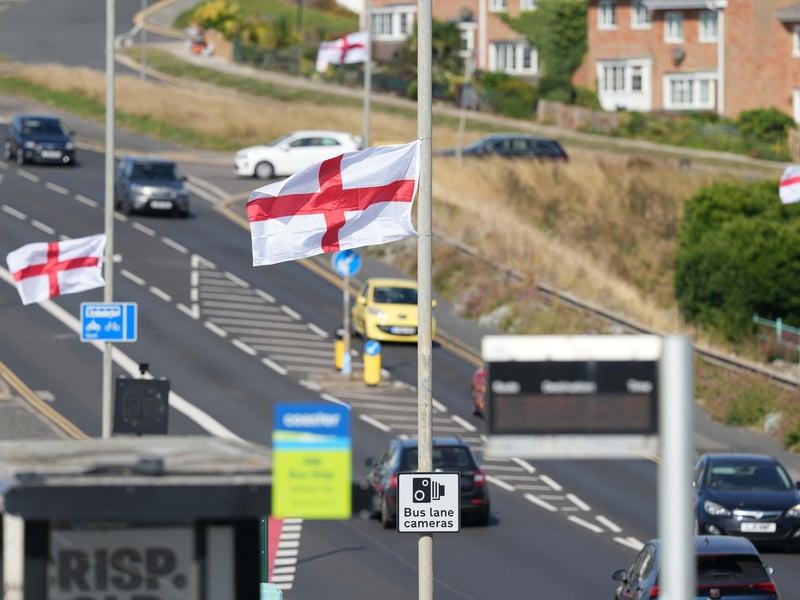
5. Brighton council will remove St George's flags on A259
St George's flags on the A259 Photo: EDDIE MITCHELL