
East Sussex author’s amusing new book explores dog idioms with Private Eye cartoonist – and a contribution from daughter Natasha Kaplinsky


This article contains affiliate links. We may earn a small commission on items purchased through this article, but that does not affect our editorial judgement.
A Barcombe Mills based author has compiled a new book that explores the wonderful world of dog idioms.
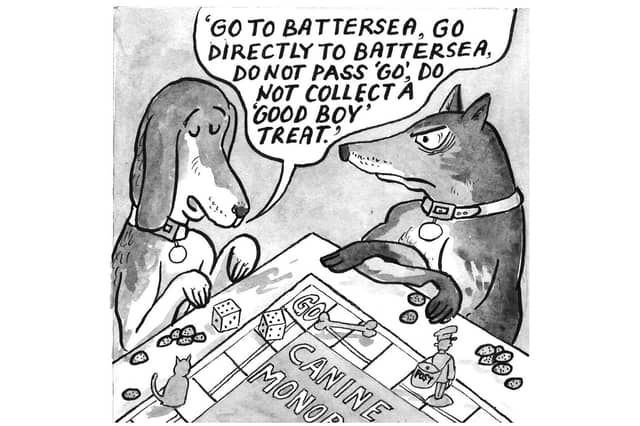
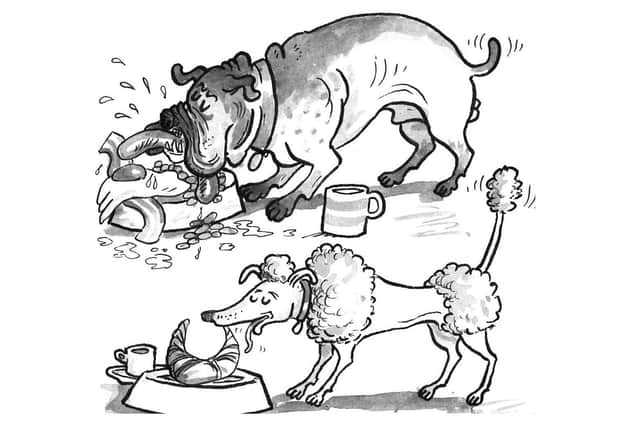
‘This Book is Not About Dogs’ by Raphie Kaplinsky looks at 39 idioms – all using the word ‘dog’ and all with illustrations by Rupert Redway – to inform and entertain the reader.
Raphie, 78, is a development economist and Emeritus Professor at the University of Sussex, now retired and previously employed by the University of Sussex and the Open University.
He is also the father of journalist and TV presenter Natasha Kaplinsky.

Raphie has written more than 15 books as an academic (as Raphael Kaplinsky), but told this newspaper: “This is the best book I’ve ever done and the most fun – and my family and the dogs agree with me.”
He explained that he got the idea a few years ago during Christmas with his wife. Raphie said: “During Covid we had Christmas and our daughter wanted us to go skiing. We said we didn’t want to go skiing, so she said ‘I’ve got five dogs, can you look after them?’ We had three of our own so that’s eight. Then somebody else said ‘can you please look after my dog?’ So we had nine. We should have had 11, but our son and family had Covid, so didn’t join us for the celebration.”
“It was wonderful,” he said. “It made us think about the centrality of dogs in our lives.”
Raphie said he and his wife had always been ‘dog people’ and both their families have always had dogs. He said the first chapter of his book is about the dogs in his and his wife’s lives from their childhoods in South Africa.
He said: “We thought that dogs are so important to human beings and then you think about the way it surfaces in language. You think about all the ways in which we have idioms to describe what’s happening in our lives. I did a trawl and found 67 idioms with the word ‘dog’ in them and thought ‘wouldn’t it be good fun if we got people to write a little story that goes with each of these idioms?’”
As an aside, he explained that ‘hot dog’ actually has 17 different meanings.
Among the idioms explored in his book are: ‘every dog has its day’, ‘you can’t teach an old dog new tricks’, ‘dog-tired’, ‘a dog’s breakfast’, ‘hair of the dog’ and ‘the dog ate my homework’. For each idiom, Raphie has written an explanation of its meaning and origins. Then a contributor has written an offbeat personal story or anecdote to go with it.
Raphie said: “Of the 39 entries, 13 are by local people.”
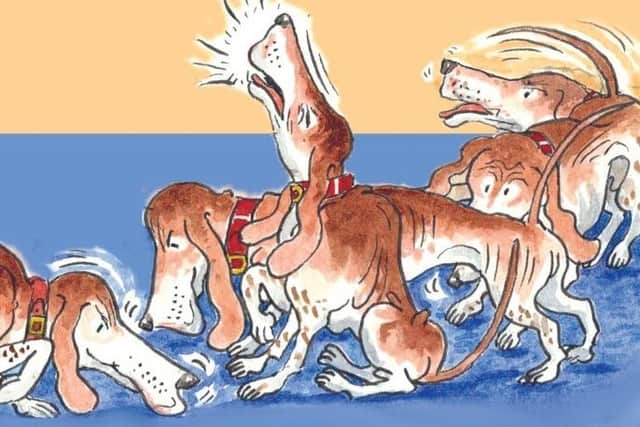
‘Barking up the wrong tree’, for example, is written by a friend in Brighton who grew up in a poor family in the 1960s. During an attempted holiday in Europe, there was an accident involving the family’s ‘battered old car’, which caught the attention of the Italian police. But then, due to a misinterpretation of the vehicle’s licence plate, the family found themselves getting flown back to England at the Italian police’s expense.
Raphie explained that the origins of ‘barking up the wrong tree’ come from Racoon hunting in America during the 1800s.
Another entry was written by his daughter Natasha.
Her story on ‘like a dog with two tails’ refers to the idiom describing someone who is unusually pleased or proud. In Natasha’s anecdote, the Strictly Come Dancing winner describes being caught by the paparazzi. She says they got a ‘snatched photograph’ of her having a friendly chat with a ‘charming policeman’ while she had her little dogs with her. But the photographs were then published in a story in a newspaper saying that the policeman was threatening to charge her because her dogs had just fouled the park.
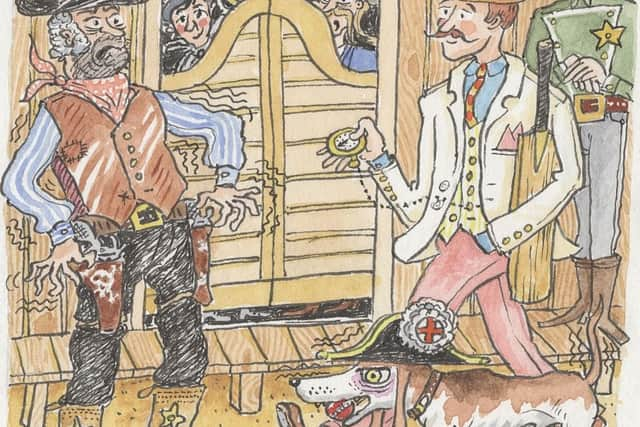
In this section, Raphie explains that the ‘dog with two tails’ idiom is believed to have originated in North America, but the first recorded use was in a poem by John Gay in the early 18th century. He also says Gay probably drew on one of Aesop’s fables.
The idiom ‘if you lie down with dogs you get up with fleas’ can be traced back to Seneca the Elder. This one is accompanied by a story from Suzi Hopkins, a playwright and artistic director from East Chiltington. It is about catching Covid at an informal gathering around a camp fire.
There’s also a rather rude anecdote from a Brighton-based contributor about some confusion involving a sausage dog at an opera. It accompanies one particularly well-known idiom ‘love me love my dog’.
Raphie said he is delighted by the ‘brilliant’ illustrations by Rupert Redway, a fellow dog lover, whose cartoons are exhibited in the Victoria and Albert collections and are often seen in Private Eye.
The book is available at Waterstones, Foyles and other bookshops, as well as Amazon, and retails at £12.95.