
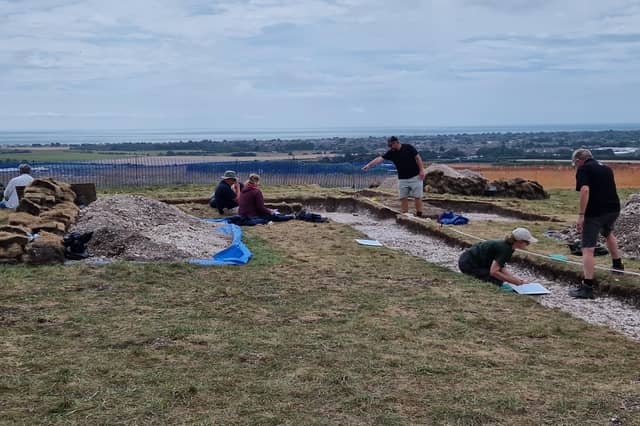


A number of trenches have been dug on Highdown Hill, an archaeological site of national importance on the South Downs in Ferring, just across the Worthing boundary.
Project lead James Sainsbury, curator of archaeology at Worthing Museum, has been impressed with the finds, some of which back up what he already knew and some which reveal a whole new history.
The most important find of the two-week dig came on Friday, July 25, but was revealed publicly for the first time only on Thursday, July 31, after osteoarchaeologist Hayley Forsyth Magee had shared her expertise.
James had expected to find a ditch in Trench H, now known as the turf barrow trench, but that has eluded the team. However, what has been uncovered here is a complete skeleton, believed to be a female aged 14 to 18.
No treasures have been found in this trench but James believes it could be an additional cemetery, previously unknown. He surmises the skeleton could be a Romano-Briton from the 2nd Century. Detailed investigations will reveal the truth over the next few months.
Trench B, thought to be an undisturbed Anglo-Saxon grave, has also been intriguing. Dozens of fragments of human bone have been found there, suggesting Victorian archaeologists Edwin Henty and Charles Hercules Read cut a pit between 1893 and 1901 for unwanted skeletal remains during their own dig.
James said Trench B had 'really impressed' and Sue Harrington had discovered another grave cut. The Victorians took a lot but they missed at least part of a burial, as well as finds including a lovely bronze pin in a shallow grave, a 6th century buckle and a small fragment of Roman glass.
James added: "We excavated a number of well-defined pit features. These were empty but could have once contained urned cremations, removed by Henty and Read in the 1890s."
The metal detectorists on site have found dozens of 4th century Roman coins, including one with wording meaning 'the restoration of happy times' dating to around 350 AD.
James said: "You can clearly see the emperor's face and on the reverse, the emperor spearing an enemy of Rome into the ground!"
A Roman ditch, full of oyster shells and big chunks of pottery, was found in Trench F and satellite imagery suggests there is a ditch more than 12 metres outside of the barrow.
The Newcastle University research team will be using new technology, Optically Stimulated Luminescence dating, to determine the age of sediments and other materials from Trenches G and H.
Prehistoric pottery and half of a loom weight were among more than 750 finds from Trench G, though most of the others were Roman date.
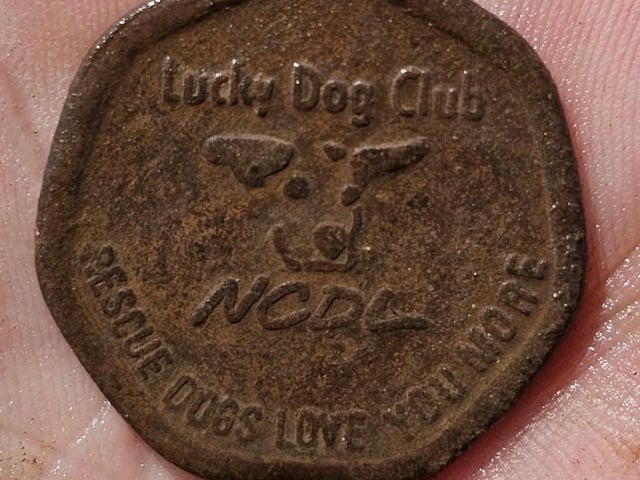
9. Highdown Big Dig finds
Dozens of dog tags have been found Photo: Worthing Museum
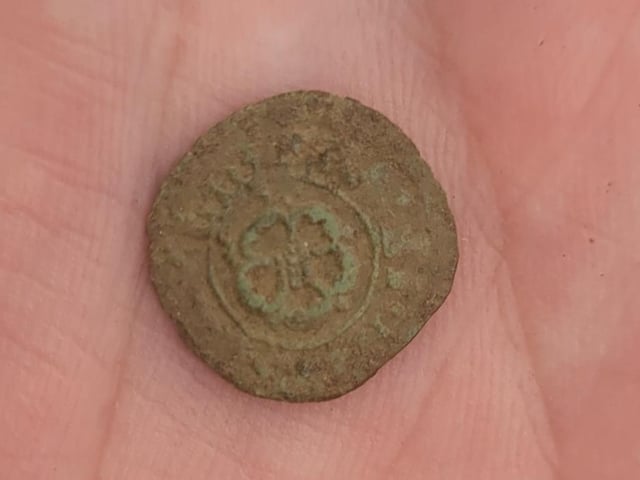
10. Highdown Big Dig finds
A rose farthing coin from the reign of Charles I Photo: Worthing Museum
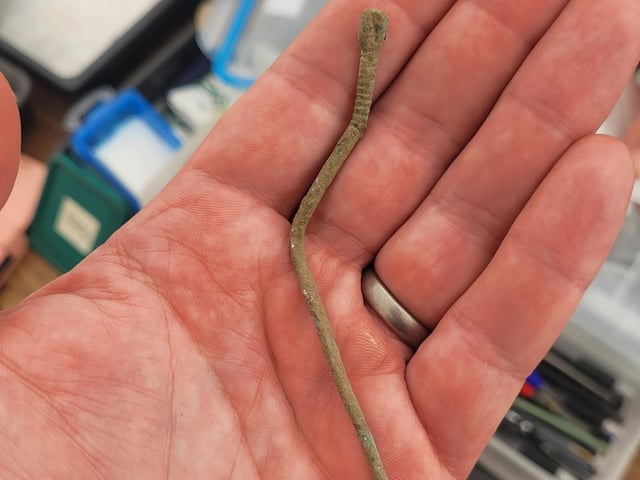
11. Highdown Big Dig finds
A bronze pin, which will clean up nicely Photo: Worthing Museum
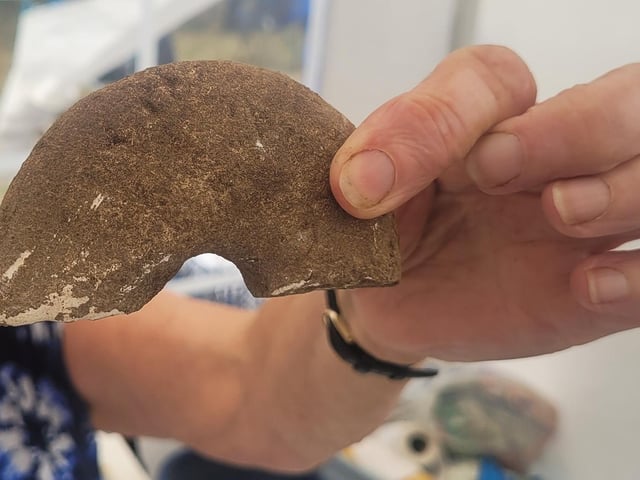
12. Highdown Big Dig finds
Half of a loom weight Photo: Worthing Museum