
It was a popular spot to the view the spectacle with other large crowds gathering on the East and West hills.
The rare phenomenon, which was visible across the UK and Ireland, started at 6.18pm and reached its peak at 7.14pm, ending at 8.07pm.
People were advised to only use specially designed solar viewing glasses that protect against infrared and ultraviolet radiation to look at the sun. People were also told they could watch the eclipse indirectly by using a pinhole projector. This allowed them to see the Sun’s image on a sheet of paper.

1. Sussex Sidewalk Astronomers and members of the public at the Old Bathing Pool Site, St Leonards, getting ready for the partial solar eclipse on August 12 2026.
Sussex Sidewalk Astronomers and members of the public at the Old Bathing Pool Site, St Leonards, getting ready for the partial solar eclipse on August 12 2026. Photo: Justin L

2. Sussex Sidewalk Astronomers and members of the public at the Old Bathing Pool Site, St Leonards, getting ready for the partial solar eclipse on August 12 2026.
Sussex Sidewalk Astronomers and members of the public at the Old Bathing Pool Site, St Leonards, getting ready for the partial solar eclipse on August 12 2026. Photo: Justin L
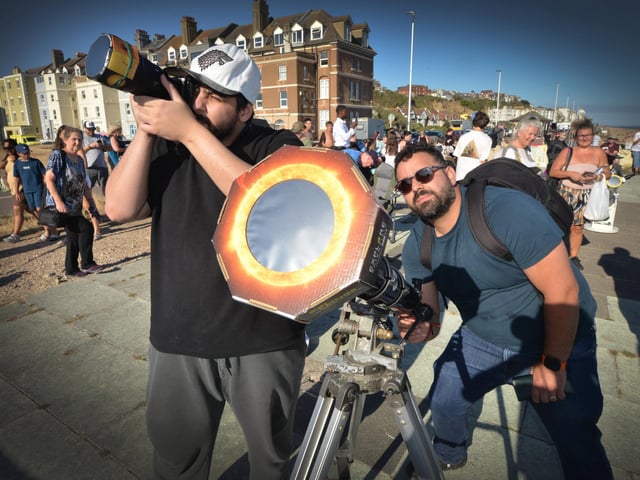
3. Sussex Sidewalk Astronomers and members of the public at the Old Bathing Pool Site, St Leonards, getting ready for the partial solar eclipse on August 12 2026.
Sussex Sidewalk Astronomers and members of the public at the Old Bathing Pool Site, St Leonards, getting ready for the partial solar eclipse on August 12 2026. Photo: Justin L
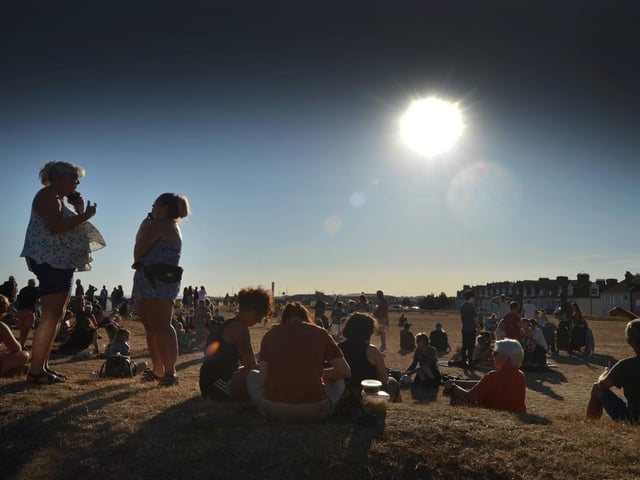
4. Sussex Sidewalk Astronomers and members of the public at the Old Bathing Pool Site, St Leonards, getting ready for the partial solar eclipse on August 12 2026.
Sussex Sidewalk Astronomers and members of the public at the Old Bathing Pool Site, St Leonards, getting ready for the partial solar eclipse on August 12 2026. Photo: Justin L