
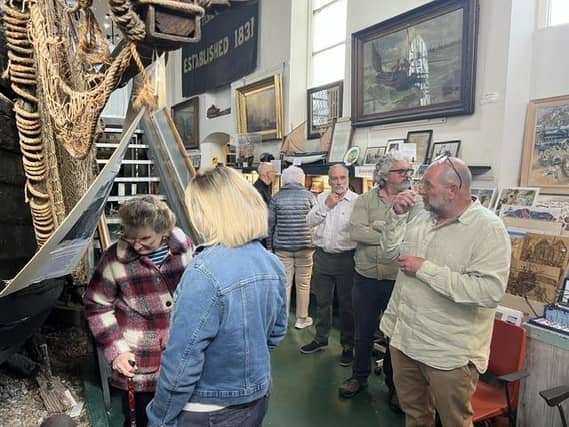

It coincided with the launch of an extensive new exhibition that chronicles the history of the museum, which is situated on Rock-a-Nore Road in Hastings Old Town.
There were speeches from museum ship-keeper and manager Stephen Roberts-Pratt and former Hastings fisherman and fishmonger Tush Hamilton, who explained the history of the Hastings fishing lugger Enterprise, the centre piece of the museum.
Kevin Boorman spoke about learning that his relative, famous Hastings lifeboat Cox George Moon was once the ship-keeper at the museum. There was also an address from Hastings Mayor Becca Horn.
Local historian and museum trustee Steve Peak explained the history of the Fishermen’s Museum: “It opened its doors for the first time on 17th May 1956, and today it attracts over 90,000 visitors every year. The Museum was built in 1853/4 as a church, which closed in 1939 on the outbreak of the Second World War.
“Until the early 1830s there was no ground where the Museum stands today, because the sea was coming up to the foot of the cliffs. In order to protect both the cliffs and the Old Town from increasing invasions by the sea, Hastings Council in 1834 and 1843 built wooden groynes to the east side of where the Shipwreck Museum is today. A large amount of shingle quickly built up here, creating a new piece of ‘ground’ in front of the cliffs. “On this new land the fishermen wanted to build sheds in which to store their fishing gear, but there were so many boat-owners seeking a space that Hastings Council had to lay out the ground in rows of plots about eight or nine feet square. Because of the small size of these plots, the sheds that the fishermen built - known as the ‘net shops’ - had to be tall and thin, making their combination of layout and design unique to Hastings. The 40 surviving net shops are now listed as grade II star by English Heritage. “The Fishermen’s Church was to be built in 1853/4 partly on the site of a compound set up on this new ground in 1839 by HM Customs to cut up boats used by smugglers. By around 1850 smuggling had almost died out, and in late 1852 the Crown therefore gave up using the compound and granted a lease of the land which it owned for the church. “The foundation stone of the Fishermen’s Church of St Nicolas was laid in August 1853 and the Church opened for worship on 26 March 1854, with the Reverend Tom Tanner as its first chaplain. The Crown had granted a 75 year lease of the ground, which Hastings Council took over when it expired, and the Council remains the landlord of the building today. There was seating for 290 people. The popular Tom Tanner - ‘The Rev Tom’, as he was known - remained chaplain until his death in 1880, by which time he had won over the fishermen to accept the presence of the Church. Among the Church’s visiting preachers was the famous author Charles Kingsley, in 1857. “The Church had to close soon after the war broke out in September 1939 because it was inside a zone of prohibited access to the public. During the war the Church was requisitioned by the military, who used it as a store. It suffered some damage, including the loss of three newly-painted windows. “The war ended in 1945 and in early 1947 the Rev Leslie Hook, rector of All Saints, had to give up using the Church because he could not obtain a long lease from Hastings Council, which then let it to Butlers Emporium hardware shop in George Street, which used it as a store. “In 1953 Old Hastings Preservation Society members tried to save one of the last two surviving Hastings sailing luggers, but this failed, and one of them, the Industry RX 94, was burnt on Bonfire Night 1953. This prompted special efforts to save the other lugger, the Enterprise RX 278, built in Hastings in 1912. The OHPS said that the near-derelict Fishermen’s Church should become a museum, and in July 1955 the Council gave the scheme the go-ahead. “Butlers moved their stores out in March 1956, and on 17 April part of the Church’s south wall was demolished and the Enterprise was hauled inside. The interior of the building was in such a bad state that it had to be almost gutted. But, nonetheless, it was quickly restored and many exhibits were put on display, including the last wooden horse capstan (still in the Museum today). The Fishermen’s Museum was officially inaugurated on Thursday 17 May 1956, when the mayor, Alderman Frederick Hussey, stood on the deck of the Enterprise and declared it open. “The Museum now owns five net shops, plus five old fishing boats which are standing outside on the beach. A sixth boat has been cut in half to create both a net shop and a cottage. The Museum is open 364 days a year, from 11am, and admission is free; donations most welcome. The ship-keeper (manager) is Stephen Pratt, and the Museum is run by OHPS. There are more details about the history of the Museum, of which I am the honorary curator, on my website www.hastingshistory.net."
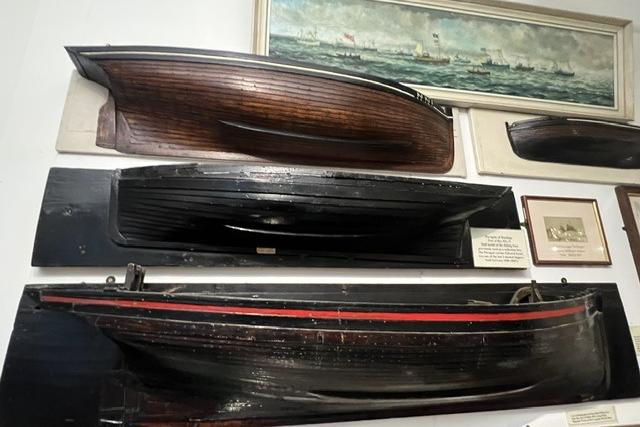
13. Hastings Fishermen's Museum is celebrating 70 years
Hastings Fishermen's Museum is celebrating 70 years Photo: staff
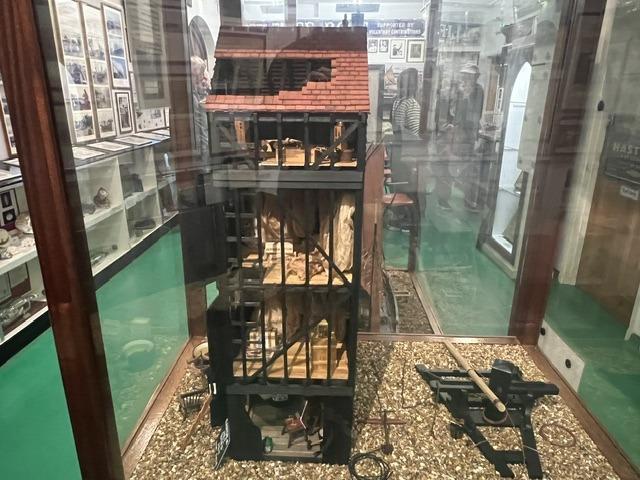
14. Hastings Fishermen's Museum is celebrating 70 years
Hastings Fishermen's Museum is celebrating 70 years Photo: staff
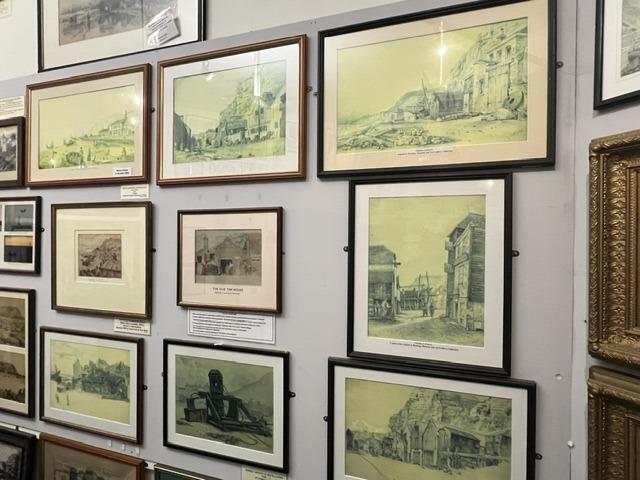
15. Hastings Fishermen's Museum is celebrating 70 years
Hastings Fishermen's Museum is celebrating 70 years Photo: staff
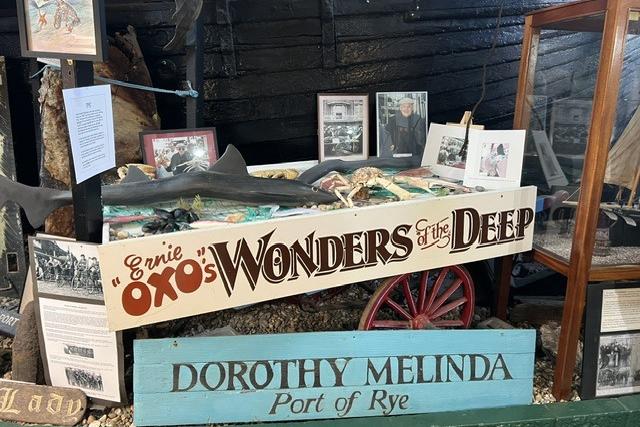
16. Hastings Fishermen's Museum is celebrating 70 years
Hastings Fishermen's Museum is celebrating 70 years Photo: staff