
Planning application for traveller site in Newhaven refused permission

A planning application for a traveller site in Newhaven has been refused permission.
The application, which was submitted to South Downs National Park Authority (SDNPA), was for land to the north of The Crescent in Denton.
The application form said it was for the ‘continued use of land as a private Gypsy/Traveller site’ and for the ‘provision of landscaping and rearrangement of caravans’.
Its planning, heritage, landscape, design and access statement, which was prepared by agent Robert Tutton Town Planning Consultants, said: “It is proposed that this land be retained as a private Gypsy/Traveller site, to derive optimum benefit from its accessibility and sustainability advantages, and that the present caravans be arranged along the northeast and southwest boundaries, closer to the frontage.”
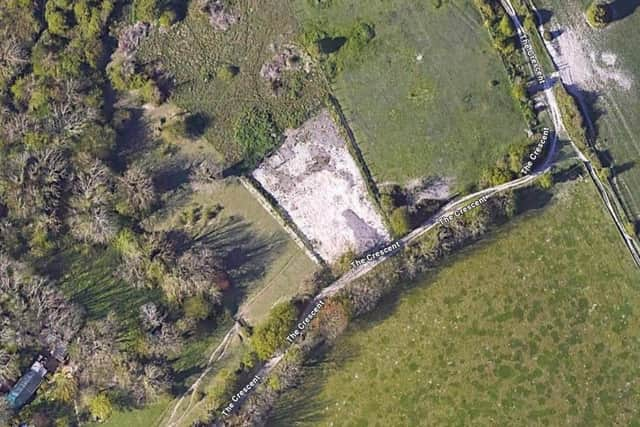

This planning statement said the site comprises 0.255 hectares of land and said permanent infrastructure could be provided if planning permission was given. It said: “Respect for the special character of the area has been accorded priority in the arrangement of the site.”
The application form said this latest submission was a resubmission of application SDNP/25/02709/FUL, which had been refused on January 22.
People can view all of the application documents at planningpublicaccess.southdowns.gov.uk/online-applications using reference number SDNP/26/00511/FUL.
The planning statement said there is ‘an evident need for further Gypsy/Traveller pitches’. It added that this pitch ‘would not detract from the existing street-scene and would be in keeping with the character of its sensitive surroundings and the setting of a heritage asset’.
But the SDNPA’s decision notice, published on July 30, said: “The development, by reason of the visual and aural impacts arising from its suburbanising features including hardstanding, caravans, portaloos, parked vehicles, residential paraphernalia, vehicle movements and generator noise, would fail to safeguard the experiential and amenity qualities of the open downland landscape.”
It said that, even with its proposed mitigation measures, the development ‘fails to conserve or enhance landscape character, views from public rights of way or the setting of the nearby scheduled monument’.
The application’s planning statement said the proposal would provide safe access for pedestrians, cyclists and vehicles, as well as parking. It also proposed planting native trees along the boundaries and site frontage, with the areas between caravans being laid to grass to ‘soften the appearance’ of the development further. The statement said: "Continued use of this site in the manner proposed would achieve more efficient use of this land without harm to the character or appearance of the National Park, a heritage asset or users of the bridleways or public footpaths. It would play a modest yet valued part in the provision of Gypsy/Traveller pitches in this sector of the National Park and comprise an acceptable form of development that accords with the development plan and no other material considerations suggest otherwise.”
But the SDNPA’s decision notice said: “The development, by reason of its unsustainable location in terms of access and infrastructure, would fail to provide safe or suitable access for the use, protect the amenity of all road users or protect the biodiversity, landscape and amenity value and character of a historic bridleway.”
It added that ‘insufficient information’ had been provided to show that the site could be ‘acceptably served’ by power, water supply and foul water drainage ‘without harm to the special qualities of the National Park’.
The decision notice also said the development ‘interferes with the ability to access and use Footpath 36b’, which means it does not protect the safety and amenity of all road users or provide ‘a legible and attractive experience’ for people using the public rights of way.
Both this recent application and the previous one received dozens of objection letters.
Newhaven Town Council said of the recent application: “This location is totally unsuited for accommodation as it is without water/drainage and other utility infrastructure supply, and vehicle and even general access to the site is highly limited, particularly for emergency services.”
Ms Chloe Rowling, from East Sussex County Council, said ESCC’s Rights of Way Team had ‘concerns about the suitability of public bridleway Newhaven 41a,b,c (The Crescent)’ being used for vehicular access to the site. She said there is ‘evidence of damage to tree roots’ that are ‘forming trip hazards’. She added: “Where deep tyre ruts have been formed, areas of rubble have been deposited and the size of the bricks is causing an uneven surface.”
Sean Macleod, former Lewes District Councillor for Newhaven North, was against the previous application. He said that works on the site had started years ago and said he and several residents objected. He described the site as ‘just a field’ with no running water or utilities and said it would be difficult to access it via the bridleway in winter. He was also concerned about the road becoming muddy in wet weather.
Mr Macleod welcomed the refusal of the most recent application, calling it ‘good news’. He said: “The Traveller encampment at the Crescent has been there for five years now. It is time that the South Downs National Park took some serious action to return the land to how it was originally.”