
Southern Water reveals why 'millions' of plastic beads have washed up on East Sussex beach; MP warns of 'environmental catastrophe'
A water company has revealed the likely cause for ‘millions’ of plastic bio-beads washing up on an East Sussex beach.
The tiny pellets, which are used in the treatment of wastewater, have appeared along the ‘entire two-mile coastline’, according to a MP, who has written to Southern Water.
The bio-beads appeared on Camber Sands beach on Friday (November 7).
Helena Dollimore, MP for Hastings and Rye, said: “Millions of plastic beads have washed up onto our beautiful Camber Sands. I will be putting the pressure on Southern Water and the Environment Agency to explain what has happened and how they are going to help.


“The volunteers down at Camber Sands also need your help – there are literally millions of these beads and they are struggling to remove them all before they hurt the local wildlife and environment. Please contact Strandliners if you can help. I will be keeping everyone updated on the situation. It's also really important to keep a look out and report any sightings to Strandliners.”
Ms Dollimore wrote to Southern Water’s chief executive, Lawrence Gosden about the issue, sharing the letter on her official Facebook page.
In the letter she said: “I am extremely concerned by the sudden the washing up of millions of bio-beads at Camber Sands beach and along the Hastings and Rye coastline.
“Bio-beads are commonly used in wastewater plants locally, in Beckley treatment plant and in Eastbourne.
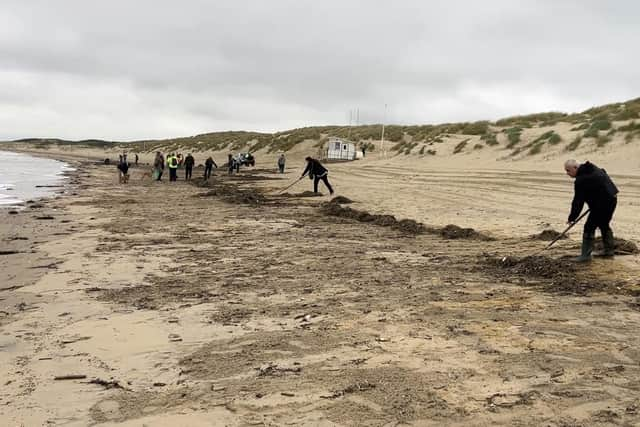
“The scale of pollution is severe. A continuous line of bio-beads stretches along the entire two-mile coastline, embedded in dense seaweed and sand.
“Local volunteers, Rother Coastal Officers and two expert charities - Strandliners and Nurdle, are working tirelessly on the beach to remove as many beads as possible, but it is a race against time.
“It was also concerning to hear from coastal officers that a higher than usual number of dead seals and harbour porpoises have been washing up this week and the cause of their death must be investigated to see if there is any connection.”
A spokesperson for Southern Water said: “After completing the initial stages of a thorough investigation, which is continuing, we believe it is highly likely that the beads have come from our Eastbourne Wastewater Treatment Works. We've identified a failure of a screening filter which has apparently led to beads used in the treatment process being released into the sea during heavy rainfall. The screen should have prevented this occurring.
“We are very sorry this has happened and are doing everything possible to investigate and resolve the problem. We'll provide further updates as soon as more information becomes available.
“Southern Water teams continue to work closely with Rother District Council, which is leading the clean-up efforts, and we remain committed to supporting this work in every way we can. Southern Water volunteers will continue to assist. Our staff are there to help, and we ask that they are treated with respect as they help with the beach clean.”