
Campaigners place dozens of pairs of shoes outside council HQ to represent failed children
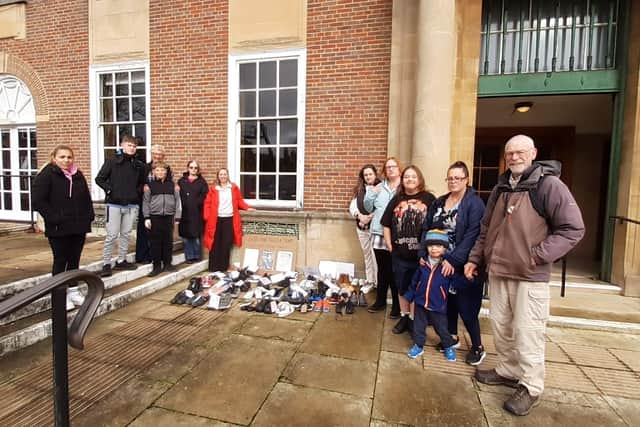
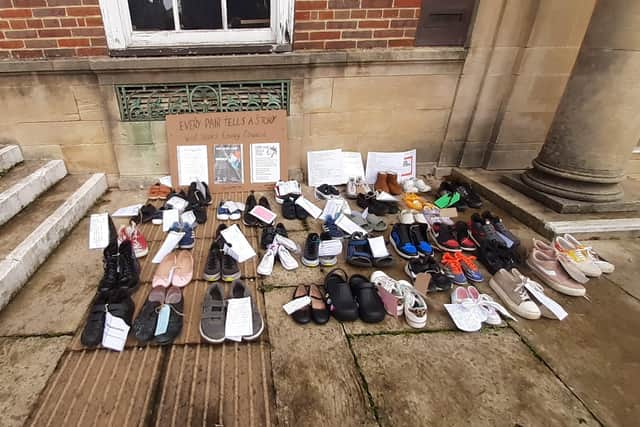
Dozens of pairs of shoes were placed outside West Sussex County Council’s HQ to represent children who campaigners said had been failed by the SEND system.
SEND stands for special educational needs and disabilities, and every parent who has such a child knows of the struggle to get them the right support to see them through school – or even to get them into school in the first place.
On Monday (November 3), Lucy Pratt, of Chichester, was joined by other parents and children at County Hall for the SEND Sanctuary UK’s Every Pair Tells a Story event.
Lucy is mum to Sophie, 15, and Ollie, 10, both of whom have special needs. Her experience when it came to trying to secure their Education, Health and Care Plans (EHCPs) would be recognised by many parents across the country.

It ranged from ‘parent blaming’ – saying Sophie was copying behaviour she had seen at home – to being told she was ‘too academic’ to need a support plan, and not hearing anything for weeks or months at a time.
Lucy said that Sophie was in secondary school when she received her autism diagnosis and the EHCP was finally put in place. Since then she has thrived and is looking at college courses.
A spokesman for SEND Sanctuary UK said: “This movement is not only for children missing from education. It stands for every child whose needs have been ignored, misunderstood or dismissed. It is for those isolated in classrooms without the right support, pushed into unsuitable mainstream schools, or waiting months and years for EHCPs that are delayed, denied or disregarded.”
For Lucy, communication is high on the list of problems. Rather than the ‘radio silence’ she and others say they have endured, she said that something as simple as a ‘we’re working on it’ email would be welcome.
It was a view shared by Sophie Burrows, mum of two boys, aged 13 and 11, who have special needs.
Having endured four years of ‘EHCP trials and tribulations’, she said: “I want more accountability throughout all of the Local Authorities, so that somebody actually has some repercussions for the fact that so many children are being failed on education in so many ways – or being rejected from schools, put on part-time timetables – and the effect that has on so many families.”
As of November 1, 10,715 children in West Sussex had an EHCP, compared to 5,297 in January 2019.
Some 1,312 children are going through an EHC needs assessment, while requests for an assessment have been made for another 168. In the past 12 months, 256 assessments were completed within the required 20 weeks.
The pressure on the council to meet the huge increase in demand for the service has led to missed deadlines and complaints from frustrated parents.
Since June, the authority has paid out more than £30,000 to parents who had their complaints upheld by the Local Government & Social Care Ombudsman.
Lucy said she recognised the pressures but pointed to the impact they have had on families. She said her son had had five case-workers in five years, adding: “They just start and then they leave. Sometimes I don’t blame them because it must be an extremely hard job.”
As well as children needing their first EHCP, there are many others who need to be reassessed as their needs have changed over the years. But, as Lucy explained, that has led to even more delays and children being stuck with the wrong sort of support.
A spokesman for the council said: “We remain committed to ensuring that all children and young people with SEND receive the support they need to thrive. As part of our wider transformation work, we continue to take significant steps to improve the timeliness and quality of EHCPs and related assessments.
“Our teams are working diligently to streamline the EHCP process, ensuring that assessments are carried out promptly and in close collaboration with families, schools, and health professionals. We have increased staffing within our SEND services to manage rising demand and are investing in training and digital tools to enhance the consistency and quality of decision-making.
“In addition, we are strengthening our early identification pathways, enabling children to access support at the earliest possible stage. We continue to monitor outcomes closely and engage with parents and carers to ensure that the support provided is tailored, effective, and responsive to each child’s unique needs.
“We remain focused on delivering inclusive education and ensuring that every child has the opportunity to reach their full potential.”