
How a social media post about Crawley’s mayor opening a hospice superstore showed how hate speech is becoming a shameless norm
When a story was shared on-line about Crawley’s mayor opening a hospice superstore, the writer might have expected a few thumbs-ups and the odd ‘that’s nice’ comment.
What happened instead was an example of how hate speech has not only worked its way into society but is fighting its abusive way to becoming the shameless norm.
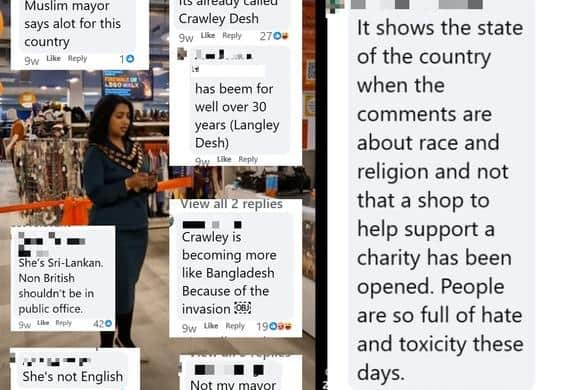

Alongside the petty, yet expected, digs at her clothes and what she was saying, presumptions about the mayor’s race and nationality were spewed prominently in the comments, countered vehemently by people who were clearly unwilling to let such attitudes pass unchallenged.
Michael Jones, leader of the borough council, called the comments ‘sickening’ and described the treatment received both on and off-line by candidates standing for election.
He said: “Some of the heated remarks made on the doorstep are a difficulty for any governing party in a mid-term election, but I’m afraid more can be currently attributed to the anger being stoked by hateful comments flooding social media.
“Real life incidents are still much rarer than on-line because I think most people still realise this is more likely to be treated by the police as a public order offence if it goes too far.
“Councillors are now frequently getting a lot more abuse on-line – by which I mean gratuitous abuse, rather than any legitimate argument on local policy or issues of debate.
“Sadly, I have noted that councillors from a BAME background appear to be attracting more of this, which strongly indicates a racist motive.”
Duncan Crow, leader of the Conservatives, said that, since the founding of Reform UK and the 2024 election of Donald Trump, he had seen ‘a higher level of abuse, aggression, and unpleasantness in the political arena’.
Mr Crow accused the far-right of becoming ‘increasingly emboldened and abusive, particularly with on-line trolling’. And he raised concerns that this would make ‘more civilised people less likely to air their views, for fear of abuse’.
It was a point well made, as anyone who has faced abuse on-line for daring to share an opinion will attest. The old statement ‘I disapprove of what you say, but I will defend to the death your right to say it’ clearly has very few followers on the bottomless pages of Facebook and X.
Mr Crow said: “I’ve seen some appalling things locally whipped up by notorious far-right figures in Crawley, including seeking to demonise British Asian men in our town, by circulating a video of a local man of Asian heritage being harassed by a far-right activist, wrongly accusing him of child sexual abuse.”
A spokesman for Crawley’s Green Party warned that hate speech could lead to a ‘divided and hostile society’, particularly affecting those from marginalised communities.
He added: “When public discourse becomes aggressive or exclusionary, it risks normalising discrimination and discouraging people from participating in civic life.
“Similarly, when politicians do not meet the expected standards, whether this be through their language, misinformation, or lack of accountability, it can wear away the public’s trust in politics and political institutions.
“This can turn people away from voting and lowering voter turnout.”
Independent candidate Richard Symonds stressed that free speech was ‘essential’ and respect ‘non-negotiable’.
While he has received no abuse on the door-step while out canvassing, he reported ‘a clear frustration’ among many people.
He added: “Many residents feel their concerns are being ignored, and that frustration is now being expressed more bluntly.
“People are more confident in voicing their views than a decade ago – but confidence without responsibility can quickly become divisive.”
On the issue of respect, the Green Party spokesman said some of the party’s candidates were worried about the reception they would receive when out leafleting.
Stressing that candidates from all strands of the political rainbow deserved respect and not to face ‘any hatred or abuse’, he added: “Everyone seems so divided right now, that it can be a scary experience not knowing who you will be faced with on the door step.”
Looking at some of the more complex issues which have grabbed people’s attention, Mr Symonds declared the need for people to be provided with accurate information, rather than being fed sound-bites from here, there and everywhere.
He said: “On complex issues, understanding is mixed. Some are deeply engaged; others are repeating headlines. That makes honest, clear explanation more important than ever.”
The need for honesty was one of the points echoed by Mr Jones.
He said: “There is a responsibility for those seeking to represent our communities to act responsibly and not to pander to racism and ignorance, or people’s baser prejudices.
“This is being abused by some, stoking fears based on people’s fears, often through outright untruths rather than actually addressing genuine dangers.
“Far more than ever, people feel happy to state as fact things which are merely their feelings. Representatives have a duty to be balanced and fair to the whole electorate.
“Sadly I don’t think some of those standing can or will adequately do this based on comments they have made.”
The lack of consequences for posting misinformation or even bare-faced lies on social media has not helped the situation.
People often choose to believe things that align with their opinions – this is nothing new. But when someone with a hefty bundle of followers shouts something from the rooftops, lots of people listen, whether it’s true or not.
And social media has a very high rooftop from which misplaced confidence can fly.
Mr Jones said: “I have noticed in the past couple of years a growing willingness to abuse using anonymous profiles, which have harvested stock photos of other people to build the pretence of ‘real people’ or just have pictures of pets on them with no real content.
“This is not the behaviour of normal members of the public. Many of these are clearly sock puppet accounts from far-right supporters or even foreign bots.”
Crawley’s Liberal Democrats and Reform groups were asked to contribute to this article.