
West Sussex local government reorganisation delayed again – reaction
The government has been called on to ‘engage constructively and respectfully’ with councils in West Sussex over local government reorganisation.
Council leaders said the failure of Steve Reed, Secretary of State for Housing, Communities & Local Government, to make a decision on how the county will be divided from 2028 was ‘frustrating and disappointing’.
The reorganisation forms part of plans to simplify local government by ending the two-tier system and establishing new single-tier unitary councils.
But, while other counties have been told what that will mean for them, West Sussex is one of those unlikely to hear before October.

Speaking in the House of Commons today (July 16), Mr Reed said ‘further time is required to get the decisions right’.
Martin Boffey, leader of Horsham District Council, said: “I would implore the government to change tack, engage constructively and respectfully with West Sussex councils in ways that it has not done thus far, and to help ensure any new organisation is a success.
“We continue to hope that the final outcome will be based on the needs of our communities and delivering services for local people in the most sustainable way.
“But this can only be achieved if the government recognises that local councils know their areas better than Whitehall or Westminster. We need to be part of this decision rather than a victim of it.”
The priority of the district and borough councils is to continue to work collaboratively with the government and each other to secure the strongest possible outcomes for their residents and communities.
But elections for the new shadow unitary authorities are scheduled to be held in May 2027, preparing for the new authorities to formally launch in April 2028 – and council staff have been left somewhat working in the dark as they prepare for the change.
Michael Jones, leader of Crawley Borough Council, said: “This latest delay begins to put at risk the safe and effective transition to unitary government in the time-frame specified by government. We are seeking clarity about next steps.
“In the meantime we will continue to work with West Sussex councils to seek to mitigate the impact of this further delay.”
Robert Eggleston, leader of Mid Sussex District Council, said “The further delay to a decision on the future of local government in West Sussex is disappointing and it means uncertainty remains for local communities, staff, and councils.
“We recognise the importance of taking the time needed to reach the right decision and will continue to work constructively with partners as the process moves forward.”
Jeremy Gardner, leader of Adur District Council, said: “Although we understand that this additional delay may be disappointing to residents, businesses, staff and councillors in Adur, we are keen to ensure that we get the right decision for our communities.”
And Caroline Baxter, leader of Worthing Borough Council, added: “Despite today’s announcement, we’ll continue working with neighbouring councils and the government to ensure the best possible outcome for Worthing, one that unlocks investment, supports local businesses and delivers strong and well-designed local services.”
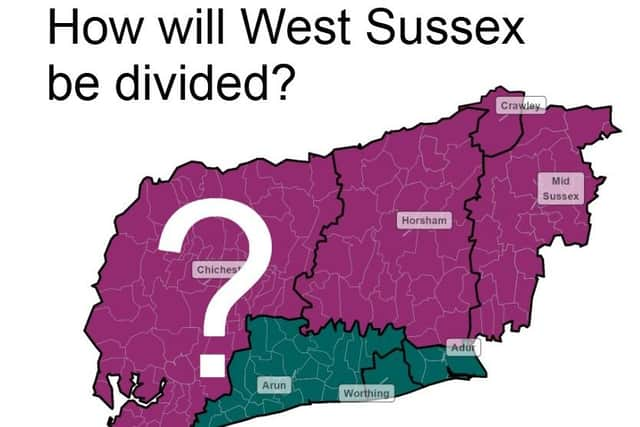
In September 2025, the county, district and borough councils submitted their preferences for the change. The county council proposed one unitary authority to cover the whole of the county, while the district and borough councils proposed two – with Adur, Arun, Chichester and Worthing in one, and Crawley, Horsham, and Mid Sussex in the other.
But Mr Reed put forward a third option – not popular with any of the councils – placing Chichester, Crawley, Horsham and Mid Sussex in one authority, with Arun, Adur and Worthing in another.
Adrian Moss, leader of Chichester District Council, said the government had been ‘unable to back their proposal with any evidence at all’ that it was the right way to proceed.
He added: “To not make a decision now is very worrying because it leaves uncertainty and will cause real issues for the councils and for our staff. It will make putting the unitaries together – doing the necessary work – really difficult.”