
REVIEW - Worthing Lunchtime Concert of Songs by female composers
REVIEW BY Richard Amey - Lunchtime Concert of Songs by female composers, Christ Church, Worthing by Caroline Goodwin (soprano) and Zhanna Kemp-Dashkovskaya (piano).
Enough resurfacing women composers to form a football team featured in this programme – one of them the singer herself. British soprano Caroline Goodwin and Russian pianist Zhanna Kemp-Dashkovskaya performed 14 items by 11 lady composers, yet only for two male flies to appear in the ointment. Ironically, they reared their heads in the item that most moved the audience.
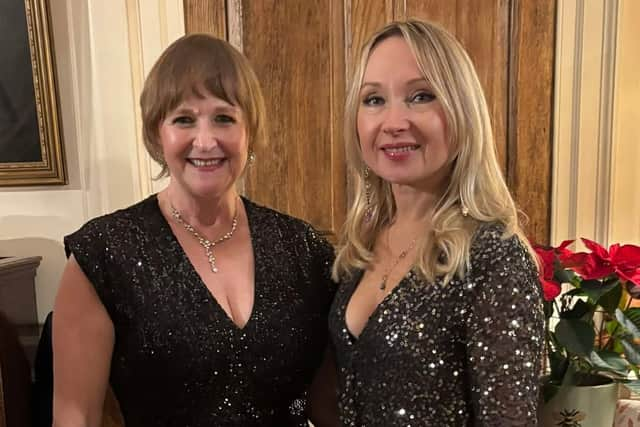

The song that cut the deepest was not the first, but their 11th: ‘Tenderness’, by Alexandra Pakhmutova, which Zhanna (say it “Zjarna”) introduced by quoting one of its lines: “The world is empty while you are gone”. No, the subject was not a romantic male, departed for bed sheets new, but a Russian hero being worshipped nationwide in 1961 after becoming the first man in space: Yuri Gagarin.
A Latvian member of the audience later joined Zhanna in telling me the song was the idea of Gagarin himself and the words of the song – although written from a woman’s view – were by the composer’s husband. Lacking this extra information to confuse their listening, the audience became almost spellbound as Russian art struck abroad yet again. Their artists do masterclasses like this in finding a way to feel down about something triumphant.
Caroline told me she finds her audiences often in tears over this song, which, after Gagarin fell back to earth, became a Russian chart-topper and turned Mrs Pakhmutova, then 32, into the USSR’s famous go-to, all-purpose female composer. Might the western tears not be tragic emotion, but despondent envy? Having an anonymous space-touring millionaire tattooed on your torso is not a fraction the same as having your own pioneering cosmonaut smiling out through your open shirt-front!
The up-gearing last lap of this concert was spurred by their 10th song. French, short, urgent, a ‘Chanson’ of roses, lilies and kisses – with the instruction (genuine female, this time) to him “the most beautiful” to “close the curtains”. Had it been sung in English, it would have had the suddenly-understanding male audience members springing to their feet to form a queue.
The composer of this seduction? Sober-sided classical buffs be shocked: Nadia Boulanger, the doyen teacher at Paris Conservatoire who, in this context less of a surprise, sent pupil Astor Piazzolla back to Buenos Aires to make his name in the nightlife steam and passion of Argentine Tango.
Then came the fine American, Amy Beach’s exuberant ‘The Year’s At The Spring’ (more female sap rising), followed by ‘It Was A Lover And His Lass’ by Streatham composer Madeleine Dring – this 1949 Shakespearean setting racily combining folk flavour with jazz.
The audience brought on a Mexican encore in a sultry minor key with a back story, making the male world look stupid, amid all the mysogyny controlling most of western 20th century music selection for publication and performance. Until Kate Bush melted the rug under their feet.
Consuelo Valazquez was 16 when she wrote ‘Besame Mucho’ in 1932. She had to use a male pseudonym. “Kiss me: kiss me a lot. Gaze at me with your green eyes for the last time before leaving me inconsolable”. First banned, it became a jazz standard, while she gained world fame in popular song and concert piano. She could only then use her real name.
Pianist-singer Pauline Viardot (a genius, declared Liszt), Cécile Chaminade (world famous in the 1870s) and Boulanger were the French composing contingent with six songs chosen here. Afro-American, Florence Price’s sensual ‘Songs To The Dark Virgin’ ambiguously extols a black-skinned beauty in glamorous raiment, capable of malevolent destruction. Baroque self-publishing Barbara Strozzi (Italian) with Boulanger provided laments to love and death loss.
Caroline Goodwin’s own composition was Padre Nostro, her 2005 setting of The Lord’s Prayer for the Italian church, which she explained lacks much performed contemporary sacred music – an area she wanted to develop, including adapting English solos. Her vocal strength in high register surfaced in many a song climax, while in a different presentation she may well score with more prolonged music in her lowest range, which on fleeting hearing seems capable of conveying mystery.
Zhanna played a satisfying solo piano piece, ‘Rose’ by her compatriot Leokadia Kashperova, who taught piano to Stravinsky, but whose own music lay forgotten after the Revolution. In piano partnership with Caroline’s voice, Zhanna’s control, balance and articulation was impeccable.
Caroline Goodwin introduced each item, except Zhanna the Russian pair, and the background and lyric information they shared importantly enhanced the audience engagement.
Next up at Christ Church is Brazilian solo pianist, Clelia Iruzun (12.30pm, February 25)
Richard Amey