
The crucial role the audience has to play in Chichester's Hamlet
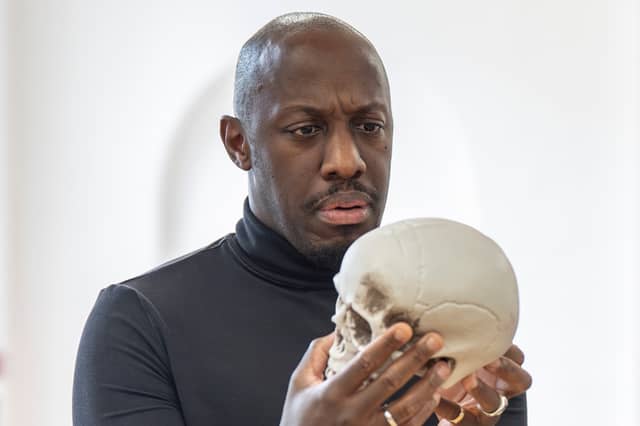

You can be daunted by Hamlet…. if you let yourself.
Giles Terera, our Hamlet in Chichester Festival Theatre’s first-ever production of the play, prefers to approach it as a blank canvas. It runs in The Minerva Theatre from September 6-October 4, directed by CFT artistic director Justin Audibert.
“I have always loved the play,” Giles says. “I remember reading it at drama school. I didn't see a lot of Shakespeare at school but at drama school I had a teacher that really turned me on to Shakespeare. And Hamlet was one of the first plays that I read and at that point in life you realise that you find yourself having these thoughts yourself and having these feelings and these passions yourself. It means something. You recognise it, and I fell in love with the play.
“But the way that I choose work and the way that I think about roles tends to be that I look for things that are engaging and for things that I've never done before. And also the more work I do, the more I'm interested in working with different directors and in hearing their thoughts and in seeing their work. It is less and less about having a shopping list of characters I want to play, but in a way Hamlet was always there.
“I love Shakespeare and I don't like being away from Shakespeare for too long. The last one I did was Othello a couple of years ago. But I don't think there was an inevitability about doing Hamlet one day. But I would say that I have been in preparation for it. I was in a production once before. I was Horatio at the National Theatre when Rory Kinnear played Hamlet and you tend to think that you know the play well but once you are in a production you realise that you don't, that there is so much more to discover and to explore.
“And also Shakespeare speaks to us in a different way depending where you are in your own life. If you read Romeo and Juliet at the age of 16 it's one thing but then if you see it again at the age of 60 then it will be something else again and that's the same with Hamlet – there are infinite ways of looking at it.
“Justin and I had worked together before, and we were looking for something to do. We just picked up on that conversation but I think with anything that I do, I'm always thinking ‘Why are we telling the story now? What is the reason for doing this now?’ If I do a piece of theatre, I'm always looking for something that will resonate with now. But actually Shakespeare will always resonate. That's the genius of Shakespeare.
“But even so you have to think ‘Why now?’ and when I read the play again, I was really interested in the fact that the characters are all of them discussing the social climate within Denmark, the state and the mood within society. Everyone's discussing it from the most influential people right down to the grave diggers. Everyone is analysing what is going on within the world of the play and I think that reflects where we are now. Hamlet is the heir to the throne of what? What is this country and what is this society that he is potentially ruling? And in the middle of this play there's a revolution. Laertes storms the castle with a riotous mob and calls for the king to be overthrown.
“I've seen the play a few times and what is really striking me now is that everyone in the play is talking about what is going within this society.”
As for playing Hamlet, as Giles says it could be daunting if you let it: “But I've always thought with any play or any character, I want to come to it as a blank canvas. I want to have an open mind. Obviously the reputation of the play and the legacy of the play in people's thoughts and opinions are infinite but I want to come to it fresh.”
And what helps in that respect is the fact, as Giles says, that Shakespeare is always very mindful of what an actor has to do: “I saw that in Othello. The fact is that he has constructed the part very, very well in terms of the climaxes and of the peaks and the troughs. He’s done all the work for you. The soliloquies are very sound in their exploration of philosophy and religion and the human impulse. You can really appreciate the writing. It is all there. You just have to pick it physically. You just have to make sure that your mind is sharp.
“But I'm at a point in my career where I've been working for a while, where my goal is always to hone my craft. I'm always thinking that I want to learn something, and the next thing I do will have the benefit of the fact that I have played Hamlet.”
And that means a unique relationship with the audience, which is again a reason the production is being done in the Minerva: “The audience is so vital to Hamlet. The role that the audience plays is so important. I really wanted to be able to see every single one of them, every single person. It is about talking to the audience. You think of the soliloquies and these are speeches where Hamlet is trying to reach conclusions to the dilemmas that he is facing. And there are many points where the audience could respond. The fact is you have to feel that he is trying to work it out and what you want is really a two-way conversation with the audience. I really don't think the audience has a passive role in Hamlet.”