
Sussex named among the worst places in England and Wales for road traffic collisions involving cars
Sussex has been named among the worst places in England and Wales for road traffic collisions involving cars, according to new figures.
It ranked joint-fourth, alongside Cumbria, with 53 incidents per 10,000 people recorded last year.
Staffordshire recorded the highest number of incidents at 112 per 10,000 people – almost double that of South Wales, which was second at 60.
The third most hazardous place was Humberside at 56.
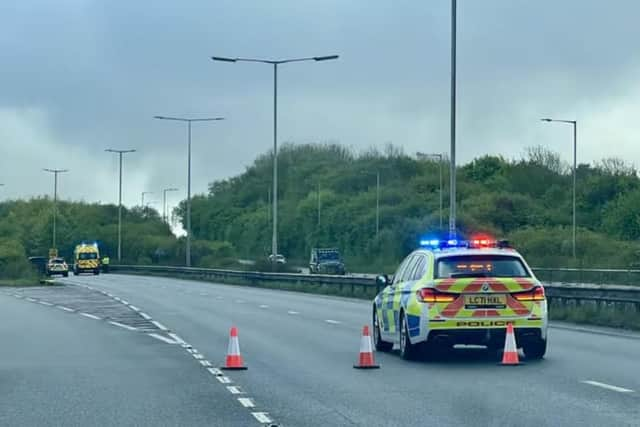

The figures were compiled by legal technology specialist Access Legal, using police data from 2022 to 2024.
Humberside was named the most dangerous place for those classed as ‘vulnerable road users’ such as cyclists and pedestrians. There were 56 collisions per 10,000 involving pedestrians, and another 56 per 10,000 involving bike riders (motor and pedal bikes).
Sussex also saw two collisions involving bike users – motor and pedal – and 10 involving pedestrians.
Darker nights and bad weather can lead to a rise in incidents. Separate figures from the AA suggest that crashes rise by around 11% in the fortnight after the clocks go back compared to the previous fortnight.
As well as highlighting the most dangerous areas, Access Legal also looked at which ones were the safest and which had seen the biggest improvements.
Greater Manchester came top for both driver and bike safety with six incidents per 10,000 people, and one per 10,000 respectively.
Staffordshire – despite being the most dangerous place for motorists – saw one pedestrian collision per 10,000 people, the lowest of anywhere in England and Wales.
Of the 21 areas analysed, 17 saw a decline in car collision numbers over the past year. The biggest drop in 2023-24 was in North Wales (-34%), followed by Greater Manchester (-30%).
In contrast, Cumbria saw the biggest 2023-24 increase at 16%, while Avon & Somerset and Essex reported marginal rises of 2% and 0.6% respectively.
Mark Baker, road safety team manager at Sussex Police, said: “Road safety remains an absolute priority within Sussex Police, Chief Constable Shiner as the National Police Chiefs’ Council lead for Roads Policing is determined Sussex Police will work to prevent death and injury on our roads.
“The Sussex Police vision is to make the road network of Sussex safer and free from death and serious injury.
“Our principles are:
- Engage – We will engage with the public and partners, using this as the first tool to achieve our vision.
- Educate – We will use opportunities to educate the public to remove death and serious injury from the roads in Sussex. Including where appropriate offering educational diversionary schemes as an alternative to prosecution
- Enhance – We will work internally and with the public and partners to enhance our own capability whilst improving road safety and supporting other agencies with their responsibilities where appropriate.
- Enforce – We will use proportionate enforcement as a tool in achieving our vision, following national guidance as to thresholds and enforcement standards.
“This will be achieved through the following:
- We will work with partners where appropriate to recognise individual agency capability and responsibility.
- We will robustly target the fatal 5 offences. Developing specialist capabilities which will include the development of a Fatal 5 Team.
- Our decisions will be evidence led through improving data collection to best target resources and funding.
- We will target the repeat, persistent drivers who continually pose a risk to pedestrians and other road users. Utilising the criminal justice system
- We will develop and explore new and innovative ways of working to be at the forefront of roads policing delivery.
- We will maximise opportunities to invest in and improve road safety, particularly in known casualty hotspots.
- We will offer diversionary and educational activities to positively influence driver behaviour.
- We will deliver renewed enforcement activities through capital expenditure in mobile camera capabilities.
- We will work with local communities to problem solve and deliver long term sustainable solutions to road safety.
- We will ensure that victims and families receive appropriate levels of support when effected by serious injury or road death.”
Sucheet Amin, a senior partner at Aequitas Legal in Manchester and a personal injury solicitor since 2001, said: “You’ll need to call the police if you or a passenger are injured in a collision, as well as an ambulance if urgent medical attention is required – and notify your motor insurance company as soon as you can, even if you weren’t at fault.
“In any collision, it’s important to exchange details – including name, contact details and home address.
“While it’s helpful if the other driver knows their insurance company, it’s critical that you obtain the car registration number and the make, model and colour of the vehicle.
“As long as it’s safe to do so, taking pictures and videos of the scene and where the cars ended up can prove useful evidence.
“Try to capture any tyre marks and positions before moving the cars to the side of the road if you can do so safely.
“If there are any witnesses, ask them for their full contact information.”
“Most people know they are entitled to compensation for injuries and lost earnings but there could be other elements such as damaged property in the car, increase in car insurance premiums, and repaying private healthcare costs.
“Where someone is seriously injured and they require care from a partner, family member or friend, then a claim for care and assistance is possible.
“In extreme cases where a person isn’t able to return to the same job or can’t work at all, future loss of earnings can be claimed which is often complex.
“There may also be complexities around proving the accident wasn’t your fault or gathering the necessary medical evidence to support a claim for serious physical and psychological injuries.
“A personal injury solicitor can help you to navigate this – and they will know how to value your compensation claim and ensure you receive a fair settlement.
“If the party at fault denies causing the accident or refuses to agree to fair compensation, a solicitor can involve the court for a final decision.”
Read the full report here.