
Why are sinkholes appearing across Sussex? University professor explains what’s behind the recent spate of incidents and whether they can be prevented

From Bexhill to Bognor Regis, Sussex has been hit by a spate of sinkholes since the beginning of 2026.
The incidents, which have occurred from the east to the west of the county, have caused dozens of road closures and traffic delays as councils have tried to repair each sinkhole as quickly as possible.
On June 1, West Sussex County Council announced that excavation works had finished at a sinkhole following the closure of Linden Road, Bognor.
In July, West Sussex Highways said a sinkhole had opened in Barnham, just outside a barber shop in Barnham Road. The incident happened while Yapton Road in Barnham remained closed following the discovery of another previous sinkhole.
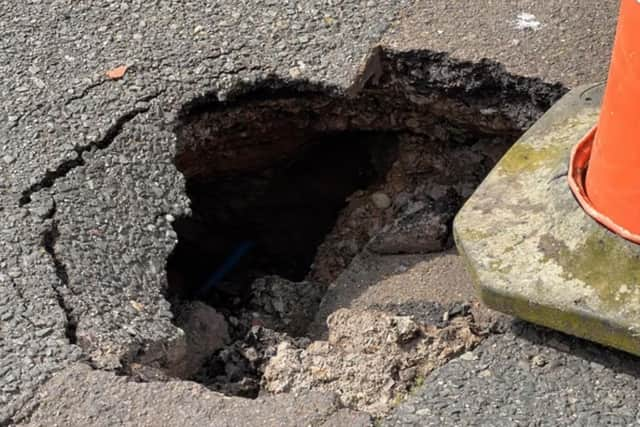

In early July, East Sussex Highways closed a section of Cooden Sea Road in Little Common, Bexhill, following the discovery of a sinkhole. Repair works were expected to last for days and East Sussex Highways said this happened as investigations into earlier sinkholes in Eversley Road were ongoing.
Other road closures due to sinkholes appearing since the beginning of 2026 have happened in: East Wittering (Stocks Lane), Petworth (Middle Street), Hove (Adelaide Crescent) and Crawley (Three Bridges Road).
We asked an expert from the University of Brighton what could be behind the recent incidents. Martin Smith is a Professor of Geochemistry, as well as a geologist and mineralogist, and is the Associate Dean for Research and Enterpise in the School of Applied Sciences.
He told this newspaper that sinkholes can form depending on the bedrock geology that they are on.
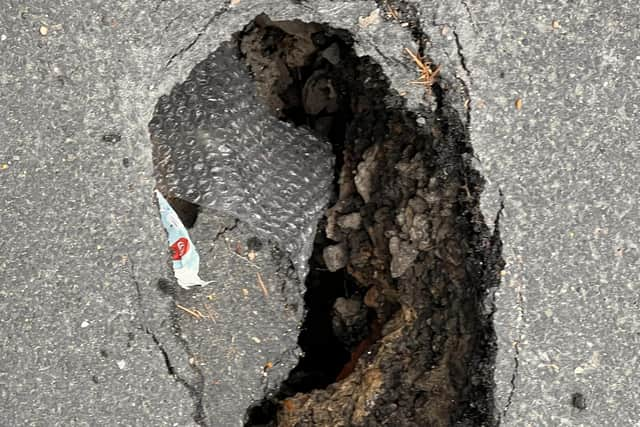
He explained: “You can have sort of loose sand, so that if there’s heavy rainfall it actually washes sand out from below the surface and eventually that collapses and opens up a sinkhole. Or it could be that they’re on chalk. Because it’s limestone it can dissolve. So over time a cavity can actually dissolve in the rock and, eventually, that will collapse into what is the early stages of a cave system forming and a solution cavity forming.”
Professor Smith said sinkholes forming is mainly to do with the ‘underlying geological materials’. He said: “If you’re looking at areas that have got relatively unconsolidated sandstone – material that's more like sand than sandstone really – then that can wash out and be moved. And if you’re on chalk then dissolution of chalk can build up over time, particularly if you’ve got water concentration.”
He continued: “I don’t think it’s particularly a coastal thing. It’s down to the bedrock or the sediments overlying the bedrock and what they are.”
When asked whether there is an increase in sinkholes at the moment, or whether we just seem to be noticing them more, Professor Smith said: “It could well be that it’s just a coincidence. Potentially, when we’ve had some heavy summer rain that may have had an influence on it.”
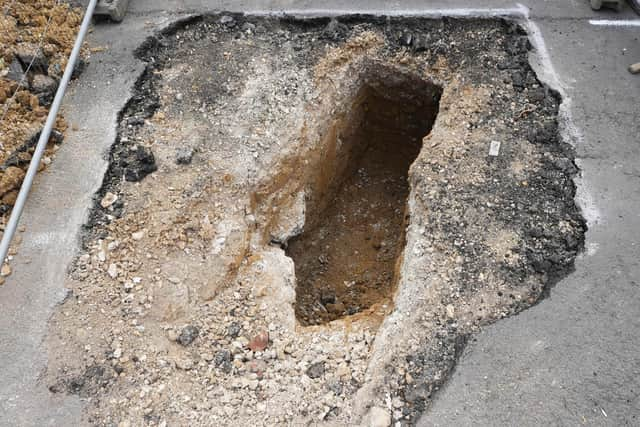
He said: “It could just be that we’ve had a very dry period – particularly where you’ve got loose sand where material’s dried out and loosened, and then heavy rainfall has washed out some of the support under a road system.”
Professor Smith said that heavy intense rainfall at any time of the year could do this. But he clarified that he would need to look properly at the individual sites to say exactly what was going on.
Professor Smith added that he could not give an expert opinion on how to repair sinkholes because he is not a civil engineer. But he said that if sinkholes are on loose sediment then something would need to be done stabilise the sediment and backfill the hole. Sinkholes on chalk, meanwhile, could mean large cavities building up over time, so they would need larger engineering solutions.
He said: “Ultimately I think they’re not preventable. It would take a major change to how a road was constructed in the first place. If there’s no visible cavity when construction takes place it could develop afterwards. You could look for early detection signs but that would mean regular surveys. So it would be very difficult to actually prevent them.”
He said companies could, during construction, identify areas that might be prone to sinkholes by understanding the geology. They could then ‘construct accordingly’. But Professor Smith added: “Sinkholes can form after construction so there’s no definite way to decide where they’re going to form.”