
Walking in Turner's footsteps at Petworth House
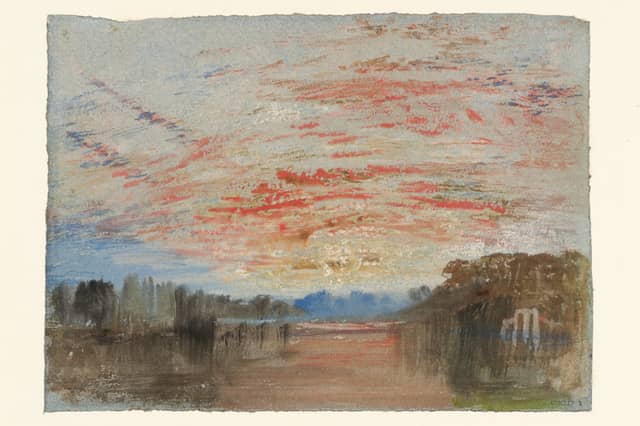

The 250th anniversary of Turner’s birth is the perfect moment to explore his long and important association with Petworth House where he remains a key driver of visitors.
His hold on our collective imagination is still immense – as a new exhibition at Petworth will demonstrate.
Emily Knight, property curator at Petworth House, said: “I think a lot of that has to do with the fact that he had an incredibly long and productive career which was really varied. You see how his style changed as an oil painter. There is a huge arc in his development as an artist but it was also his use of other media. He is best known for his oil painting but there is an amazing array of his work. He was a watercolorist and he worked in print and he did so much else.
“And I think also there was a level of experimentation, and that is something that we have looked at in this exhibition, his interest in light and colour and atmosphere and reflection. You can see him feverishly exploring all these ideas whether he is working on canvas or on paper. He had this continued artistic curiosity, and it resulted in a phenomenal body of work. For a creative and artistic mind, the world and how he sees it and experiences it is forever interesting. Whether he was reaching for something that he could not obtain or whether it was just his eternal curiosity I don't know but in my view I think there was just this feverish need to experiment within him.”
Coupled with which of course there was an incredible skill: “He visited Petworth in 1827 and that was his most productive visit. There is a huge body of work that came from that. You can see him playing with perspective. Some of it is very slight. Some of it is much more finished, and we know that certainly from 1827 until the death of the 3rd Earl of Egremont he was coming on an annual basis.”
His links with Petworth go back much further than that, though: “I think Petworth brought him this amazing landscape to explore with an incredible patron, the 3rd Earl who was very open and welcoming. There was quite a buzzing social life here and Turner could come and explore the landscape and the fishing ponds! There was a really relaxed atmosphere.
“And the 250th anniversary is a great way to celebrate. The story of Turner at Petworth is so important to the National Trust because it is such a big driver of our visitors, but the great thing is that there are very few places where you can stand, as you can stand here, and feel that you are standing in his footsteps in such a real way.”
The exhibition offers the largest collection of Turner’s works in the UK outside London. It shows how he was inspired by Petworth’s Capability Brown landscape and historic art collection. It also delves into Turner’s experiments with colour, light and atmosphere as well as his relationship with Petworth’s owner, the 3rd Earl of Egremont.
Turner’s Vision at Petworth exhibition runs until November 16 at Petworth House and Park.
The Tate is the principal lender for the exhibition, and conversations started with them at the end of 2023 and the beginning of 2024.
Emily said: “It is very exciting and satisfying but nerve-racking that the exhibition is open. I hope that we are saying something that adds to the conversation around Turner and Petworth. We have been quite playful with the design of the exhibition and really wanted to draw on some ideas about his techniques.”