
County cricket – an antidote to many of sport’s ills... and everyone should give it a try
In a world of hyper-capitalist greed, county cricket offers escapism to a simpler time
As the new County Championship season begins, it’s worth noting that the charm of the county game is no revelation - but juxtaposed with the hostility of today’s world, it’s never felt so vital.
Sitting at the 1st Central County Ground in Hove on a sun-drenched Thursday afternoon was practically the stuff of sorcery. It was mid-March, but in a welcome act of meteorological subterfuge, those without the knowledge would assume it was a mid-summer’s day.
For Sussex County Cricket Club, it must have felt like a literal breath of fresh air. After a torrid winter, one where the story of financial mismanagement resulted in points deductions across all three formats and outcries of dismay from former players, a sun-drenched, pre-season friendly that welcomed a healthy smattering of spectators through the gates (free of charge) would have lifted the spirits of everybody associated with the club.
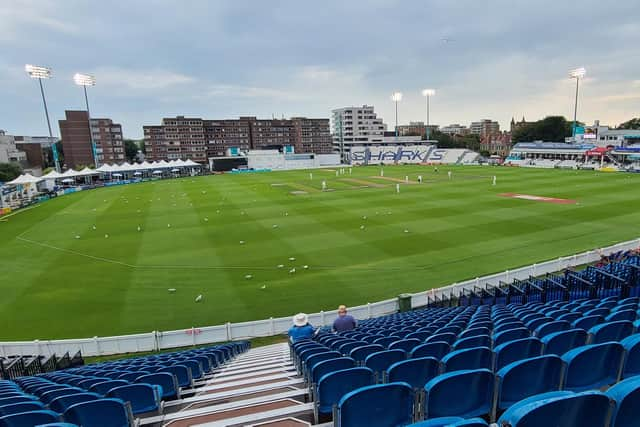

And so it should. It certainly lifted mine. Looking out from my seat, I was struck by the intimacy and seclusion offered by this wonderful old ground in the heart of vibrant Hove. I am local to the club, born a couple of miles up the road in Brighton, yet the number of time I’ve spent within its confines is embarrassingly small.
The majesty and charm that county cricket offers has never been lost on me, and I understand why those who follow it closely may view this apparent and sudden enlightenment through a negative lens, but hear me out.
Professional sport, just like the wider world it’s part of, has become a soulless venture in pursuit of endless growth. What was once part of communities and financially accessible to all is now a hyper-capitalist vehicle intent on extracting the maximum from the very people who gave – and continue to give – the whole thing life.
You don’t have to look far to see this in action. In cricket, it’s India, England and Australia’s ransacking of the majority of the world game’s finances. In football, it’s the now commonplace, last-minute changes to Premier League fixtures that leave fans facing impossible journeys or astronomical travel costs. This is for the benefit of broadcasters.
The free-marketeers will tell you this is only fair, as the sums of money pumped into the game by companies such as Sky Sports should at least yield preferable viewing slots. There might be a world in which this is fair, but it’s not this one, because fans face the double burden of broadcasters hoovering up the soul of the game for the benefit of the subscribed TV viewer, as well as ever-increasing ticket costs.
For instance, take Arsenal: the current league leaders received the third-highest amount of ticketed income (£127m) in the 2023–24 season, behind only Real Madrid and Paris St-Germain. Yet this hasn’t stopped season ticket prices from increasing five years in succession. In addition to that, the club has introduced two new general admission ticket categories, ‘A+’ and ‘B+’, which, despite all the PR, is in my view shameless and merciless.
Across all sports, the venues themselves are suffering too. In my relatively short lifetime, English football has lost The Baseball Ground, Maine Road, Highbury, The Dell, Upton Park, White Hart Lane, Goodison Park and many more grounds. Australian cricket is also on the slow road to apparent multi-purpose symmetry, with The Gabba to be demolished after the 2032 Olympics.
Despite their obvious comfort and benefits, a world where professional sport is played out inside indistinguishable silver bowls will suffer as a spectacle. We are perhaps only decades away from such homogeneity. It is, at the end of the day, an effective arms race.
This is why county cricket is so important. This is why, sitting in my seat at Hove, the juxtaposition of the outside world had never felt so stark. It offered a glimpse of what things were - literally how things looked - as photographs in the museum showed a barely changed landscape, I felt connected to a time before concrete mega bowls, surveillance doorbells, and soon-to-be trillionaire tech bros.
Perhaps most importantly, though, it offers the sanctuary of a member-owned model. One that distributes power more evenly, where all appointments are decided by vote, and with no shareholder to reap dividends - a total reinvestment of any profit. No matter how big or small.
Yes, there are long-standing financial problems embedded into most counties, and the demographic of the members is likely far from representative, but this doesn’t mean a 150-year-old ownership model (still adopted by 15 of the 18 county teams) that is built upon the principles of pure democracy is a bad thing. Nor does it mean it can’t offer escapism from the complexity and brutality of today’s world.
So, if your schedule ever permits, try it. In the case of Sussex, most evening sessions of home County Championship matches are free to enter (many clubs offer this). You can even bring your own alcohol and food.
In a city where the price of a pint is increasingly hovering around £8, the option of bringing your own food and drink into a 153-year-old venue to watch professional sport is certainly something to bear in mind.
Or perhaps more generally, in a time when it’s increasingly impossible to relate to those who govern us, you just want to feel part of something. If that’s the case, then a small dose of county cricket might just be the tonic for you.