
I faced Centre Court serves in real time at Wimbledon from Andy Murray, Jannik Sinner and Naomi Osaka – and 5G technology made it brutally real

Standing in Wimbledon Park during The Championships – I had the opportunity to return serves from Andy Murray, Jannik Sinner and Naomi Osaka.
Well, not exactly – but it wasn’t far off.
In reality, I tried out a 5G-powered system designed to recreate the speed, spin and trajectory of live Centre Court serves using real-time match data.
The experience, known as Vodafone’s 5G+ Serve, uses the UK’s fastest 5G+ network (Vodafone’s next-generation 5G Standalone technology) to capture live serve data from the Wimbledon broadcast feed and stream it over a dedicated network slice. That data is then fed into a custom-built robotic arm and tennis ball launcher capable of recreating elite-level serves with startling accuracy, pace and spin.
It’s not just a simulation. It’s an attempt to reconstruct the physics of professional tennis in real time.
Oliver Kibblewhite, founder and managing director of the 5Gs, explained the thinking behind the system.
“We’re taking real-time telemetry from Centre Court as well as a full menu of some of the greatest hits shots and we use this custom tennis ball launcher to be able to replicate those shots here on the court for users and members of the press,” he said.
The idea, he added, came from a simple but revealing question: how do you bring the reality of professional tennis to people who will never normally face it?
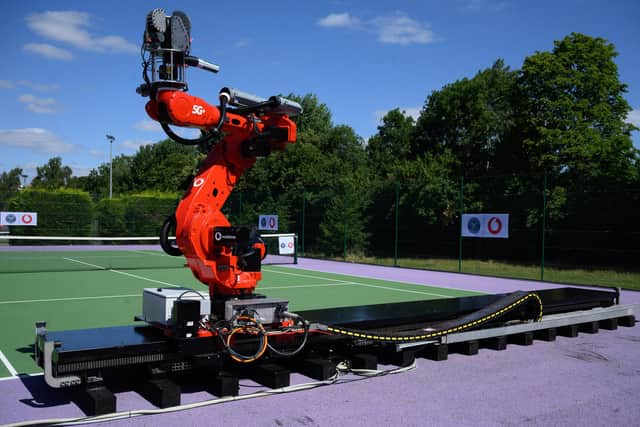

“Returning a serve from a tennis pro is something that most of us will never get the opportunity to actually do,” he said.
That challenge is exactly what Vodafone’s 5G+ Serve is designed around. New research commissioned by Vodafone shows how widely underestimated elite tennis actually is. A third of Brits (34%) believe they could return a professional serve with training, rising to 43% of men and more than half (51%) of under-35s. One in five (19%) think they could do it with no training at all.
That confidence stretches further: 13 per cent believe they could return a serve from men’s world number one Jannik Sinner, and 22 per cent think they could handle a serve from Serena Williams, while nearly one in four men believe they could win a match against a professional at Wimbledon if prepared.
On court, that optimism tends to evaporate quickly.

Once the experience begins, the setup becomes clearer: an industrial robotic arm paired with a custom launcher engineered to reproduce real match conditions – including extreme pace, directional variation, and spin derived directly from live data.
The system can replicate serves at up to 153mph, a benchmark claimed within the Wimbledon environment as part of the installation. As Kibblewhite put it, “I would say about 50 per cent of people manage to get a racket to it. The return rate though maybe not quite so high.”
Then it was my turn.
I chose to face serves inspired by Sinner, Andy Murray and Naomi Osaka. The machine doesn’t feel like a game or simulation once it starts – it feels like reaction time compressed into fractions of a second. The ball arrives fast, heavy, and often with unpredictable movement off the bounce.
Out of six serves, I managed to return just two. Even those returns barely counted as controlled shots. The rest passed in a blur of pace and angle that left little room for adjustment.
What makes the experience unusual is its grounding in real-world data. Vodafone’s 5G+ Serve pulls directly from live broadcast feeds and historical match archives, meaning you are effectively reacting to the same kinds of serves delivered on Centre Court.
The realism is reinforced by timing. The system uses Vodafone’s 5G+ Local Slicing, reserving dedicated capacity on the network to ensure ultra-low latency and consistent performance even during peak demand across the Wimbledon grounds. That infrastructure is what allows serves to be recreated almost instantly, rather than as delayed or buffered simulations.
Former rugby player and TV personality Joe Marler launched the experience on day one of The Championships.
He said: “I was up for the challenge – I’m not a professional tennis player, but I’ve got decent reactions and some padel experience, so I backed myself going in. Safe to say, I was humbled. It’s a lot harder than it looks.”
Two-time Wimbledon doubles champion Jamie Murray also highlighted the reality gap between perception and performance.
“Returning a top level serve is one of the hardest things an athlete can do… it’s about spotting subtle cues and anticipating the shot before the ball has even left the racket,” he said.
Vodafone says the experience is designed not just as entertainment, but as a demonstration of what its network can enable beyond sport – from real-time gaming to high-quality live streaming. As part of its role as Official Connectivity Partner of The Championships, Vodafone has enhanced 5G capacity across Wimbledon, aiming to deliver faster speeds and more reliable performance across the grounds, even at peak congestion.
The broader context is clear: connectivity is increasingly shaping how fans experience live sport. Vodafone’s research found that 41 per cent of Brits see innovative fan experiences as key to bringing them closer to the action, whether through immersive tech like AR or VR, or opportunities to experience elite performance from the inside.
For spectators at Wimbledon Park, the 5G+ Serve offers exactly that – not a filtered highlight, but a direct confrontation with elite-level speed.