
REVIEW: How The Gang of Three at Chichester's Minerva Theatre proves that nothing has really changed in 50 years' of British politics

Forty-five years’ ago the headlines of the national newspapers were awash with the phrase ‘The Gang of Four’.
In 1981, the unthinkable happened to an unchanging political landscape dominated by two – the Labour and Conservative Parties.

Margaret Thatcher, the Tories’ prime minister, had secured her first term in office two years earlier.
Meanwhile, the Opposition was divided. Sound familiar?
Four heavyweight politicians – David Owen, Shirley Williams, Roy Jenkins, and Bill Rodgers – decided to leave Labour and form their own central, pro-Europe party, the SDP. They had become increasingly concerned by, as they saw it, Labour’s drift to the left and its animosity to a stronger European political understanding.
This touring production at Chichester’s Minerva Theatre appears to have lost one of the four in its title The Gang of Three.
But not so.
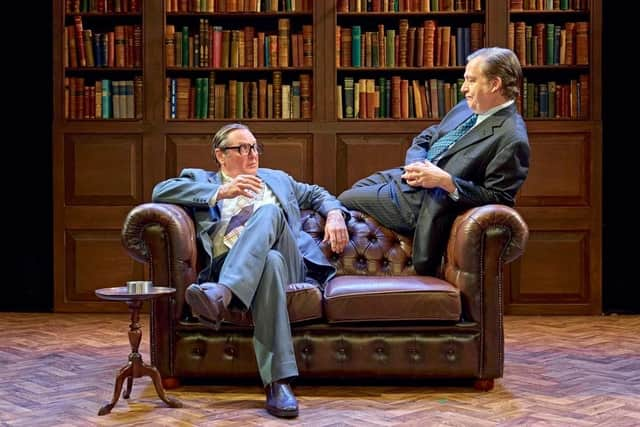
While the three features Roy Jenkins (Hywel Morgan), the other two are other ‘big beasts’ from Labour – Denis Healey (Colin Tierney) and Tony Crosland (Alan Cox). Robert Khan and Tom Salinsky’s drama explores the political journey leading to the split, through the prism of their political ambitions, social philosophy, and background.
The suggestion is clear, that if they had joined forces more effectively they could have taken the Labour leadership at several key points – not least after the resignation of Harold Wilson in 1976 - and the ultimate division would never have happened.
This is a short, quick witted and perfectly honed revisiting of possible conversations between the three.
Story-line? Not exactly. There is no rounded beginning, middle and end. Instead it is a series of stained-glass fragments leaded together to shine a radiating light on a period of modern political history which is often overlooked.
Whatever your party politics, there is however a depressing sub-text that in politics nothing has really changed. Half a century later and the parties are still arguing about what if any political arrangement there should be with the rest of Europe, how the economy should be managed, and how you bring equality to all while incentivising those who will create the wealth to fund ambitious spending plans.
More than that, as the revolving door of Prime Ministers in the past decade has shown – the apparent appetite of some MPs to further their own political careers remains unabated and untamed.
Thought-provoking, entertaining, and underpinned by meticulous research, The Gang of Three challenges the political machine of British democracy.
Perhaps in another 50 years, future audiences will see something similar around the birth of other parties – Reform, the Greens. Whether the underlying scenarios are significantly different though very much remains to be seen.