
Fresh talent and skills for the future of farming take centre stage at the 2026 South of England Farming Conference
See the latest news from Your World at https://www.sussexexpress.co.uk/your-world
The South of England Agricultural Society hosted its annual Farming Conference on 11 November at the South of England Showground in Ardingly, West Sussex, attracting more than 200 attendees in person and online.
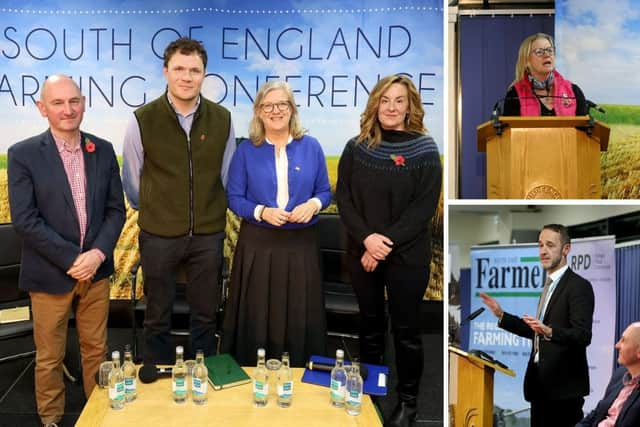

This year’s theme, ‘Who’s Responsible for the Next Generation?’, brought together leading voices from across the agricultural industry to discuss the shared challenges and responsibilities facing the next generation, against a backdrop of economic, environmental and social change.
Introduced by Kaye Masefield-Baker, trustee of the South of England Agricultural Society, and chaired by Charlotte Smith, presenter of BBC Radio 4’s Farming Today, the conference panel featured Matt Naylor, Group Managing Director at Naylor Flowers, and Co-Managing Director at Socius; Holly Morgan, Farmer at West Sussex-based Butterbox Farm; and Joe Barrett, Regenerative Agriculture Manager at Nestlé UK & Ireland.
Kaye set the scene, saying the next phase of farming won't be all about food production, but also sustainable land management, environmental protection, diversification, recreation, health and wellbeing, and how we look after the countryside. “New entrants will come from all backgrounds, including science, IT, PR, HR - all the skills that are needed by our industry. Being a farmer is now so multi-faceted, we need to welcome these new entrants into our community,” she added.
Understanding people and what motivates them
Opening the discussion, Matt Naylor shared his experience of growing his flower business, highlighting the importance of effective people management in attracting and retaining staff. He explained that everyone joining his business is motivated by different things, whether that is pay, flexibility or personal ambition, and that understanding these individual needs is essential to building a successful team.
“When we talk about the problem of the next generation in generic terms, as a single problem to be solved in a single way, it is more complex than that, as every business is individual and every region is different in terms of what it needs,” said Matt.
His approach is to understand what matters to each individual and create an environment in which people can achieve their ambitions. He believes the ability to manage and motivate people with different needs and expectations will be one of the most important skills required by the next generation of farming business owners.
Opening the door to people from outside farming
Holly Morgan shared her journey into agriculture, having started her career in farming despite not coming from a farming family. What began with an inspirational visit to a farm as a child has developed into a thriving business supplying meat boxes to the local community, operating a popular farm shop and café, and bringing people closer to agriculture through farm visits and seasonal events.
For Holly, education and engagement are vital to encouraging more people into the industry and helping consumers understand where their food comes from.
“Every weekend we welcome hundreds of children into our farmyard to meet us, meet the animals and see what we do. They might even see a lamb being born or hold a chicken,” she explained. “Having this contact with the public gives us the opportunity to educate our customers, answer their questions, promote local suppliers and champion local producers who are unable to get their products onto the shelves in shops.”
Holly believes that connecting with the local community and continually looking for new ways to diversify have been central to the growth of her business. Exploring different ways to generate income from a farm not only creates new opportunities but also helps spread financial risk and build resilience.
Regenerative agriculture and a more resilient future
Joe Barrett, who oversees the operational delivery of Nestlé’s UK & Ireland regenerative agriculture programmes, highlighted the importance of building stronger connections across the supply chain and supporting farmers in adopting more regenerative practices. He explained how regenerative agriculture can help create a more resilient farming system.
“We are looking for our farmers to be farming in harmony with nature, farming to improve soil health, and farming to increase our ability to infiltrate water, which in turn leads to a more resilient performance,” said Joe. “We believe that farming regeneratively is key to a sustainable next generation, but it can’t be truly sustainable if there is no one there to farm in the future.”
Joe went on to outline some of the initiatives Nestlé is supporting to attract and develop young talent, including leadership programmes across Europe for farmers aged 16–35. These programmes give participants opportunities to develop not only practical farming knowledge but also the business and leadership skills needed to succeed.
One programme, launched in partnership with First Milk, was developed to address a gap in tertiary education and provide young farmers with additional training and support.
Audience debate highlights challenges and opportunities
An engaging Q&A session broadened the discussion, with audience members raising issues including succession planning, support for farmers transitioning to regenerative agriculture, and how people without a farming background can be given the opportunity to enter the industry and build successful careers.
Joe suggested that the changing structure of the farming sector, including the growth of contract farming, could create new opportunities for those without a family farming background. “In my opinion, it is a shame that we are losing those family farms, but this does also create an opportunity for those aspiring farmers who don’t come from family farms to get involved,” he said. “I think there is still going to be an element of traditional succession planning, but there is more opportunity within the farming landscape we are inheriting now for a more diverse bunch of young farmers to come through.”
The discussion also highlighted the need for more opportunities for young people to gain practical work experience, alongside better connections between aspiring farmers and older generations looking to step back from the day-to-day running of their businesses.
Education was another recurring theme, with calls for greater engagement with schools to showcase the breadth of career opportunities available across agriculture and its associated industries.
One area of particular concern was the shortage of skilled workers in the meat processing sector, including butchers and abattoir staff. Holly highlighted the pressures facing abattoirs, including increasing regulatory demands, rising operating costs and difficulties attracting new employees, despite the potential for well-paid and rewarding careers.
Technology: threat or opportunity?
The role of robotics and artificial intelligence (AI) in the future of farming also prompted debate, with audience members questioning whether increasing automation could lead to job losses across the sector.
Joe argued that robotics should be viewed as an opportunity rather than a threat, particularly in areas such as milking and weeding. “Jobs may look different, but there will still be jobs,” he said.
Matt, however, urged caution, highlighting the value of human judgement, adaptability and practical skills. “The ability of the human hand and eye cannot be replaced by machines. If the job changes or the specification changes, the machine becomes obsolete, but a human can adapt and their skills are transferable,” he added.
The panel also explored AI's potential to support farming businesses, with Joe highlighting its usefulness for measurement and verification, while Matt pointed to its ability to manage data and improve productivity and quality.
A shared responsibility for the future
The conference concluded with an inspirational address from Jeremy Kerswell, Principal of Plumpton College, who reinforced the importance of diversity, welcoming people from different backgrounds and encouraging fresh thinking across the agricultural sector.
A clear message emerged throughout the event: securing the future of farming is not the responsibility of one generation, one business or one part of the industry. It requires collaboration, a willingness to embrace change, and a commitment to creating opportunities for a more diverse range of people with different backgrounds and skills to enter, develop, and thrive in agriculture.