
Hastings retro with Steve Peak: Christmas shopping in King William's Harbour
See the latest news from Your World at https://www.sussexexpress.co.uk/your-world
If you’re spending the run-up to Christmas in the Priory Meadow shopping centre, don’t forget that you and the shops are together standing on what has been a cricket pitch, a boggy marshland and William the Conqueror’s main harbour.
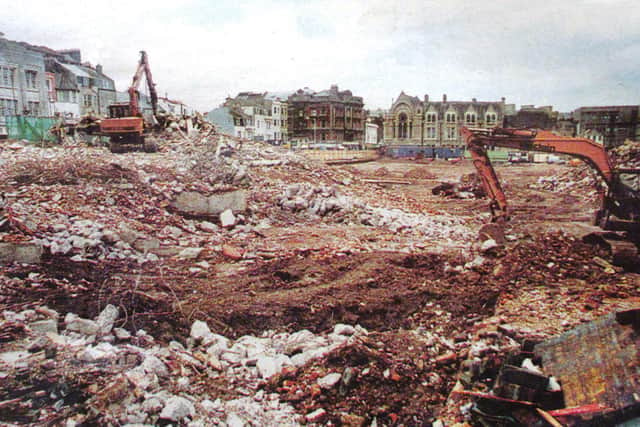

Priory Meadow and all the town centre are in the Priory Valley, which when William arrived was a natural harbour, with the town of Hastings then being based on top of the White Rock headland, on the west side of the valley. Over the following centuries the harbour gradually silted up, and Hastings moved into the Bourne Valley, where the Old Town is today.
In 1578 some prominent local towns-people persuaded Queen Elizabeth to fund the turning of the marshy Priory Valley into a ‘haven’, a sheltered closed-in dock, like a marina. But after £2,000 (about £750,000 in today’s money) had been spent on the scheme, in about 1580 the rest of the finance went missing and construction stopped. However, a raised embankment had been built across most of the mouth of the Valley from the west side, lying roughly where Cambridge Road is today, as a barrier providing defence from the sea.
This embankment immediately created a valuable road out of Hastings to the west, and as such was also to become the inland boundary of the America Ground two centuries later. But the embankment also blocked some of the valley’s drainage channels, turning the bottom of it into marshland. This had a major effect on the expansion of the town, as the valley could not be built upon until the mid-19th century.
By the early 1700s the Priory Valley had become a mixture of this low-lying marsh, with farmland on the slopes, and much shingle piled up against the c1580 embankment. The Priory Stream ran down the east side of the Valley into the sea where Harold Place is now.
Then In the 1790s what had been the small fishing port of Hastings for the past two centuries started becoming a popular seaside resort, and much development began in the early 1800s. As the town could not expand to the east, it started spreading west under the Castle Cliff and into the Priory Valley, going as far as the Priory Stream. On the other side of the Stream were the marshes inland of the embankment, including the future site of the Priory Meadow shopping centre, which were too wet to build on, while south of the embankment were the mostly unused acres of the area known as the America Ground. At that time it was usually called the Priory Ground, named after the Priory that had stood in the Valley from c1190 till 1417, and which had owned much of it.
The expansion of Hastings speeded up from 1814, and work started in 1816 on building up-market housing in Wellington Square and Castle Street, followed in 1820 by Pelham Place, and then Pelham Crescent from 1823. All this construction work on the east side of the Stream needed many labourers, skilled workers, workshops and stores, and as there were few available places in the existing town, the handy Priory Ground west of the Stream started becoming both a housing and industrial estate.
By 1820 the boom had speeded up, and the need for somewhere to live became especially urgent. At around that time it became clear that Hastings Corporation was not exercising any local authority rights it might have had over the Priory Ground, and, as the possible landlord, the Earl of Chichester, had a low public profile, people began squatting unchallenged on the Ground.
As the Ground appeared to be lying outside the town’s border and had no clear landlord, so its residents and businesses had no taxes and little (if any) rent to pay. This meant that the financial overheads of running a trade or living there were low, while at the same time their employers could pay them less than usual, giving the developers more to invest - a mutually beneficial arrangement.
In 1827 the government decided to carry out an inquiry into who actually owned the heavily-occupied Ground. This concluded that in fact it was the Crown, which in law owned all English and Welsh foreshore by default if no other party could prove otherwise. The deadline for clearing the Ground was Christmas 1835, and the Crown’s Commission of Woods and Forests then took possession of it. For the following 14 years it was an open unused space, a piece of derelict ‘ground’ which was remembered as often being called ‘America’ - hence the name the ‘America Ground’ that gradually came into use in the 1840s.
As the town steadily expanded in the 1830s, the Crown decided they had to protect their increasingly valuable potential building site from the sea. So in 1836/37 they built a large defensive sea wall from what is now Harold Place to the end of Robertson Street. This can still be seen inside the underground car park, forming all of the inland wall, a rare surviving example of how sea-defences were built almost two centuries ago.
Not much happened on the America Ground - officially called the Crown Land - until 1849, when a wealthy Scottish businessman, Patrick Robertson, took a 99-year lease on most of it. Earlier he had become affluent from a controversial form of drug trading in the Far East, selling opium to the people of China, which enabled him to semi-retire to Hastings in 1847. The land north of the 1578 embankment was still soggy undeveloped marshland, awaiting proper drainage.
But by 1849 Robertson had seen the potential of creating what was to become known as the Regent Street of Hastings - Robertson Street - because of the imminent arrival of the railways in Hastings. The opening of the train station in the Priory Valley in the early 1850s was the catalyst that created today’s town centre. The spoil from creating the tunnels was spread onto the marshland, turning it into a possible development site.
By the end of the 1850s most of the buildings now standing on the America Ground had been built. In addition the road layout in the valley had been largely drawn as it is now, with all the roads coming together where the Prince Albert Memorial clock-tower was built in 1863.
But the site of today’s shopping centre was still considered to be soggy ground which it was best not to build on, so in 1864 the 6½ acre ‘Central Cricket and Recreation Ground’ was laid out there. In June 1868 the first Australian cricket team to come to England played one of its matches there. This was a team of Aborigines, not whites, and the three-day match finished early so that they could give a public demonstration of their native skills (including boomerangs). The Aborigines won, scoring 119 + 185, with Hastings 152 + 113 for 4.
In April 1981 the death knell for the popular cricket ground was sounded when a proposal was made to build a shopping centre on it. This came to nothing, but in 1982 Hastings Council announced that, sooner or later, it would happen. Despite this being strongly opposed by many members of the public who regarded the cricket ground as legally being publicly-owned open land, in 1987 a detailed plan was agreed by the council.
But controversy raged on, as the developers could not find the money to build the shops, and a new cricket ground had to be created. This opened in 1991. The Central Cricket Ground finally closed in the autumn of 1994 and the Priory Meadow shopping centre opened on 20 March 1997.
In the summer of 1989 I made a film of the town centre, trying to record the many changes that were about to take place, especially the final days of the Cricket Ground. It can be viewed on my website www.hastingshistory.net/films. The history of the America Ground is in my book The America Ground, Hastings, published by The History Press.