
Hastings retro with Steve Peak: The history of the Hastings Carnivals
See the latest news from Your World at https://www.sussexexpress.co.uk/your-world
The Hastings Old Town Carnival on Saturday 8 August will be celebrating the 100th anniversary of the first ever public demonstration of television, which had been invented in the town by John Logie Baird.
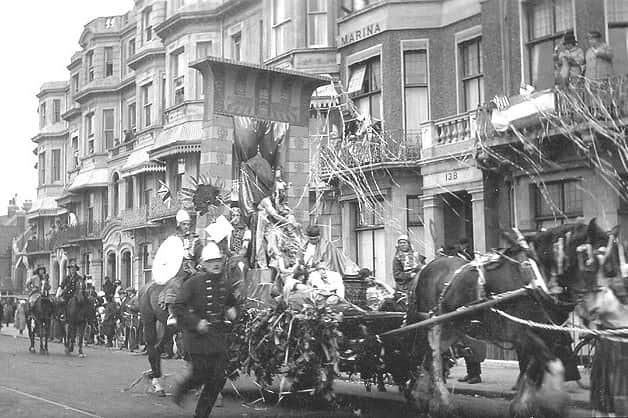

The town’s first carnival like we know them today took place on Wednesday 28 August 1895, part of extensive celebrations around the borough from 26-29 August. The carnival was the highlight of four days of “constant amusement” around the town: fetes, processions, displays, fireworks, fancy dress dances, vocal concerts and many other festivities. But the main event was the floral carnival and “Battle of Confetti” along the seafront on the Wednesday.
The Hastings Observer on 31 August reported that “Hastings and St Leonards have this week been the scene of a series of festivities unparalleled not merely in their own annals, but also unique in the history of the watering places of the United Kingdom as a whole. Four whole days of uninterrupted amusements such as those we have just experienced must stamp the Premier Cinque Port as one of the most enterprising pleasure resorts extant.
“The borough put on its holiday garb. Venetian masts and streamers gave colour and animation to the Front Line [seafront], and to this the work of the Carnival Committee, the tradesmen and private residents added their efforts, until the principal thoroughfares were ablaze with bunting and drapery. Not for many years probably has the town been so full of visitors.” The organiser of the unique celebrations was local historian and businessman Henry Cousins, author of the significant book Hastings of Bygone Days.
The 1895 festival was a great success, with evening events being visited by a staggering 80,000 people. So it was repeated in 1896, lasting a week, with a grand fancy dress procession, a cyclists’ gymkhana, a battle of confetti, tortoise races, wrestling on horseback, a procession of decorated vehicles, a prize for the best-decorated bath-chair and a “grand battle of flowers”.
After 1896 there were many carnivals of different shapes and sizes over the following decades. By the 1960s they had become an un-exciting procession along most of the seafront, from Grosvenor Gardens to the Old Town and then up Queens Road to Alexandra Park. This near-three mile route was too long, attracting few participants. The 1968 carnival was ranked a failure so the organizers decided to cut out the Old Town section in the July 1969 procession.
But this decision provoked a great deal of anger among many Old Town people, so they organized their own carnival in just five weeks. This, the first Old Town Carnival, took place on Wednesday 27 August, starting at Rock-a-Nore and going along the seafront to the fountain roundabout, then returning via George Street, High Street and All Saints Street to Rock-a-Nore. The Observer’s front-page headline on 30 August was “Old Town Procession Captures True Spirit of Carnival”. It went on “A tremendous success – better than expected! That was the unanimous verdict on Wednesday’s spectacular 1½ long Old Town Carnival procession which weaved proudly through the historic streets as the highlight of Old Town Week.
“A crowd estimated at 12,000 lined the entire route several deep to watch what was, amazingly, the result of only five weeks’ work by the specially formed Hastings Old Town Carnival Association. The procession, noted particularly for its almost total absence of commercial floats which have dominated the main Hastings Carnival recently, showed an abundance of enterprise and ingenuity on the part of the big family that is the Old Town.”
Through the 1970s there was intense rivalry between the two carnivals, and then in the 1980s Hastings Council tried to remedy things by providing new attractions in the town, including the annual Town and Country Fair, firework displays and the Beer Festival. But these highlighted just how boring the long-distance Hastings Carnival was compared with its Old Town rival, so the Hastings Carnival was scrapped, with the last one taking place in July 1988
The Old Town Carnivals have always been very popular, usually having a theme. This year it is television, as this is the 100th anniversary of its first ever public demonstration. Its inventor John Logie Baird in early 1923 created the world’s first television images in a room above a shop in the Queens Arcade, opposite Hastings town hall.
Baird, born in Glasgow in 1888, had come to Hastings in 1922 because of poor health. As a youngster he had studied mechanical engineering at the University of Strathclyde until 1914, and in following years he embarked on a career as an inventor-entrepreneur. By the autumn of 1922 the businesses he had set up were so successful that he sold them and came to lodge in Hastings. This was mainly to help overcome his serious chest complaint, but he decided that while recuperating he would explore various ideas he had had for some time. One of these was ‘the moving transmission of pictures by wireless’ - television as we know it today.
In his autobiography Baird recalled: “I went for a walk over the cliffs to Fairlight Glen, and my mind went back to my early work on television. Might there not be something in it now?” During the walk, he quickly saw a way of making it work, and he returned to his lodgings at 21 Linton Crescent. A fellow-lodger was a friend. “He was very helpful, and operations were started by the purchase of a tea chest, an old hat box, some darning needles and a bulls-eye lens from the local shop.”
Many other bits and pieces were bought and Baird initially assembled it all in his bedroom, but this was not popular with the landlord, so he rented the room in the Queens Arcade. Here in the first weeks of 1923 he attracted the interest and support of several local knowledgeable people, including Vic Mills who had just opened a radio business in the town.
Mills helped Baird put together the many parts he had assembled, including a large rotating disc with holes in it. After many experiments, in late February or early March, Baird managed to transmit images of Mills’s moving hand. This was the first time anyone had achieved an instantaneous moving picture anywhere in the world.
Baird spent all of 1923 making his historic invention workable. He took out a patent, and in the summer of 1924 he moved to Frith Street in London’s Soho. Here on 26 January 1926 he gave his first public demonstration of his ‘televisor’ system, as he called it. To many distinguished people, he demonstrated the transmission of images of a face in motion by radio waves to a receiver unit. The image was poor, but it attracted enough interest to make Baird the leading figure in the growth of television.