
Hastings retro with Steve Peak: The history of the shopping centre
See the latest news from Your World at https://www.sussexexpress.co.uk/your-world
In last week’s Observer I described the background to how the Priory Meadow shopping centre came to be built where it is today. But the idea of building shops on what was then the town’s popular cricket ground and open space met with strong opposition when the first proposals were made in 1970s.

The new 'Central Cricket and Recreation Ground' was opened on 20 July 1864 on what had been the waterlogged marshes known as the Priory Meadow. The 6½ acres of William the Conqueror’s former harbour were levelled, turfed and fenced off by local enthusiasts, and the ditch running through the marsh was filled up and diverted through a pipeline. The ground would be used for cricket, circuses, booths, flower shows and many other things. In 1908 it was the start-and-finish location for the town’s first marathon race.
Initially the Central Cricket Ground was leased from the Cornwallis family for £25pa, but in August 1872 it was bought from them for £5,000 by a charity. But the charity was a private body so, contrary to popular belief in later years, the Ground was not publicly-owned with Hastings Council supervising it in some way. This misunderstanding was fuelled by the fact that the trust legally had to open the Ground to the public one day in every week (but not Sunday).
In early 1970 rumours circulated that the Cricket Ground was going to be sold for development, so in June that year the Friends of Priory Meadow group was set up at a meeting in the town hall. This came to nothing, but in August 1978 an experienced Yorkshire-based development company held a meeting with senior councillors and Council officers to discuss its idea of building a multi-million pound shopping centre on the Cricket Ground. Informal meetings had taken place in June and August. A new protest group wanting to preserve the Ground was formed, and on 13 November 1978 86-year old Lord Cornwallis, whose father sold the land to the cricket ground trust, gave a speech opposing the proposal to over 400 people at the White Rock Pavilion.
In March 1979 the Department of the Environment refused to allow Hastings Council to compulsory purchase the Cricket Ground, and the proposal came to nothing, but it was the first time that such a definite plan had been put forward. This prompted ongoing discussions in following years between Hastings Council and the Ground charity’s trustees about the principle of development on the Ground.
Several trustees said they would back the idea, prompting the Derby-based Viking Group to publish plans in mid-April 1981. They proposed a multi-million pound development, with three large stores, a supermarket, about 40 small shops and parking for about 500 cars. The Cricket Ground would be moved to the Horntye area of Summerfields, off Bohemia Road. Later that year another five developers expressed interest, and this prompted the Council to hold a public consultation exercise in the first months of 1982.
The Cricket Ground trustees backed the idea, and, despite widespread opposition, on 21 July 1982 Hastings Council voted for a shopping centre to be built there after a new cricket ground was opened at Horntye. An alternative proposal by several councillors for the centre to be on the gasworks site further up Queens Road, where Morrisons is today, was defeated.
Following the Council’s approval, a formal month-long public inquiry into the proposal was held at the Queens Hotel in March 1983, with many people campaigning to save the valuable green open space. Then to public delight and Council horror, the government in May 1984 refused actual planning permission because of unsatisfactory roads, parking and drainage. But the Secretary of State specifically agreed to the “principle of development” on the Cricket Ground, provided those problems were overcome.
The local establishment then had to spend the next two years wheeling and dealing behind the scenes, firstly with the Cricket Ground charity, many of whose members now opposed the project. However, eventually in June 1986 the charity’s committee voted in favour of selling up and moving out to Horntye, but this was only on the casting vote of chairman Lord Cornwallis. At the same time the Council’s Local Plan had to be amended to include new town centre policies that met the government requirements. This was achieved in August 1986.
This resulted in the trustees lodging a planning application for an outline proposal for a shopping development, which was granted by the Council in early April 1987. In the same month East Sussex County Council gave approval for the roads scheme the Council was proposing to build around it. In October 1987 the Council agreed to compulsorily purchase the Cricket Ground, meaning the scheme could definitely go-ahead at last.
Six development companies submitted detailed schemes in November 1987. Twelve months of controversy followed, with many members of the public decrying the loss of not only the green heart of the town but what many regarded as land that was publicly-owned, in spirit if not in law. Despite the opposition, in November 1988 the Council gave planning permission for a massive new shopping centre. A deal had been done with Speyhawk Land and Estates, who had offered £60 million (later reduced to £43 million) for a 25 year lease of the Priory Meadow. In February 1989 the compulsory purchase orders for the Ground and the road developments were granted.
Public anger then focussed on why the Council should approve something that so many local ratepayers strongly opposed. What was going on behind the scenes? An editorial in the Hastings Observer on 8 June 1989 strongly condemned the secrecy with which the Council had been handling its decision-making. In early July over 600 people signed a petition demanding an inquiry into the re-development and the way it had been approved.
Also in that July it had become almost inevitable that there were going to be large scale changes to both the Cricket Ground and to many of the town centre’s streets and buildings. So I was loaned a video camera by Sussex University to make a record of what the middle of the town was then like before the bulldozers moved in. My hour-long film Hastings Town Centre 1989 is on my website www.hastingshistory.net/films.
But Hastings Council had found a problem underground. Chief executive Roger Carrier admitted in May 1989 that: “A detailed site investigation has revealed that the site problems are much worse than originally assumed. Water pressure is much higher, and over 500 piles have to be sunk to a depth of 28 metres.” The piles were having to go through the shingle that had filled King William I’s harbour to try and find some solid ground underneath.
Their concerns were highlighted a month later, when on 11 August 1989 the agreement between the Council and Speyhawk was signed - in Jersey! Speyhawk had flown Council officers there because it saved the company £400,000 in stamp duty. This infuriated opponents to the plans even more, sparking many accusations of Council incompetence, deceit and corruption.
But there was then a national slump in the large-scale retail trade, and Speyhawk never began large-scale work on the Ground, eventually leading to them withdrawing in May 1991. But by coincidence the first game of cricket was played at Horntye that same month. The charity had been offered 14 acres of land and £1 million in compensation for the loss of its original facilities.
Hastings Council then began discussions with Boots Properties about a new scheme. Two years later, in August 1993, outline planning permission was given to Boots for their £50 million proposal, despite protests by well-known Test cricket stars. Full planning permission was granted two months later, and contracts between Boots and the Council were signed in January 1994.
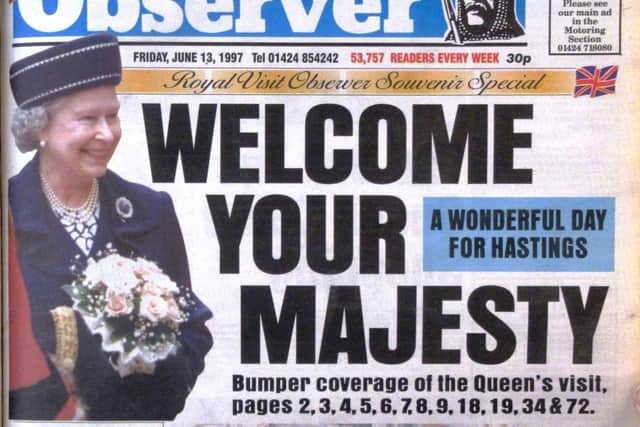
In following months the Council’s compulsory purchase of the Ground was confirmed again, and in late August 1994 the last event was held there, a Festival of Sport and Leisure. Construction of the new Priory Meadow shopping centre began in May 1995. At 9.00am on Thursday 20 March 1997 its doors were officially opened to the public by the mayor Cllr Graeme White. Then on 6 June Queen Elizabeth II was shown round the crowded shopping centre by Cllr White, as part of a wide-ranging visit to the town.