
Letter to the editor: Wisborough Green and the new battleground in the countryside
See the latest news from Your World at https://www.sussexexpress.co.uk/your-world
The recent local election results across West Sussex tell an important story about the changing mood of rural England.
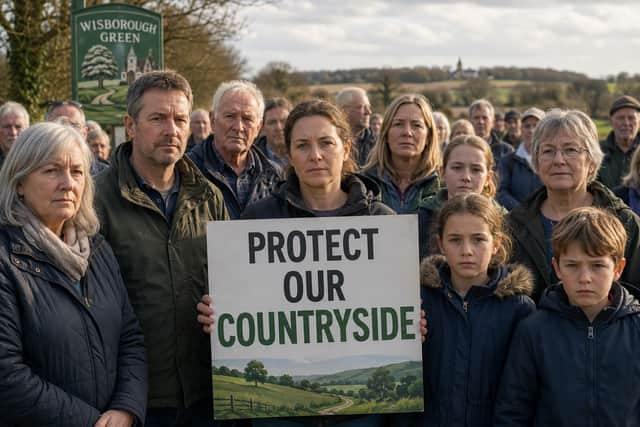

Across many areas, traditional political loyalties are fragmenting. The rise of Reform UK, the growth of Green representation, and the spread of councils under “no overall control” all point towards something deeper than normal party politics: a growing sense that national decisions are increasingly colliding with local communities and landscapes.
Nowhere is that tension clearer than in the debate surrounding large-scale solar developments in rural Sussex.
At Wisborough Green, the proposed solar farm application has now effectively been paused following the recommendation for further bat activity surveys. That means no decision is now likely until late 2026 or beyond. While some will see this simply as a delay, it actually reflects something much bigger happening nationally: the planning system is being forced to wrestle with competing priorities that are no longer easy to reconcile.
On one side sits the national push for energy security and rapid renewable deployment. Government policy is increasingly urgent in tone, particularly following instability in global energy markets and growing concerns around long-term resilience of the electricity system.
On the other sits the reality of the English countryside — landscapes valued not only for ecology, but for identity, recreation, heritage, mental wellbeing, and community cohesion.
For years, these debates were often framed too simplistically as “green energy versus NIMBYism.” That framing is now breaking down.
Recent planning decisions and legal challenges suggest a more complex picture is emerging. At Runcton, the solar farm appeal decision was recently quashed following agreement by the Government over concerns relating to procedural fairness and public participation. Meanwhile, in Derbyshire, the Planning Inspectorate dismissed a major solar farm proposal at Morton despite acknowledging the significant national benefits of renewable energy generation. The Inspector concluded that cumulative landscape harm, impacts on countryside experience, and effects on local users ultimately tipped the planning balance against the scheme.
Those decisions matter because they show that the countryside is no longer being viewed simply as “available space.” Increasingly, inspectors and councils are being asked to weigh more intangible but deeply important questions:
How is rural landscape actually experienced by local people?
What happens when industrial-scale infrastructure alters the character of everyday countryside access?
How should ecology, biodiversity, and habitat connectivity be balanced against energy infrastructure?
And who ultimately bears the costs and who receives the benefits?
There is also a more practical dimension to this which is often underestimated: the role of rural lanes. In places like Wisborough Green, lanes such as Drungewick Lane are not simply transport routes — they are shared spaces used daily by walkers, cyclists, horse riders, and families accessing the countryside. For many, particularly those without access to a car, they are the primary gateway to open space. The introduction of sustained construction traffic, even if temporary in planning terms, raises important questions about safety, accessibility, and how these routes function in practice. Increasingly, these lived realities are forming part of the broader planning balance, rather than being treated as minor or short-term effects.
That last question — who bears the impact — is becoming particularly politically sensitive.
Many rural residents increasingly feel they are being asked to absorb long-term landscape and environmental impacts in support of national infrastructure strategies whose economic returns often flow elsewhere — to developers, investors, energy markets, and national targets. At the same time, concerns remain about whether some projects will even be deliverable at the pace originally claimed, given mounting grid connection constraints nationally.
This is not an argument against renewable energy. Most people recognise the importance of clean power and energy resilience. But there is a growing debate about where, how, and at what scale development should occur — and whether the planning system is adequately balancing national ambition with local consequence.
That debate is unlikely to disappear. In fact, it may become one of the defining political questions in rural England over the next decade.
The Wisborough Green application now enters a new phase where ecology, process, landscape, and public confidence will all come under much closer scrutiny. Whatever one’s view of the proposal itself, the coming months are likely to say a great deal about how Britain intends to manage the increasingly difficult relationship between climate policy, energy security, and the future of the countryside itself.