
Major exhibition explores British Landscapes: A Sense of Place
As Pallant House Gallery director Simon Martin says, everybody has an emotional attachment to the landscape.
And that’s what the new exhibition British Landscapes: A Sense of Place (running until November 1) explores.
Over the next few months, it will look at how artists from the 18th to the 20th century have responded to the landscapes of the British Isles. Bringing together works by more than 60 artists, the exhibition reveals landscape not simply as scenery, but as a powerful expression of memory, identity and emotion.
Spanning Romanticism, Modernism and postwar abstraction, the exhibition traces a rich lineage from Thomas Gainsborough and the golden age of British watercolour to the postwar works of Wilhelmina Barns-Graham, Barbara Hepworth, Paul Nash and Eric Ravilious.
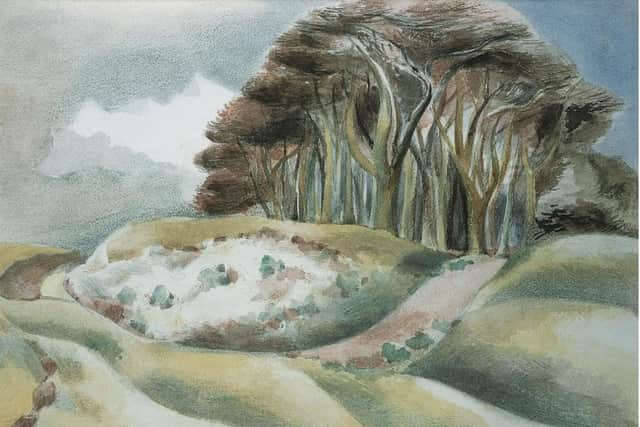

From quiet lanes and chalk hills to industrial sites and abstract coastlines, painters, printmakers and sculptors have depicted places shaped by labour, conflict and imagination. British Landscapes: A Sense of Place invites visitors to reflect on how Britain’s landscapes have been lived in, remembered and reimagined – and how they continue to shape our collective sense of belonging and resilience.
Simon said: “We all have that special place that we like to visit with family and friends, and that's what this taps into. I think one of the things about this exhibition about British landscape is that if you think about all the genres of art, landscape is probably the defining genre in British art history. If you think of the two most famous British artists, Turner and Constable, they were landscape artists.
“This exhibition looks largely at the 20th century and so many of the great modern British artists that have been drawn to the landscape but who use it express all kinds of different ideas in so many different ways whether it be post impressionism or surrealism or abstraction. They have used the landscape as a way to express what they wanted to explore.”
The exhibition seemed the perfect way to celebrate the 20th anniversary of the opening of the gallery's new wing: “So often galleries and museums can show only very little of their permanent collection. We have a collection of five and a half thousand artworks, and what we wanted to do with this was really just to fill the new wing with our collection and celebrate how the collection has grown. One of the earliest works in the exhibition is a drawing by Thomas Gainsborough which was from the founding collection at the gallery from Walter Hussey. He had these wonderful historical pieces.
“But we start the show with a group of works by the Smith brothers of Chichester who were pretty much the start of landscape artists in Britain. They came to success because of their patron who was the Duke of Richmond but they were so interesting. They were taking Italianate landscape and imposing it on the Sussex landscape. They were bringing to the Sussex landscape this continental idealised view.
“And then from the 20th century onwards we're looking at how do artists evoke a sense of place. It is to do with memories and history and the people that lived and worked there and the psychology. But also what is so interesting is how the landscape in the British Isles is so often for artists a way to address contemporary concerns.
“I think one of the most interesting works for me is by Mark Gertler who was a child of Russian immigrant parents and who was on the edge of the Bloomsbury group. He was a conscientious objector during the First World War, and he painted this peaceful landscape in December 1916 just after the end of the Battle of the Somme, and when you think of that context, this view of peaceful England becomes so much more charged.”
The majority of the works in the exhibition are from the gallery's own collection: “But what is great is that quite a few of them will not be familiar to people. There are a lot of works on paper. There are watercolours or different types of prints or photos, and some of them have not been shown for a long time and it feels very fresh to be exhibiting them now.
“We have also included a small number of loans. Some have been long-term loans that we've had but we've also requested some for this exhibition. I think the most exciting is Eric Ravilious’ watercolour of the Cerne Abbas Giant in December 1939 just after Ravilious had become a war artist. But when you look at it, what is so interesting is that the figure of the giant is not white but blood red. At that point they were turfing over this figure so that it could not be used by enemy bombers (for navigation). You have this figure of this ancient warrior almost being disguised in the landscape.”
The exhibition is accompanied by a new illustrated catalogue written by Simon, with contributions from contemporary artist Haroun Hayward whose exhibition Haroun Hayward: Path through Trees runs alongside British Landscapes: A Sense of Place.