
A history of Hastings' hotels

A new hotel is to open in Hastings, the first for many years. The 84-bedroom Premier Inn on the site of the former car park in Cornwallis Street will open on December 10.
It will join the ranks of the town’s prominent hotels, alongside the Astral Lodge, the Lansdowne, the Royal Victoria, the Travelodge and the White Rock.
The town’s biggest hotel is the Royal Victoria, on the Marina. It was built at the heart of James Burton’s new town of St Leonards, with its first stone being laid on 1st March 1828. Over 200 distinguished people sat down to dinner there when it was opened on 28 October 1829.
Initially called the St Leonards Hotel, it was the first and main building in the new town, and from the outset was the centre of social life. The main entrance was in the rear so that visitors would not be exposed to sea-spray as they alighted from their carriages. It was renamed the Royal Victoria Hotel in 1839 after the then-Princess Victoria stayed there in 1834.
What was once another big hotel on the seafront is now a block of 36 flats. The Queen’s Apartments on the corner of Carlisle Parade and Harold Place was built in 1862 as the Queen’s Hotel. Ironically, it was named after Queen Victoria, as was its rival hotel in St Leonards. Just a few yards from the building, the 65-feet tall Prince Albert Memorial clock-tower was also built in 1862, in memory of Victoria’s late husband. The size, appearance and quality of the hotel, combined with the nearby beautiful clock-tower, helped set the progressive tone for the newly-developed town centre in the Priory Valley, in contrast to the overcrowded, lower-class and unhealthy Old Town.
The Queen’s Hotel stood at the east end of the former ‘America Ground’ that had been leased to Patrick Robertson in 1849. His estate was at a higher level than the land to the east, so there was a drop in the ground level next to the Queen’s. This meant there was no road along the seafront, as there is today, and the large space at the end of Harold Place quickly became a site for many attractions. In 1930/1 Hastings Council built today’s promenade and main road past the Queens Hotel as part of Sydney Little’s Front Line Improvement Scheme, reclaiming land from the sea in order to build a new seafront. This included the UK’s first underground car park next to the hotel.
But by the early 1970s the British seaside tourist trade had almost collapsed as foreign holidays became very popular, and the Queen’s Hotel entered a long period of decline. There were several changes in ownership, and parts of the top floor became unusable because of leaks in the roof. In the October 1986 hurricane, a hotel guest was killed by bricks falling through the roof. Finally around 2003 the club became an oriental restaurant and the rest of the Queen’s Hotel was converted into apartments.
But the most important hotel in the town in Victorian times and for centuries before then was the Swan, which stood on nearly an acre of ground on the corner of the High Street and Swan Terrace. The first record of it is in 1523, although it may well have been older than that. It contained 42 bedrooms, a fine Assembly Room with a music gallery, spacious market or dining room, a suite of reception rooms, a bar, offices and a large courtyard with a range of stabling and coach houses, plus a brewery. In addition, on the corner of Hill Street and Swan Terrace stood the Swan Shades, a pub for the working classes where shady activity might take place. The Shades is now a house.
During the 18th and early 19th centuries the Swan became famous for its assemblies, balls, dinners, concerts and for being the main stage coach terminus for London, Dover, Brighton and other long-distance journeys. Political parties made it their rendezvous at election times
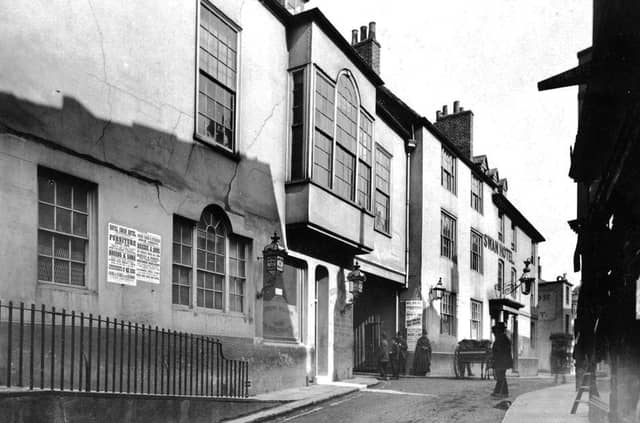
But by the 1870s the great expansion of the town and the construction of many other hotels had led to a decline in the Swan’s significance. In early 1889 it was sold to the London Distillery Company, who then sold it to local builders John and William Taylor who demolished it in the following months. The photo shows the Swan in 1888/9 with posters on its walls advertising its contents for sale. The Taylor brothers then built a smaller pub on the corner, plus about 20 houses on the vacant space surrounding the former site. The new Swan pub was then leased to the London Distillery Company, but this proved a bad speculation, and they lost £2,000.
The replacement Swan pub was destroyed during the second heaviest bomb attack on Hastings in the Second World War. On 23 May 1943 it was obliterated by a high-explosive bomb, and many other High Street buildings were seriously damaged Eleven people in the Swan were killed. Since then its site has been a public garden.
The Swan’s rival hotel was the Crown in All Saints Street, on the corner of Crown Lane, where there has been a pub since 1794. It was a coaching inn, and in the early 19th century the Crown and the nearby Swan were described as “the principal rendezvous of gentility”. An advert in 1816 said: “The Crown Inn coach sets off every morning at 8am and arrives in London at 6pm. It is driven by the most experienced coachman.”
With the arrival of the railways in the early 1850s, the commercial centre of Hastings moved west, and both the Crown and Swan became minor taverns. On 11 March 1921 the Crown was burnt out in a major fire. The Observer reported: “The old-fashioned inn was an easy victim of the flames, and a quantity of spirits which became ignited added to the conflagration.” The Crown was demolished and the current pub was built, taking in some premises in All Saints Street that had adjoined the old building.
You can find much more about the history of Hastings and St Leonards on my website www.hastingshistory.net.